Increased Burden from Global Supply Shortage
Industry Concerns Grow Over Potential Spread
[Asia Economy Reporter Kiho Sung, Sejong=Reporter Hyewon Kim] This is the third time this year that some production lines of Hyundai Motor Company and Kia Motors have come to a halt. Following a temporary suspension of some production lines in March due to the deepening global supply chain crisis caused by the Russia-Ukraine war, operations stopped again due to parts supply disruptions caused by the Cargo Solidarity Union strike. This time, the aftermath of the Cargo Solidarity Union strike extended to the suspension of deliveries from first-tier suppliers, forcing some factories to shut down production lines. With raw material price increases and global supply shortages expected to continue into the second half of the year, concerns are rising that the ripple effects of the strike could become visible in other automakers as well.
According to industry sources on the 1st, T.I. Automotive sent an official letter on the 29th of last month to Hyundai Motor and Kia’s chassis parts purchasing and development teams, notifying them of the inability to supply fuel tanks. The company explained, "On the 24th, we requested understanding for a 20% production cut this week and a 30% cut next week, but since this was not reflected in the actual production schedule, supply disruptions occurred."
In response, a Hyundai Motor and Kia representative said, “We have not completely stopped the production line but are conducting ‘gonghaenggeo’ (production adjustment) for vehicles that use the affected parts,” adding, “We are assessing the specific situation and will do our best to normalize production.”
The market is also expressing concerns that the prolonged parts supply disruptions caused by the Cargo Solidarity Union strike could lead to a long-term production slowdown. During the seven-day strike last month, Hyundai Motor’s Ulsan plant experienced an average daily production shortfall of about 300 vehicles across five production lines, totaling around 2,000 vehicles over the week. Industry estimates put the cumulative damage at over 30 billion KRW.
Production halts in the finished car industry are not new. Since 2020, shortages of Chinese-made wiring harnesses and, this year, the suspension of Ukrainian wiring harness supplies due to Russia’s invasion of Ukraine have caused global automakers to suffer production delays. A bigger concern is the potential for production issues caused by raw material shortages.
New car deliveries from automakers have been delayed by 12 to 18 months due to semiconductor supply issues. An industry insider explained, “Popular models like hybrids and electric vehicles can only be received about a year after ordering,” adding, “This period coincides with the time it takes from ordering to receiving automotive semiconductors.” The fuel tanks causing the recent production stoppage at Hyundai and Kia are mainly installed in hybrid vehicles. Therefore, it is anticipated that the production halt could further delay deliveries of hybrid vehicles.
The finished car industry is closely monitoring the situation. While a rising exchange rate can increase sales, rising raw material prices are burdensome. Automakers can endure, but parts suppliers who process and deliver raw materials face difficulties. If the parts industry suffers a significant shock, the foundation of the industry could be shaken.
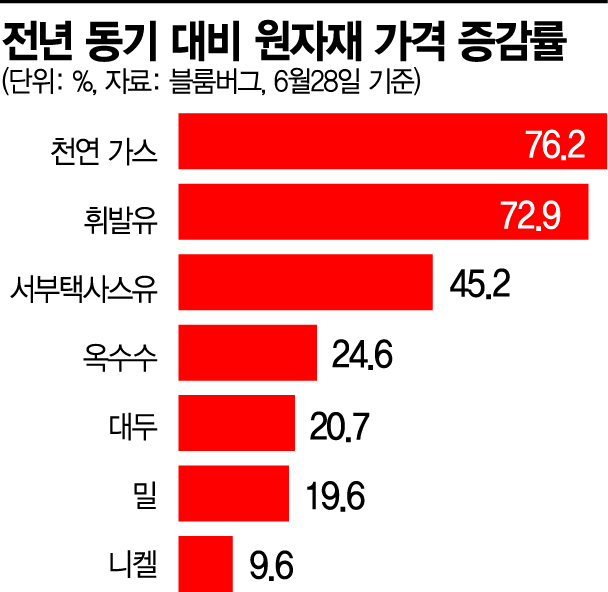
Companies expect the rise in raw material prices and global supply chain shocks to persist long-term. The Bank of Korea recently conducted a survey from May 12 to June 2 targeting 570 companies nationwide to examine the impact of inflation on businesses. All 250 respondents reported experiencing raw material price increases. Among them, 60% said raw material prices rose less than 20% over the past year, while 40% reported increases of 20% or more.
Notably, more than half of the respondents expect the Ukraine crisis to continue “until the end of this year” (60%), but a significant number also foresee it lasting “beyond next year” (41%).
© The Asia Business Daily(www.asiae.co.kr). All rights reserved.
![Clutching a Stolen Dior Bag, Saying "I Hate Being Poor but Real"... The Grotesque Con of a "Human Knockoff" [Slate]](https://cwcontent.asiae.co.kr/asiaresize/183/2026021902243444107_1771435474.jpg)















