High-Difficulty Surgery... Leading Global Hospitals Also Have Around 10% Surgical Mortality Rate
Reducing Complications Through Robotic and Thoracoscopic Minimally Invasive Surgery
Customized Surgery via Multidisciplinary Collaboration and Systematic Intensive Care Management
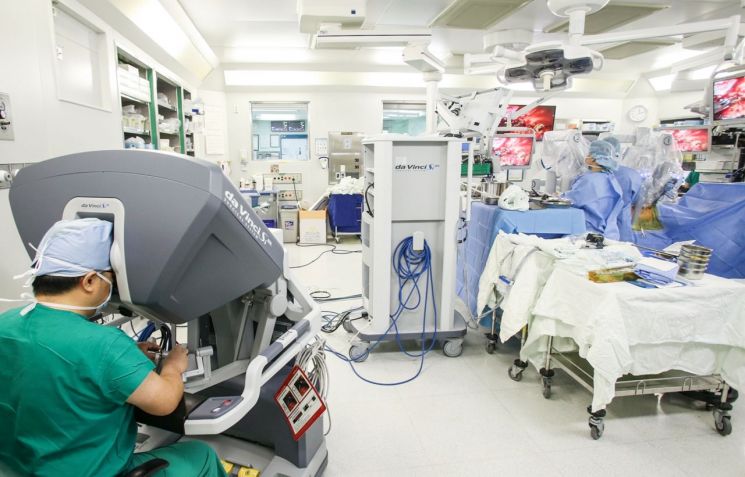 Kim Yong-hee, Director of the Esophageal Cancer Center at Asan Medical Center, Seoul (bottom left), is performing esophagectomy surgery using the Da Vinci robot on an esophageal cancer patient.
[Asia Economy Reporter Lee Gwan-joo] Seoul Asan Medical Center set a milestone last year with an esophageal cancer surgery mortality rate of '0%'. The surgical mortality rate refers to the percentage of patients who die within 30 days after surgery among all surgical patients.
The Department of Thoracic Surgery at Seoul Asan Medical Center announced on the 30th that among 177 esophageal cancer patients who underwent esophagectomy and reconstruction surgery last year, not a single patient died within one month after surgery.
Esophageal cancer surgery involves removing the esophagus affected by cancer and reconstructing it using the stomach or intestines. Due to the extensive incision area and the high number of elderly patients, it is considered a high-risk surgery with significant chances of postoperative complications and death from infections. The surgery entails cutting out the cancerous esophagus and creating a new esophagus using the stomach, small intestine, or large intestine, which is then connected to the remaining part of the original esophagus. The average surgery time is 8 to 12 hours, and in complex cases with previous esophageal cancer surgeries, it can take up to 26 hours, making it a highly challenging procedure.
As a result, hospitals worldwide that perform more than 30 esophageal cancer surgeries annually are rare, and even those ranking high globally in surgery volume show an average surgical mortality rate around 10%. In this context, Seoul Asan Medical Center’s record of zero surgical deaths is an astonishing achievement.
Since its opening in 1989, Seoul Asan Medical Center has been performing esophageal cancer surgeries and reached 1,000 cases in 2011. Since 2017, it has conducted over 150 esophageal cancer surgeries annually. To reduce scars, pain, and the risk of complications from the wide incision area, the center actively performs minimally invasive surgeries using robotic or thoracoscopic techniques. Robotic surgery requires only about 4 to 5 small incisions less than 1 cm each on the chest and abdomen, reducing patient pain and shortening recovery time. Among the 177 esophageal cancer surgery patients last year, 110 (62%) underwent surgery using the Da Vinci robot.
The success is also attributed to a close multidisciplinary collaboration system. Treatment of esophageal cancer requires cooperation among various departments including thoracic surgery (pulmonary esophageal surgery), gastrointestinal surgery, colorectal surgery, otolaryngology (head and neck surgery), radiation oncology, medical oncology, gastroenterology, and radiology. Seoul Asan Medical Center was the first in Korea to start integrated esophageal cancer care over 20 years ago, establishing patient-tailored surgical plans and systematic intensive care management, which significantly reduced surgical mortality rates.
Kim Yong-hee, Director of the Esophageal Cancer Center at Seoul Asan Medical Center (Professor of Thoracic Surgery), stated, “Considering that esophageal cancer surgery mortality rates are significantly higher compared to other cancers, this record of ‘0% esophageal cancer surgery mortality’ is an extraordinary achievement. It also means that elderly esophageal cancer patients have safely undergone surgery and gained opportunities to live new lives.” He added, “We will continue to strive to provide high-quality treatment to esophageal cancer patients based on an organic multidisciplinary collaboration system.”
© The Asia Business Daily(www.asiae.co.kr). All rights reserved.
![Clutching a Stolen Dior Bag, Saying "I Hate Being Poor but Real"... The Grotesque Con of a "Human Knockoff" [Slate]](https://cwcontent.asiae.co.kr/asiaresize/183/2026021902243444107_1771435474.jpg)















