Yoon and Kishida Meet Face-to-Face Five Times at NATO Summit
Both Leaders View Each Other Positively... "The Challenge Is How Open Their Staff and Ministries Are"
[Asia Economy Reporter Yoo In-ho] Expectations are rising for a top-down approach to improving Korea-Japan relations as the leaders of South Korea and Japan met face-to-face five times at the North Atlantic Treaty Organization (NATO) summit held in Madrid, Spain.
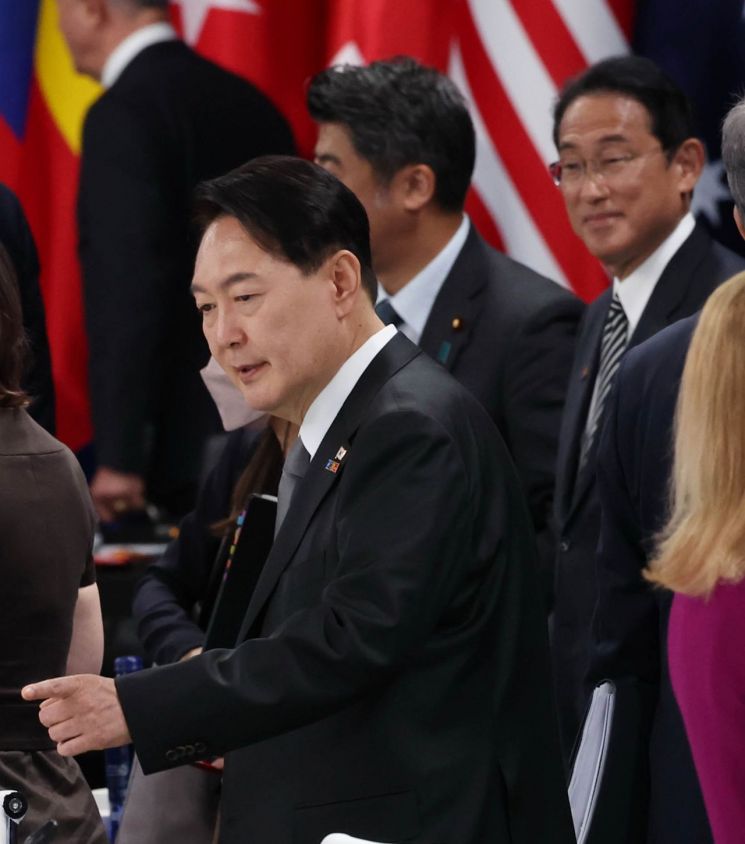
Although the two countries did not hold a formal summit, they expanded points of contact and formed a consensus by utilizing opportunities to meet inside and outside the meeting venue over the course of a one-night, two-day event.
According to the Blue House on the 30th, President Yoon Suk-yeol and Japanese Prime Minister Fumio Kishida met four times over two days (local time) on the 28th and 29th through a welcome gala dinner, the Korea-Japan-Australia-New Zealand (AP4) summit, the Korea-US-Japan summit, and the NATO allies and member states summit.
The Korea-Japan leaders also took a commemorative photo with the NATO Secretary General, making it a total of five meetings.
It is evaluated that the two leaders reaffirmed the necessity of improving bilateral relations by meeting several times in a ‘full aside’ format, including two soda-ja (side) talks.
The Korea-Japan leaders first met during a nearly informal four-minute encounter at a dinner hosted by King Felipe VI of Spain on the night of the 28th (local time).
Both leaders spoke in unison about the importance of improving bilateral relations.
President Yoon said, “After the House of Councillors election, we intend to promptly resolve pending issues between Korea and Japan and move forward in a future-oriented manner.” This indicated an understanding of the Japanese government’s burden ahead of the House of Councillors election on July 10 and a willingness to seek solutions to the biggest challenge, the forced labor compensation issue.
Prime Minister Kishida responded, “I know President Yoon is making efforts for Korea-Japan relations,” and added, “Let us work together to develop Korea-Japan relations into a healthier relationship.”
A Blue House official told reporters, “It is a top-down atmosphere, not bottom-up. The Korea-Japan leaders are ready to resolve the issues,” and explained, “The remaining task is how open-minded and sincere the aides and each ministry will be in developing honest dialogue.”
President Yoon’s recognition of Prime Minister Kishida as a partner is also a positive factor for improving bilateral relations. In a brief meeting held between the AP4 summit and the Korea-US-Japan summit the following day, President Yoon said about Prime Minister Kishida, “My impression is that he can be a partner who can resolve Korea-Japan issues and develop bilateral relations for our shared future interests.”
In diplomatic circles, there is a forecast that since President Yoon has created an opportunity to restore trust and resolve issues through summit diplomacy, the two governments will actively pursue attempts to improve relations based on the NATO summit.
Earlier, a National Security Office official explained at a briefing at the Yongsan Presidential Office on the 26th, “After the Japanese House of Councillors election, a momentum for Korea-Japan consultations on issues such as forced labor is expected to be established at the working-level. Korea-Japan shuttle diplomacy may also resume.”
However, some voices point out that if President Yoon pushes for improving Korea-Japan relations through direct summit negotiations without sufficient public opinion gathering on historical issues, there could be side effects such as worsening domestic public opinion.
The fact that critical voices are already emerging domestically regarding Prime Minister Kishida’s emphasis on joint Korea-US-Japan drills in the event of North Korea’s nuclear tests and Japan’s defense enhancement during the Korea-US-Japan summit is evidence of this.
© The Asia Business Daily(www.asiae.co.kr). All rights reserved.

















