Next Year's Minimum Wage 9,620 Won
Disappointment Over Failure to Apply Industry-Specific Differentiation
About 70% Are Livelihood-Type Self-Employed
Sales Per Store Remain Stagnant
[Asia Economy Reporter Lim Chun-han] “The minimum wage has risen so much over time that we’ve even mobilized family members to help at the store to try to reduce labor costs, but there’s no way left.”
On the 30th, Mr. Lee, who runs a convenience store in Songpa-gu, Seoul, said, “Since the outbreak of COVID-19, profits have dropped significantly, so I’m employing only the bare minimum number of part-time workers,” adding, “From next year, I think I’ll have to work more myself. Labor costs and rent are the biggest parts, and nothing is staying the same, so it’s a big problem.”
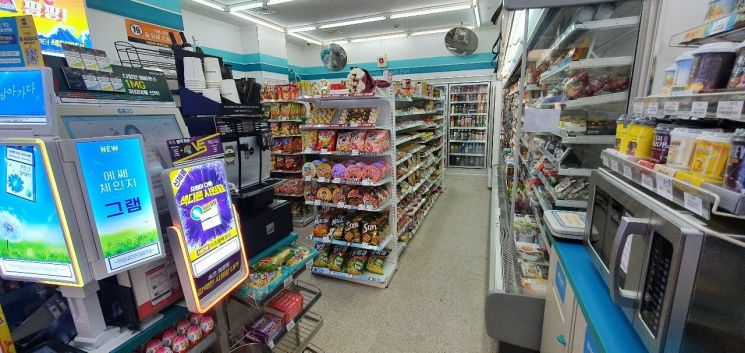
With next year’s minimum wage decided to rise 5% from this year to 9,620 won, convenience store owners are once again distressed by the increase in labor costs. On the ground, there is growing concern that in an already difficult situation, some may even be driven to close their businesses. Convenience stores typically operate 24 hours a day, making them the industry most sensitive to minimum wage hikes. According to the industry, about 70% of convenience stores are operated by livelihood-type self-employed individuals.
Although the amount consumers spend at convenience stores increases every year, sales per store remain stagnant. This is due to intensified competition among convenience stores and rising costs such as rent and labor. According to the Ministry of Trade, Industry and Energy, the average purchase amount per person at convenience stores increased by 26.3%, from 5,544 won in 2017 to 7,001 won in 2021. On the other hand, sales per store increased by only 0.3%, from 48.5 million won in 2017 to 48.63 million won.
In particular, the convenience store industry is greatly disappointed by the failure to apply differentiated minimum wages by industry. President Yoon Suk-yeol stated during his presidential campaign that “a forward-looking review of differentiated application by industry and region should begin.” The National Convenience Store Franchise Association said, “Self-employed business owners are on the brink of collapse, yet the minimum wage rises every year, and weekly holiday pay also increases accordingly,” adding, “It is becoming difficult to bear the wage increases, leading to more split shifts, and distrust and conflicts between workers and business owners are being triggered.”
Convenience store headquarters are also concerned about the rise in minimum wage. An industry insider said, “Basically, as labor costs borne by store owners increase, profitability deteriorates. Then, additional support measures to revitalize sales become inevitable,” adding, “Due to this minimum wage increase, the scale of coexistence support must also increase, so headquarters are also in a burdensome situation.”
© The Asia Business Daily(www.asiae.co.kr). All rights reserved.
![Clutching a Stolen Dior Bag, Saying "I Hate Being Poor but Real"... The Grotesque Con of a "Human Knockoff" [Slate]](https://cwcontent.asiae.co.kr/asiaresize/183/2026021902243444107_1771435474.jpg)















