Fully Excavated Early Joseon Dynasty Cheotdu Revealed
Key to Unveiling Joseon Royal Maru Decorative Items and Their Lineage
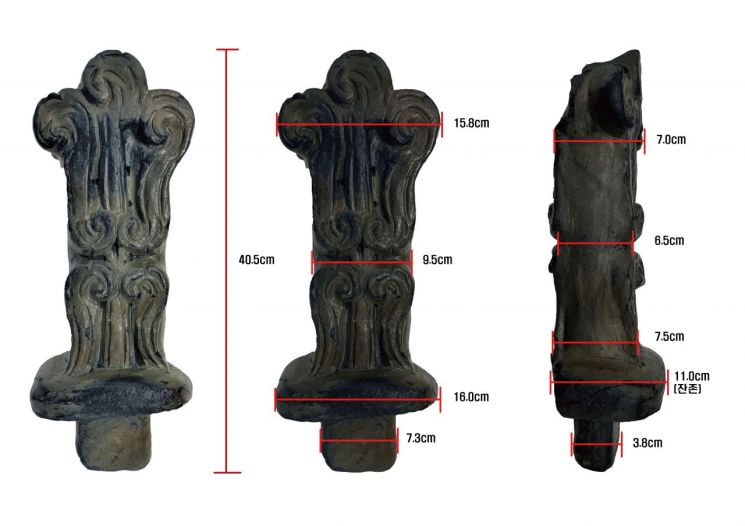
The National Research Institute of Maritime Cultural Heritage excavated the upper part of a Chwidu (鷲頭) from the Cheongpodae mudflat in Yangjam-ri, Nam-myeon, Taean-gun last month. Chwidu is a large decorative ridge-end tile installed on both ends of the ridgepole (the main ridge at the center of a building's roof) of palaces and similar structures. It is typically made in three separate pieces, which are assembled and installed together. In 2019, a local resident digging for clams discovered the lower part of this Chwidu. In June of last year, the National Research Institute of Maritime Cultural Heritage found another piece, a Geompa (劍把), a clay ornament shaped like a sword handle that is inserted into the upper part of the Chwidu.
The fully excavated Chwidu was publicly unveiled for the first time on the 29th at the National Palace Museum of Korea in Jongno-gu, Seoul. It dates back to the early Joseon period and resembles artifacts excavated from Gyeongbokgung Palace, Hoamsa Temple Site, and the main gate of the Ming Dynasty in China. The most striking piece is the Geompa, shaped like a sword handle, which was used to prevent rainwater from entering the interior of the Chwidu. Its dimensions are 40.5 cm in length, 6.5 cm in height, 16 cm in width, and it weighs 4.2 kg. The lower part has a shaft that fits into the square hole of the upper part of the Chwidu. Cloud patterns are depicted in two tiers on both the front and back surfaces, a feature unique to early Joseon Geompa. A representative from the institute stated, "In the late Joseon period, Chwidu were simplified into plain rod shapes without patterns." They also pointed to the dragon motifs embossed on the lower parts of a pair of Chwidu, explaining, "This is the result of strictly applying standardized dragon iconography."
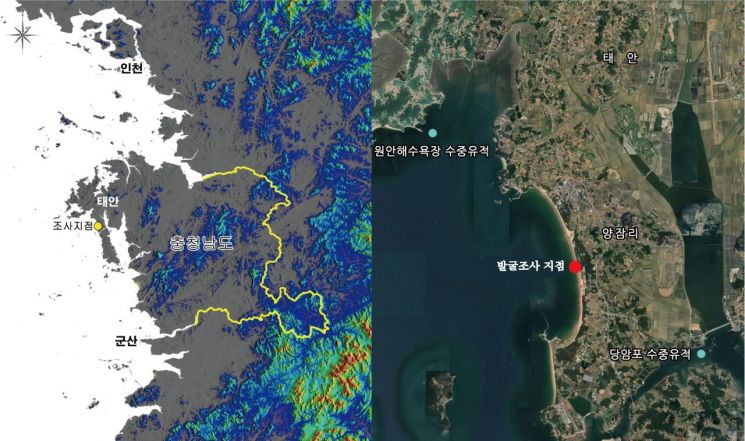
The complete form of the dragon head ornament is key to revealing the characteristics of the Joseon royal ridge decorations. It is also regarded as the only archaeological material that can verify the detailed appearance of early Joseon royal architecture such as Gyeongbokgung Palace and Hoamsa Temple Site. The institute plans to conduct additional excavations and underwater surveys at the Cheongpodae mudflat until mid-August to confirm the presence of related artifacts. Research on the existence of related old ships and the production and distribution of royal decorations will also be actively pursued.
© The Asia Business Daily(www.asiae.co.kr). All rights reserved.
![Clutching a Stolen Dior Bag, Saying "I Hate Being Poor but Real"... The Grotesque Con of a "Human Knockoff" [Slate]](https://cwcontent.asiae.co.kr/asiaresize/183/2026021902243444107_1771435474.jpg)

















