June Business Survey Index (BSI) and Economic Sentiment Index (ESI)
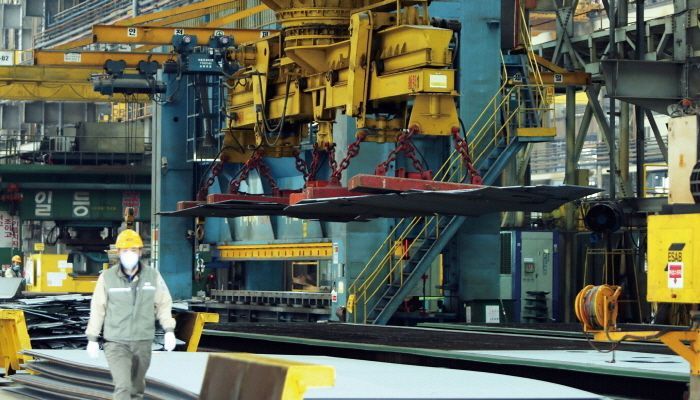
The corporate sentiment index sharply declined due to rising raw material prices caused by global inflation and increased economic uncertainty.
According to the 'June 2022 Business Survey Index (BSI) and Economic Sentiment Index (ESI)' released by the Bank of Korea on the 30th, the BSI for all industries this month recorded 82, down 4 points (p) from the previous month.
The BSI is a statistic that surveys companies' judgments and outlooks on the current business situation; if negative responses outnumber positive ones, the index falls below 100.
The overall industry BSI dropped to 83 in March, then slightly rose to 86 in April and May due to the lifting of COVID-19 social distancing measures, but declined again this month. The BSI for next month's business outlook also fell 5 points from 87 last month to 82.
The Bank of Korea explained, "the BSI declined due to the prolonged Ukraine crisis leading to increased raw material prices and logistics costs, continued inflationary pressures, and concerns over economic slowdown caused by interest rate hikes in major countries."
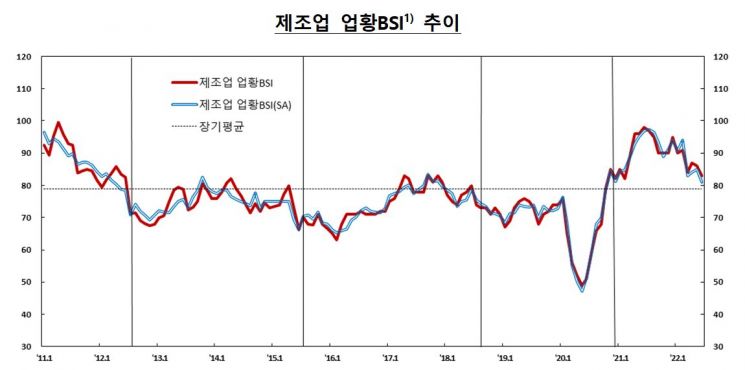
The manufacturing sector's June business BSI was 83, down 3 points from the previous month, falling to a level similar to the previous low of 82 in February last year. The BSI for next month's business outlook also dropped 4 points to 83.
By company size, both large enterprises and small and medium-sized enterprises (SMEs) fell 3 points compared to the previous month, and by company type, export companies dropped 7 points while domestic companies fell 1 point.
As the economy worsened, the sales BSI fell 7 points to 98 from the previous month, while profitability BSI (75) and financial condition BSI (81) each declined by 4 points.
Specifically, due to increased raw material price burdens and supply disruptions caused by the Cargo Solidarity strike, non-metallic minerals dropped 18 points, and the perceived business conditions for chemical products (-15 points) and electrical equipment (-12 points) were also poor.
Companies cited rising raw material prices (33.8%) as the biggest management difficulty, followed by uncertain economic conditions (16%), labor shortages and rising labor costs (9.2%), and sluggish domestic demand (7.2%).
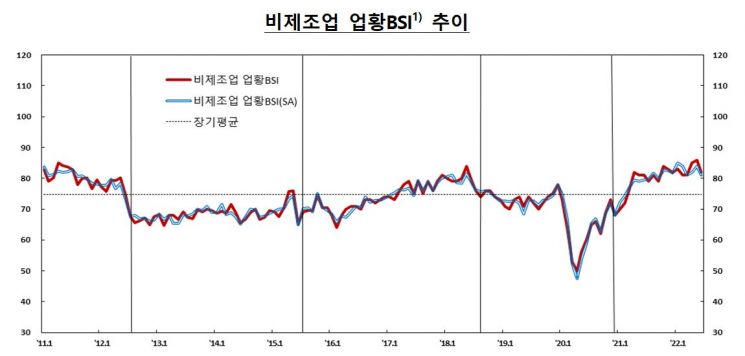
The non-manufacturing sector's June business BSI was 82, down 4 points from the previous month. The BSI for next month's business outlook (81) also decreased by 5 points compared to the previous month.
With the lifting of social distancing, visitors to sports and leisure facilities increased, causing arts, sports, and leisure to rise by 15 points, but transportation and warehousing (-9 points), construction (-7 points), and wholesale and retail (-6 points) declined due to rising fuel costs and increased raw material price burdens.
The July non-manufacturing business outlook BSI fell mainly in information and communication (-19 points), real estate (-7 points), and wholesale and retail (-6 points). The Bank of Korea explained, "As the vacation season approaches, demand for media and software is expected to slow," adding, "sales performance is sluggish, and overall costs related to real estate development are expected to increase."
The June Economic Sentiment Index (ESI) recorded 102.5, down 4.2 points from the previous month. The ESI centers around a long-term average of 100; a value above 100 means that the economic sentiment of all private economic agents, including companies and households, is better than the past average.
This month's survey was conducted from the 15th to the 22nd nationwide targeting 3,255 corporate entities, of which 2,800 companies (1,653 manufacturing and 1,147 non-manufacturing) responded.
© The Asia Business Daily(www.asiae.co.kr). All rights reserved.
![Clutching a Stolen Dior Bag, Saying "I Hate Being Poor but Real"... The Grotesque Con of a "Human Knockoff" [Slate]](https://cwcontent.asiae.co.kr/asiaresize/183/2026021902243444107_1771435474.jpg)

















