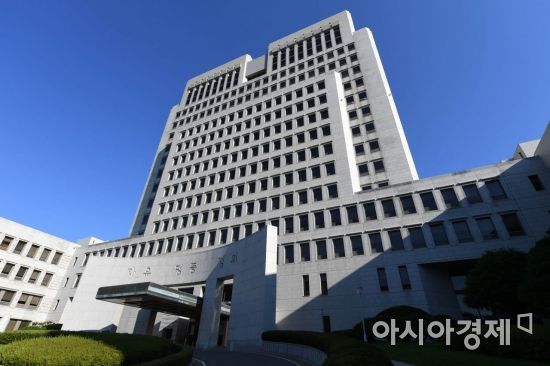
[Asia Economy Reporter Choi Seok-jin, Legal Affairs Specialist] The Supreme Court has ruled that the performance-based salary system at private universities, which reflects professors' new student recruitment achievements in their annual salary calculations, is valid.
The Supreme Court's 3rd Division (Presiding Justice Kim Jae-hyung) announced on the 29th that it overturned the lower court ruling in favor of Professor Kim, who worked at a private university A in Yeosu, Jeollanam-do, and filed a wage lawsuit against the university foundation, and remanded the case to the Gwangju District Court.
Professor Kim was appointed as a full-time lecturer at University A in 1997, promoted to assistant professor in 2001, and associate professor in 2008.
The school foundation operating University A adopted an annual salary contract system for faculty and staff through a board resolution in June 2003 to reduce personnel expenses amid a financial shortage caused by under-enrollment.
The compensation regulations stated that "the annual salary of faculty and staff shall be determined by an annual salary contract, and the salary calculation shall consist of a base salary reflecting the individual's position and rank, and a performance bonus reflecting achievements and results."
From June 2003, Professor Kim signed an annual salary contract with the school foundation every year, which included the clause that "the salary amount for the current year shall be determined based on the previous year's salary amount, considering the performance evaluation and school evaluation criteria for the current year."
Accordingly, the school foundation annually calculated the salary amount by summing the base salary, seniority allowance, seniority allowance increment, academic guidance fee, faculty allowance, research funds, research assistant fees, fixed meal allowance, and holiday leave pay on an annual basis, then multiplying this total by an application rate determined by combining "individual recruitment performance evaluation relative to total recruitment quota" and "departmental enrollment rate evaluation."
Additionally, in November 2012, the school foundation introduced a performance-based salary system that differentiated salaries based on professors' performance evaluations, which considered department new student enrollment rates, department current student enrollment rates, and employment rates.
Professor Kim was dismissed due to department closure in May 2016, having received wages totaling approximately 242 million KRW from April 2013 to February 2016 under this system.
Professor A, who received about an 8% salary cut during the 2013-2014 academic year, filed a lawsuit claiming approximately 14 million KRW in unpaid wages in March 2016, just before dismissal.
Article 3, Paragraph 2 of the Special Act on the Improvement of Teachers' Status and Protection of Educational Activities stipulates that "school corporations and private school administrators under Article 2 of the Private School Act must maintain the salaries of teachers at their schools at the level of public school teachers."
Furthermore, Article 80 of the school foundation's articles of incorporation stipulated that teachers' salaries should follow the regulations for educational public officials' salaries. However, the regulations for educational public officials' salaries were abolished by Article 2, Paragraph 1 of the Supplementary Provisions of the 1982 Public Officials' Salary Regulations, and Article 4 of the same supplementary provisions stipulated that in such cases, the Public Officials' Salary Regulations should be applied.
Professor Kim argued in court that the school foundation's introduction of a performance-based salary system in November 2012, which differentiated salaries based on professors' performance evaluations considering department new student enrollment rates, current student enrollment rates, and employment rates, violated Article 39-2, Paragraphs 1 and 3 of the Public Officials' Salary Regulations, which were adopted by Article 80 of the articles of incorporation, and thus was invalid under Article 53-2, Paragraph 3 of the Private School Act.
Article 39-2 (Performance-based Salary Payment for National University Faculty) Paragraph 1 of the Public Officials' Salary Regulations states that "performance-based salaries for national university faculty subject to the annual salary system shall be paid differentially based on evaluations of achievements in education, research, and service over a certain period as determined by the head of the national university."
Paragraph 3 of the same article sets the range of performance-based salary amounts to be paid to the top 20% highest-ranking faculty and the next 30% based on the performance evaluation results in Paragraph 1.
Article 53-2, Paragraph 3 of the Private School Act states that "faculty at higher education institutions may be appointed under contracts specifying working period, salary, working conditions, achievements, and performance agreements as determined by the articles of incorporation. In this case, the working period shall follow the relevant regulations applied to faculty at national and public universities."
In essence, the Private School Act allows salary matters to be determined by the articles of incorporation, and since the school foundation in this case adopted the abolished educational public officials' salary regulations, the Public Officials' Salary Regulations should apply. However, since the performance bonus was calculated based on student recruitment achievements rather than the education, research, and service criteria stipulated by the relevant regulations, the system was argued to be invalid.
The first and second trial courts ruled in favor of Professor Kim.
They held that the introduction of a performance-based salary system different from the Public Officials' Salary Regulations itself was not invalid, and using new student recruitment rates as one of the criteria for determining performance pay, which is one factor in departmental achievements, was not illegal. However, determining private school faculty's performance pay solely based on new student enrollment rates was invalid.
The second trial court stated, "New student recruitment is not considered a direct duty of faculty, and the essential duties of faculty such as student education, guidance, and academic research indirectly influence recruitment. Recruitment is comprehensively affected by the school foundation's own recruitment policies and investment in education. If faculty performance pay is determined solely by new student recruitment rates, it contradicts the purpose of performance pay, which is to comprehensively evaluate achievements in education, research, and service, and may induce faculty to prioritize recruitment activities over their essential duties, resulting in neglect of student education, guidance, and academic research."
It further concluded, "Therefore, determining private school faculty's performance pay solely based on new student enrollment rates exceeds the limits of private school autonomy and violates Article 15, Paragraph 2 of the Higher Education Act, rendering it invalid."
Article 15 (Duties of Faculty and Staff) Paragraph 2 of the Higher Education Act states, "Faculty shall educate and guide students and conduct academic research, and when necessary, may be exclusively assigned to education, guidance, academic research, or industry-academia cooperation as stipulated by school regulations or articles of incorporation, pursuant to Article 2, Item 6 of the Act on Promotion of Industry-Academia Cooperation."
However, the Supreme Court's judgment differed.
The court first referenced Article 31, Paragraph 4 of the Constitution, which guarantees university autonomy, and cited previous Supreme Court rulings on private school salaries.
Previously, the Supreme Court stated, "Although the appointment contracts of private school faculty are made according to procedures prescribed by the Private School Act, their legal nature is merely private employment contracts. Therefore, the decision of whom to appoint as faculty and the criteria and methods for salary payment are fundamentally at the discretion of the school foundation."
Regarding the performance-based salary system, the Supreme Court stated, "Unless there are special circumstances such as violation of mandatory provisions of laws related to faculty personnel or salaries, or abuse of the school foundation's rights in determining faculty salaries due to loss of objectivity or rationality in the evaluation items and criteria for faculty performance established in the articles of incorporation or faculty salary regulations, the evaluation items and criteria should be respected as much as possible and should not be arbitrarily invalidated."
The court then presented criteria for judging whether the payment standards of the private school's performance-based salary system lost objectivity and rationality, including ▲ the specific financial status of the private university operated by the school foundation ▲ the salary level of faculty ▲ the proportion of salary determined by specific performance parts in the total salary ▲ the impact of performance-based salary fluctuations on faculty's core duties and livelihood ▲ whether faculty agreed to such salary payment standards, emphasizing that these factors must be comprehensively considered.
In conclusion, the court stated, "Even if the defendant (school foundation) implemented a performance-based salary system and paid performance bonuses solely based on new student recruitment achievements, such circumstances alone do not constitute a violation of laws related to faculty personnel and salaries or the Labor Standards Act's mandatory provisions, nor an abuse of the private school's rights in determining faculty salaries, making it difficult to deem the payment standards invalid."
It added, "Even if the defendant implemented the salary system and proportionally reduced the annual salary amount based solely on new student recruitment achievements, the portion unaffected by the reduction can be considered compensation for faculty's core duties such as student education, guidance, and academic research, while the remaining portion corresponds to performance bonuses linked to new student recruitment achievements. Therefore, it is difficult to evaluate that the payment standards of this salary system lost objectivity and rationality merely because the performance bonus portion is determined solely based on new student recruitment achievements, which are not faculty's core duties."
Finally, the court pointed out, "Nevertheless, the lower court did not examine such specific circumstances and ruled that the defendant's payment of performance bonuses solely based on new student recruitment achievements exceeded the limits of private school autonomy and violated the former Article 15, Paragraph 2 of the Higher Education Act, rendering it invalid. The lower court's judgment misinterpreted the laws related to faculty salary payments and the limits of private school autonomy and failed to conduct necessary examinations, which affected the judgment."
© The Asia Business Daily(www.asiae.co.kr). All rights reserved.
![Clutching a Stolen Dior Bag, Saying "I Hate Being Poor but Real"... The Grotesque Con of a "Human Knockoff" [Slate]](https://cwcontent.asiae.co.kr/asiaresize/183/2026021902243444107_1771435474.jpg)















