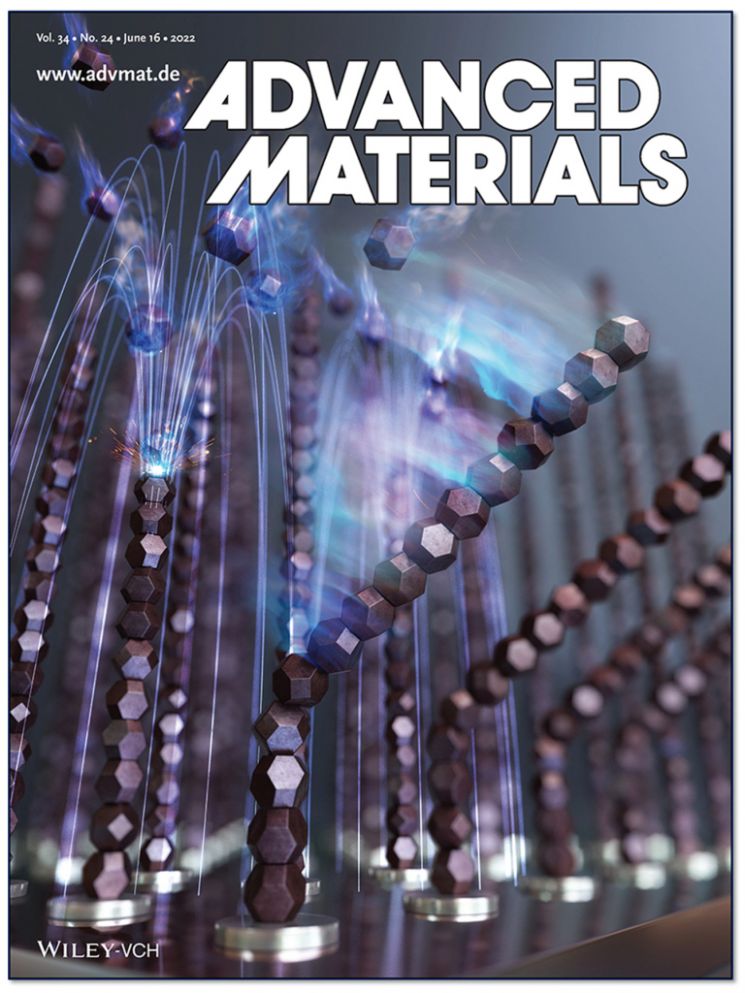
 Advanced Materials cover. The white layer at the bottom is nickel metal. On top of it, magnetic nanoparticles are stacked to form artificial cilia.
[Asia Economy Yeongnam Reporting Headquarters Reporter Hwang Dooyul] Paramecia can move even without legs. This is thanks to the presence of cilia, tiny hair-like structures on the cell surface.
A technology has been developed that can easily create these cilia-like structures of paramecia in desired shapes.
Professor Jeong Hoon-ui's team from the Department of Mechanical Engineering at UNIST developed a technique to synthesize cilia structures thin and long by stacking nanometer-sized magnetic particles upward.
This is expected to aid the development of nanorobots using artificial cilia as actuators.
Cilia can move freely in liquids and respond sensitively to small external forces, enabling various functions.
Representative functions include the cilia in the lungs of whales moving gently to push impurities away by moving liquid, or paramecia moving by rowing their cilia.
This is also why research to mimic cilia for use as micro-machine actuators is active.
However, cilia structures are difficult to make at the nanometer scale using conventional methods such as molding liquid raw materials. Especially, narrow and vertically long shapes are more challenging.
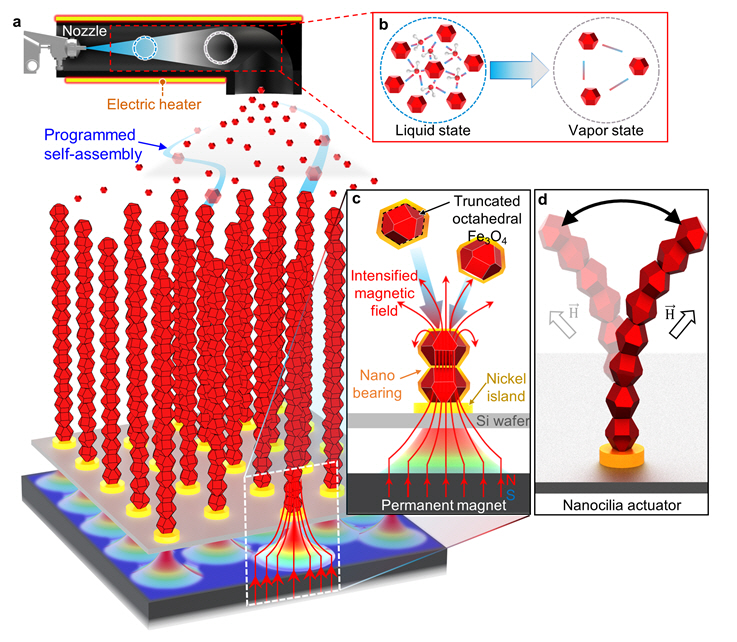
The research team developed a synthesis method that overcomes these limitations using magnetic force.
First, nickel metal pieces are arranged at the positions where cilia strands are to sprout, then magnetic nanoparticles are sprinkled from above and stacked layer by layer.
The strong magnetic force formed around the nickel attracts the magnetic nanoparticles. Thanks to the precisely designed magnetic force, the nanoparticles assemble themselves into the desired shape.
The synthesis method applies a technology that sprays nanoparticles in an aerosol state so that magnetic nanoparticles can only stack vertically.
The technology traps magnetic nanoparticles in liquid droplets (aerosols), blocking other external forces besides the pre-designed magnetic force. The liquid evaporates as it flies away.
The research team stacked up to 54 particles with an actual diameter of 373 nm (nanometers) using this technology. The aspect ratio of width to height exceeded 50, the highest among artificial cilia synthesized so far.
The completed artificial cilia could move smoothly without bearings thanks to oleic acid coated on the surface of the magnetic nanoparticles.
The research team said, “This study will help develop nanorobots that can be introduced into the body and ultra-fine actuators that remove pollutants.”
The research was selected as the cover paper of the international materials science journal Advanced Materials and was published on the 16th.
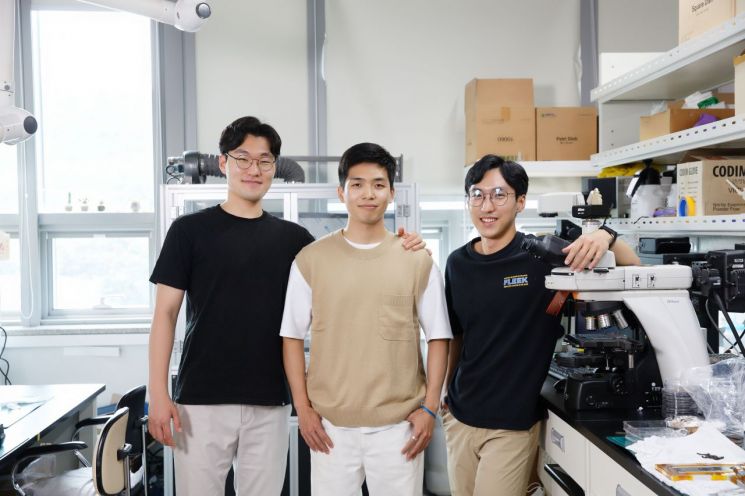 (From left) Researcher Seong Min-ho, Researcher Kang Min-su (first author), and Researcher Lee Dong-hyuk are posing in front of the camera.
© The Asia Business Daily(www.asiae.co.kr). All rights reserved.
![Clutching a Stolen Dior Bag, Saying "I Hate Being Poor but Real"... The Grotesque Con of a "Human Knockoff" [Slate]](https://cwcontent.asiae.co.kr/asiaresize/183/2026021902243444107_1771435474.jpg)

















