Among 55 Trading Days with Rising Index
Institutions Bought on 40 Days, Foreigners on 31 Days
First Half Investment Returns by Investor Type
Foreigners Break Even, Only Institutions See 'Decent' Gains
Donghak Ants and Seohak Ants Suffer Poor Returns

[Asia Economy Reporters Minji Lee, Myunghwan Lee] Is the bus that the retail investors have boarded unable to move forward? The "retail investors always lose" rule was reaffirmed in the first half of this year as well. The domestic stock market was heavily influenced by foreign and institutional investors' supply and demand, leaving individual investors struggling to make an impact. Looking at the average returns of the top net purchased stocks by investor type (excluding ETFs) in the first half, most stocks heavily bought by individuals declined. This contrasts with foreign and institutional investors who maintained positive returns.
◆ Stocks rise only when foreign and institutional investors buy; fall when only individuals buy
On the 29th, Asia Economy analyzed the KOSPI trends from January 3, the first trading day of the year, to June 28. Out of 119 trading days, the KOSPI closed higher on 55 days. Examining the trading trends by investor type on days when the index rose, institutions showed net buying on 40 of those 55 days, driving the index upward. Foreign investors also bought on 31 days when the index rose. In contrast, individuals were net buyers on only 19 days during this period. Conversely, on the 64 days when the index closed lower, individual buying was prominent. Individuals were net buyers on 59 out of those 64 days, excluding just 5 days. Compared to institutions and foreign investors, who were net buyers on only 13 and 9 days respectively during down days, the difference is significant.
Looking at index movements on net buying days by investor type, institutions and foreign investors had a strong influence. Of the 53 days institutions were net buyers this year, the KOSPI closed higher on 40 days. Foreign investors were net buyers on 40 days, with the index rising on 31 of those days. This means the index rose on 75.47% of institutional net buying days and 77.5% of foreign investor net buying days. In contrast, the simple ratio for individuals was only 24.36%.
The domestic stock market is strongly influenced by foreign and institutional investor supply and demand, meaning the index tended to fall on days when individuals entered the market. Hwang Sewoon, Senior Research Fellow at the Korea Capital Market Institute, explained, "Foreign and institutional investors are the groups with the greatest influence on price determination in the domestic stock market, so they have higher price-setting power," adding, "It can be seen that individuals have not secured price leadership."
◆ Overseas Korean retail investors < Domestic Korean retail investors < Foreign investors < Institutions: Ranking by returns
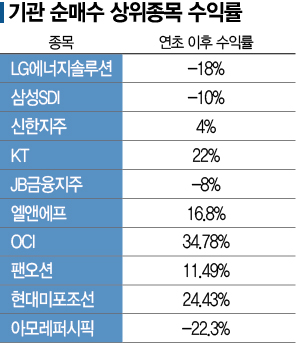
Even when calculating performance by investor type, individuals lagged far behind foreign and institutional investors. From January 3 to the day before the report, the average return of the top 10 net purchased stocks by individuals investing in the domestic market was -22%. Meanwhile, foreign and institutional investors maintained positive returns despite the challenging external environment. Institutions achieved the highest returns at 5%, while foreign investors posted returns in the 1% range, managing to break even.
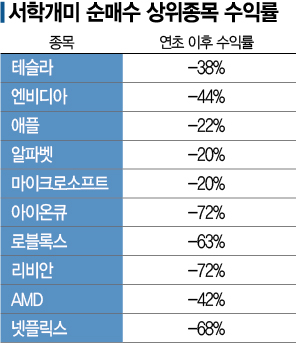
Returns for overseas Korean retail investors (Seohak Gaemi) investing in foreign stocks were even more dismal than those of domestic Korean retail investors (Donghak Gaemi). The average return of their top 10 net purchased stocks since the beginning of the year was around -46%, more than twice the decline of domestic retail investors. This was due to the U.S. Federal Reserve's tightened monetary policy, which caused the U.S. stock market, especially the Nasdaq index, to plunge over 30% in half a year.
The difference between winning and losing investments was whether returns were defended. Foreign and institutional investors sold Samsung Electronics early and instead held telecommunications, financial stocks, and stocks expected to benefit from inflation, which outperformed the market, thereby protecting their portfolio returns. Both foreign and institutional investors included telecommunications stock KT in their portfolios, which rose 22% during the first half. Other stocks contributing to gains included S-Oil (24%), Pan Ocean (11%), and Shinhan Financial Group (4%). However, individuals mainly accumulated stocks with large declines such as semiconductors and platform stocks, failing to defend returns in the down market. Moreover, a widespread belief that prices had bottomed led individuals to prematurely buy Samsung Electronics (-25%), NAVER (-33%), Kakao (-38%), and KakaoBank (-43%) at low prices, which further dragged down returns.
The same was true for overseas Korean retail investors. All stocks they bought were technology stocks concentrated in the Nasdaq index, resulting in negative returns across the board. Even Tesla, which had become a "trusted stock" for overseas Korean retail investors, plummeted over 41% amid production disruptions at its China factory and issues related to its Twitter acquisition, hovering below $700. Major Nasdaq tech stocks such as Apple, Alphabet, and Microsoft all experienced corrections exceeding 20%.
© The Asia Business Daily(www.asiae.co.kr). All rights reserved.
![Clutching a Stolen Dior Bag, Saying "I Hate Being Poor but Real"... The Grotesque Con of a "Human Knockoff" [Slate]](https://cwcontent.asiae.co.kr/asiaresize/183/2026021902243444107_1771435474.jpg)















