Stock Price Rises Over 30% in a Month... Performs Well Amid KOSPI's 13% Decline
Increase in Solar Panel Installations and Polysilicon Price Strength Also Contribute
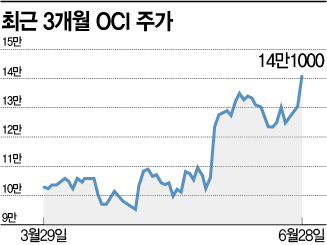
[Asia Economy Reporter Kwon Jaehee] Despite the recent sluggishness of our stock market, there is one stock that has continued to show strength on its own. That is OCI. Previously, solar energy-related stocks received attention once due to the Russia-Ukraine conflict, but OCI differentiates itself by building the entire value chain of solar energy, unlike other solar-related stocks. Recently, along with the renewable energy boom and the enactment of the U.S. law banning imports of products from China's Xinjiang Uyghur region, OCI has gained a windfall benefit and is showing strength even in a weak market.
As of 9:37 a.m. on the 29th, OCI was trading at 144,000 won, up 2.86% from the previous trading day. At the same time, the KOSPI index was down 1.42% from the previous trading day at 2,387.69, showing that OCI is continuing its upward trend alone. OCI also closed up 7.28% the previous trading day. Over the past month, while the KOSPI index has fallen 13%, OCI has shown an increase of over 30% during the same period.
The reason OCI was able to rise alone even in a crashing market is due to the solar boom combined with the U.S. import ban on products and raw materials from China's Xinjiang Uyghur region.
The installation volume of solar power is also steadily increasing. Due to global carbon neutrality policies promoting eco-friendly renewable energy transitions and the high oil price situation highlighting the economic feasibility of solar power generation, solar installations this year are expected to increase by more than 30% compared to the previous year, reaching 245 GWh.
In this strong demand environment, the supply-demand imbalance continues as the new supply volume of Chinese polysilicon is less than expected. The price of polysilicon, the main raw material for solar panels, currently stands at $33.1 per kilogram. This is a 560% surge compared to May of last year. The industry expects the supply-demand imbalance to continue until 2023, when the polysilicon expansion volume is stably supplied to the market.
Moreover, with the U.S. fully enforcing the import ban on goods and raw materials produced in China's Xinjiang Uyghur Autonomous Region, OCI has gained a windfall benefit. This is because 40% of the world's polysilicon is produced in Xinjiang, China. Accordingly, OCI, which has built the entire value chain related to solar energy, has attracted attention. Unlike other solar-related stocks, OCI succeeded in commercial production of polysilicon in 2008 and is considered the only company producing polysilicon domestically.
Lee Sangheon, a researcher at Hi Investment & Securities, analyzed, "As the strong trend in polysilicon prices continues, OCI is expected to accelerate its performance turnaround with the full-scale effect of expansion in the second half of the year."
© The Asia Business Daily(www.asiae.co.kr). All rights reserved.
![Clutching a Stolen Dior Bag, Saying "I Hate Being Poor but Real"... The Grotesque Con of a "Human Knockoff" [Slate]](https://cwcontent.asiae.co.kr/asiaresize/183/2026021902243444107_1771435474.jpg)















