KCCI Seminar on 'Rational Electricity Market Reform and Energy Policy Direction'
"Public Consensus Needed That Increasing Renewable Energy Use May Raise Electricity Bills"
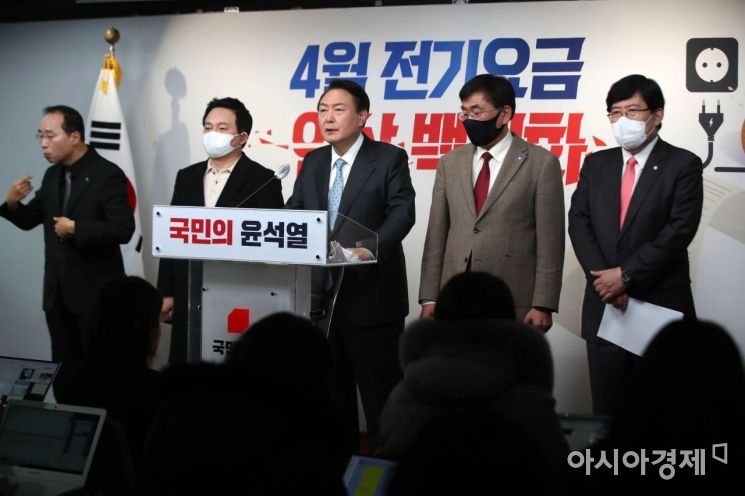 Yoon Seok-yeol, the presidential candidate of the People Power Party, is announcing the pledge to "Cancel the April electricity rate hike and establish a power supply plan based on science and common sense" at the party headquarters in Yeouido, Seoul, on the 13th. Photo by Yoon Dong-ju doso7@
[Asia Economy Reporter Oh Hyung-gil] Although the government decided to raise electricity rates in the third quarter despite the burden of rising prices, experts have argued that a reasonable rate-setting system must be established for energy transition and carbon neutrality.
The Korea Chamber of Commerce and Industry held the 2nd Energy Transition and Carbon Neutrality Policy Seminar on the 29th at the Chamber of Commerce building under the theme of "Rational Power Market Reform and Energy Policy Direction."
Professor Park Joo-heon of Dongduk Women’s University, who participated in the new government’s energy policy formulation as part of the 20th Presidential Transition Committee, said in the keynote speech at the seminar, "Residential electricity rates in Korea are at 59% of the OECD average, ranking 36th out of 37 countries, and industrial electricity rates are at 87% of the OECD average, ranking 22nd out of 37 countries. It is important to gain public understanding that electricity rates may increase compared to the past as the use of renewable energy increases for carbon neutrality."
He then explained the new government’s energy policy directions, including ▲export industrialization of nuclear power and revitalization of the nuclear ecosystem ▲strengthening nuclear energy cooperation diplomacy ▲enhancing competitiveness of next-generation nuclear technology and industry ▲advancing the solar and wind power industries linked to stable supply of renewable energy ▲realizing a high-efficiency, low-consumption energy structure and expanding the cultivation of new energy industries such as hydrogen.
Following this, Professor Park Jong-bae of Konkuk University argued, "Normalizing electricity rates is an urgent task, and to achieve this, it is necessary to establish the already introduced cost-reflective pricing system and secure the independence and expertise of the electricity rate regulatory body to ensure a rational rate-setting system."
Professor Cho Sung-bong of Soongsil University also stated, "Korea Electric Power Corporation’s (KEPCO) operating losses ultimately result in taxpayers paying for what electricity consumers should pay. Considering KEPCO’s expanding operating losses and rising international energy prices, normalizing electricity rates is inevitable," and suggested, "The KEPCO-centered electricity monopoly structure blocks consumer choice and restricts the development and dynamism of the power industry, so it is necessary to promote limited competition in the power sales sector through the activation of Power Purchase Agreements (PPAs)."
Professor Joo Byung-ki of Seoul National University emphasized, "In the energy transition process, it is essential to minimize the impact on employment in fossil fuel industries and local economies, and as intermittent and variable renewable energy expands, the public nature of the power industry must be strengthened to ensure stable power supply."
Additionally, advice on a rational power mix and activation of new energy industries was provided. Professor Cho Hong-jong of Dankook University argued, "In the context of rapid inflation in the global energy market, a scientific, economic, and democratic decision on the power mix considering energy security is necessary. Electricity rates must be rationalized to restore price signals, and the energy market should be restructured through efficient market competition."
Lee Yoo-soo, Director of the Energy Economics Institute, said, "While technological innovation and business model development are important for new energy industries, building a foundation to enhance feasibility is paramount. The future growth of the energy industry will depend on the utilization of diverse technologies and data, and for this, a flexible energy operation system and introduction of competition in the electricity market are essential."
Woo Tae-hee, Executive Vice President of the Korea Chamber of Commerce and Industry, said, "We plan to hold three more seminars related to energy transition," adding, "We will collect opinions from experts and stakeholders across government, industry, academia, and civic groups in various fields such as industry, finance, and carbon market policies, and propose alternatives to the government."
© The Asia Business Daily(www.asiae.co.kr). All rights reserved.
![Clutching a Stolen Dior Bag, Saying "I Hate Being Poor but Real"... The Grotesque Con of a "Human Knockoff" [Slate]](https://cwcontent.asiae.co.kr/asiaresize/183/2026021902243444107_1771435474.jpg)
















