Annual Increase in Gift Certificate Issuance Scale
Consumer Agency Reports 2,457 Consultations and 191 Damage Relief Applications from January to May
60.6% Refusal of Use Due to Expired Validity Period
Litigation Support System Available for Small Claims and Others
[Asia Economy Reporters Lim Chun-han and Jeon Jin-young] As the trend of non-face-to-face and online consumption expands due to COVID-19, the issuance scale of paper gift certificates last year nearly reached 13 trillion won. However, the management and supervision of gift certificates are virtually in a blind spot, causing consumer damages to increase every year.
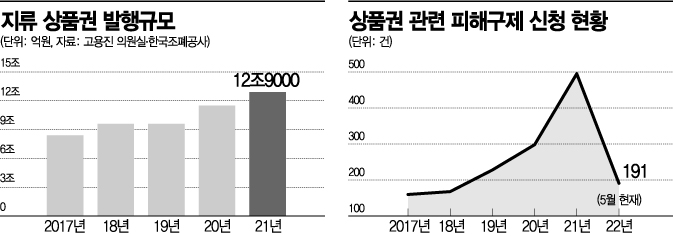
According to data obtained by Asia Economy on the 29th through the office of Assemblyman Ko Yong-jin of the Democratic Party of Korea from the Korea Minting and Security Printing Corporation, the issuance scale of paper gift certificates last year was 12.9 trillion won, marking an all-time high. This is analyzed to be because gift certificates are highly utilized when it is difficult to choose an appropriate gift due to not knowing the recipient’s preferences or for gifts to parents on Parents’ Day or holidays. By year, the amounts were 8.4 trillion won in 2017, 9.6 trillion won in 2018, 9.6 trillion won in 2019, and 11.5 trillion won in 2020.
By industry, distributors issued 134.9 million certificates, oil companies 7.32 million, Onnuri (traditional markets) 335 million, and local governments (regional love) 371.76 million, totaling approximately 848.98 million certificates. From January to May this year, distributors issued 22.19 million, oil companies 2.18 million, Onnuri 24.38 million, and local governments 96.27 million, totaling about 145.03 million certificates. Assemblyman Ko said, "The scale of gift certificate issuance is increasing every year. It is risky when paper gift certificates with silver foil scratch features are traded at places other than official sales outlets," adding, "Gift certificates can be considered as good as cash, so system improvements are urgently needed."
In fact, as the types of gift certificates diversify beyond paper to include mobile goods and cash vouchers and distribution channels expand, consumer damages are also rapidly increasing. According to the Korea Consumer Agency, the number of consultations related to gift certificates from January to May this year was 2,457, and it is estimated to exceed 4,000 by the end of the year. By year, the numbers were 2,968 in 2017, 3,413 in 2018, 3,600 in 2019, 3,905 in 2020, and 26,812 in 2021. This figure includes both gift certificates and new types of gift certificates, and last year saw a sharp increase in consumer consultations due to the Merge Point incident.
The number of damage relief applications related to gift certificates from January to May this year was 191. By year, the numbers were 160 in 2017, 168 in 2018, 228 in 2019, 298 in 2020, and 495 in 2021. By type of damage relief application, "refusal of use due to expiration" accounted for 818 cases (60.6%), making up the majority. This was followed by "refund refusal" with 181 cases, "refusal of use within validity period" with 143 cases, "non-delivery of gift certificates" with 16 cases, and "others" with 191 cases.
Experts advise that urgent measures are needed as cases of gift certificate-related damages are increasing. Professor Lee Eun-hee of Inha University’s Department of Consumer Studies said, "The use of gifticons and other gift certificates will increase further in the future," and suggested, "It would be effective for the government to regularly disclose companies with many consumer damages so that consumers can be informed." Professor Heo Kyung-ok of Sungshin Women’s University’s Department of Consumer Life and Culture said, "There are limits to laws and systems alone, so consumers should carefully check regulations, deadlines, and contents," adding, "Businesses should also refrain from marketing promotions that make refunds impossible."
© The Asia Business Daily(www.asiae.co.kr). All rights reserved.


















