[Asia Economy Reporter Seo So-jeong] The expected inflation rate for the next year, which represents consumers' anticipated consumer price increase, has reached its highest level in 10 years and 2 months since April 2012 (3.9%). The interest rate outlook also showed an all-time high level due to expectations of further rate hikes in the U.S. and additional base rate increases.
According to the 'June Consumer Sentiment Survey Results' released by the Bank of Korea on the 29th, the expected inflation rate this month was recorded at 3.9%, up 0.6 percentage points from the previous month.
The expected inflation rate has been rising for six consecutive months since January (2.6%). It surpassed 3% in April (3.1%), rose to 3.3% in May, and surged to nearly 4% this month. The 0.6 percentage point increase is the largest since related statistics began in 2008.
The inflation perception index, which reflects consumers' judgment on the consumer price increase over the past year, also rose by 0.6 percentage points from the previous month, marking the largest increase on record.
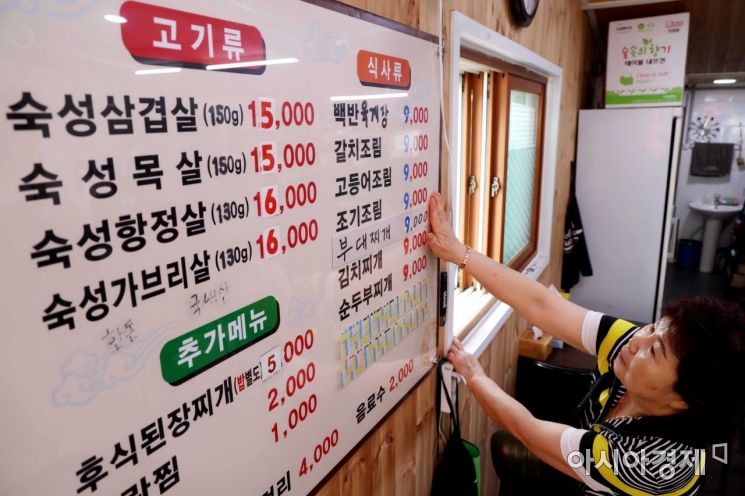
Hwang Hee-jin, head of the Statistical Survey Team at the Bank of Korea's Economic Statistics Bureau, said, "Although the expected inflation rate reflects price expectations for the next year, it also continuously incorporates current price trends, which is why it appeared high. The biggest factors are overseas influences such as rising oil and international food prices and supply chain disruptions. Additionally, the high prices of personal services closely related to daily life, including dining out, have significantly driven up the expected inflation rate."
Hwang explained, "In the past, the expected inflation rate exceeded 3.9% and reached the 4% range for about a year from July 2008 to July 2009 during the financial crisis, and again from March 2011 during the economic recovery period when the Japan earthquake and European fiscal crisis overlapped."
The interest rate outlook index (149) also rose by 3 points from the previous month, breaking the all-time record. This index exceeds 100 when more people expect interest rates to rise in six months than those who expect them to fall. It reached an all-time high due to expectations of U.S. rate hikes and additional base rate increases.
The housing price outlook index (98), which jumped 10 points last month, dropped 13 points in one month. Hwang analyzed, "This decline is due to the nationwide sales prices turning downward and the increased interest payment burden caused by rising loan interest rates."
Meanwhile, the Consumer Confidence Index (CCSI) for this month was 96.4, down 6.2 points from May (102.6). The consumer confidence index uses 100 as the baseline; values above 100 indicate optimism compared to the long-term average, while values below 100 indicate pessimism. All six components of the CCSI decreased compared to the previous month.
Hwang said, "Consumer sentiment worsened as concerns about economic slowdown grew due to rising perceived inflation and U.S. monetary tightening. There are many external factors beyond our control, such as the Ukraine crisis and U.S. rate hikes, which increase uncertainty. News about stagflation also seems to have affected sentiment."
Regarding future prospects, he added, "If domestic demand supports consumption, which is expected to increase significantly after the lifting of social distancing, it may prevent a further decline in consumer confidence. Government measures on prices, such as fuel tax cuts, could affect perceived inflation, and we need to observe how interest rate hikes psychologically impact sentiment."
© The Asia Business Daily(www.asiae.co.kr). All rights reserved.
![Clutching a Stolen Dior Bag, Saying "I Hate Being Poor but Real"... The Grotesque Con of a "Human Knockoff" [Slate]](https://cwcontent.asiae.co.kr/asiaresize/183/2026021902243444107_1771435474.jpg)















