Influence of North Pacific High Located in the South, Hot and Humid Southwest Winds Inflow
Tropical Nights Expected to Continue Mainly on East Sea, Jeju Coast, and Southern Inland Areas
Heatwave to Intensify After End of Jangma, Too Early to Predict Exact End of Jangma
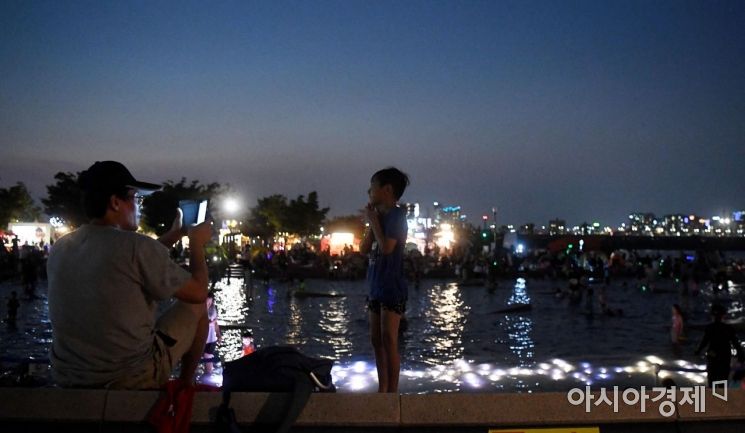 Citizens visiting Hangang Citizens' Park in Yeongdeungpo-gu, Seoul, on the 3rd, enduring the worst heatwave and tropical nights, are cooling off in the river breeze. Photo by Hyunmin Kim kimhyun81@
Tropical nights occurred for two consecutive days in Seoul, Daejeon, Gwangju, and other areas. While tropical nights usually begin in July, this year they started to intensify from June.
On the 28th, the Korea Meteorological Administration announced that as of 6 a.m., the minimum temperatures recorded at locations experiencing tropical nights were 25.8°C in Seoul, 27.7°C in Suwon, 28.2°C in Cheongju, 27.4°C in Daejeon, 27.3°C in Sejong, 25.8°C in Gwangju, 27.3°C in Jeonju, and 28.9°C in Jeju.
Warm and humid southwesterly winds flowed in, and cloudy weather prevented temperatures from dropping, resulting in many places experiencing tropical nights overnight. A tropical night is defined as when the minimum temperature between 6 p.m. and 9 a.m. remains at or above 25°C.
Across the country, record-high daily minimum temperatures for June were broken for two consecutive days. As of 6 a.m., temperatures were 25.5°C in Paju, 27.4°C in Wonju, 25.3°C in Yeongwol, 24.8°C in Chuncheon, 27.1°C in Chungju, 26.8°C in Gunsan, 26.1°C in Andong, 24.8°C in Changwon, 23.5°C in Busan, and 24.2°C in Gosan.
The regions that recorded their first tropical nights in June this year include Seoul, Wonju, Suwon, Daejeon, Gunsan, Mokpo, Boryeong, Buyeo, Chuncheon, and Cheongju. In Seoul, the first tropical night last year occurred on July 12, which was 16 days later than this year. Last year, Seoul experienced tropical nights for a total of 21 days?14 days in July and 4 days in August.
Typically, tropical nights occur when heat accumulated during daytime heatwaves remains in the atmosphere, causing high temperatures to persist overnight. On average, the number of tropical nights is 2.8 days in July, 3.6 days in August, and 0.1 days in September. Since the expansion of the meteorological observation network in 1973, the nationwide annual average number of tropical nights is 5.7 days.
This tropical night event occurred during the monsoon season. A strengthened stationary front was positioned over the central region, and the North Pacific High expanded in the south, causing hot and humid air to flow. Due to cloudy weather, radiative cooling did not occur, leading to the tropical nights. It is expected that tropical nights will continue mainly along parts of the East Coast, Jeju Island coast, some areas in Chungcheong Province, and the southern inland regions for the time being.
A Korea Meteorological Administration official explained, "In areas where the monsoon front is located, rain continues, while in other regions, heatwaves and tropical nights are occurring simultaneously. The North Pacific High dominates the southern part of our country, and even in areas without heatwaves, warm and humid southwesterly winds are flowing in, causing tropical nights and precipitation."
Heatwaves are expected to intensify from July to August, after the monsoon season ends and the North Pacific High occupies the Korean Peninsula. The Korea Meteorological Administration has analyzed through its summer climate outlook that there is a 50% chance that July and August will be hotter than average. The official added, "Heatwaves appear once the monsoon front weakens, but due to frequent changes in atmospheric pressure systems, it is still too early to predict the end of the monsoon."
Heatwaves directly and indirectly affect society as a whole. According to the 2020 Heatwave Impact Report by the Korea Environment Institute’s Climate Change Risk Research Group, the record-breaking heatwave in 2018 lasted 31.5 days, with 44,094 heat-related illness cases reported nationwide (based on National Health Insurance Service statistics) and 145 deaths, exceeding the combined total of the previous three years (39, 67, and 35 deaths respectively). Additionally, 5.93 million chickens died, and damages to 10 major seafood species amounted to 25 billion KRW.
Last year, extreme weather events such as heavy rains in Western Europe and heavy snow in North America occurred frequently worldwide. South Korea also experienced the second highest temperatures on record, a short 17-day monsoon season, and significant temperature fluctuations. According to the Disease Control and Prevention Agency’s heat-related illness emergency room surveillance system results from May 20 to September 30 last year, 1,376 heat-related illness cases were reported, with 20 deaths due to heatstroke.
© The Asia Business Daily(www.asiae.co.kr). All rights reserved.
![Clutching a Stolen Dior Bag, Saying "I Hate Being Poor but Real"... The Grotesque Con of a "Human Knockoff" [Slate]](https://cwcontent.asiae.co.kr/asiaresize/183/2026021902243444107_1771435474.jpg)















