Necessity of Utilizing Funds for Free Childcare and Early Childhood Education Raised at Forum
Financial Cuts Difficult Due to Overcrowded Classes and Aging Facilities for Future Education Investment
Emphasis on Early Childhood Education Investment Ahead of Special Account Sunset
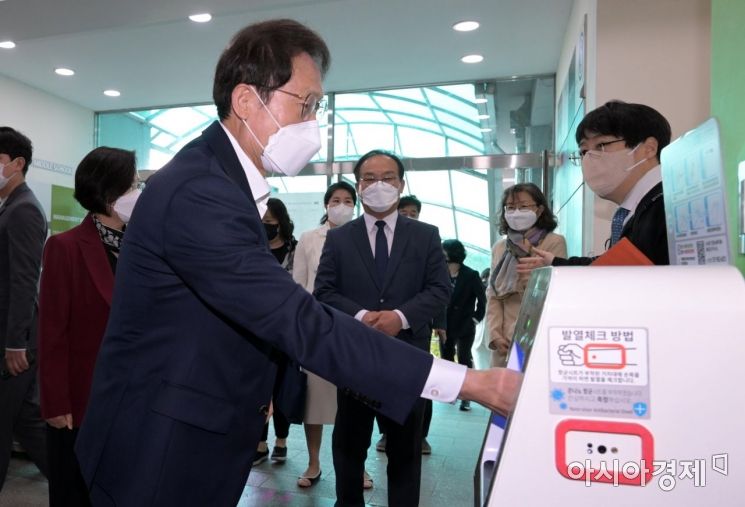 On the morning of the 2nd, when the school's return to normalcy, which had been slower compared to general society, began, Cho Hee-yeon, Superintendent of Seoul Education, visited Seongseo Middle School in Mapo-gu, Seoul, and used hand sanitizer.
 May 2, 2022. Photo by Joint Press Corps
As the government pushes for improvements to the Local Education Finance Grant system, provincial education superintendents are raising their voices, saying that the utilization of education finances should be readjusted to focus on early childhood education.
At the debate titled "Controversy over the Reform of the Local Education Finance Grant System: What is the Problem?" jointly hosted on the 28th by lawmakers Kang Min-jung and Kang Deuk-gu along with the Seoul, Incheon, Sejong, Ulsan, Gyeongnam, Jeonnam, Jeonbuk, and Chungnam Offices of Education, Cho Hee-yeon, Superintendent of Seoul Metropolitan Office of Education, stated, "Instead of dividing the Local Education Finance Grants and lowering the quality of education, we should seek measures based on free early childhood education and free childcare."
Currently, the Local Education Finance Grants are used for early childhood, elementary, and secondary education, receiving 20.79% of domestic taxes. The Ministry of Economy and Finance holds the position that the grants need reform because they do not reflect the declining school-age population trend and balanced investment in education is not being achieved.
Superintendent Cho argued, "Since the effect of the Special Account Act for Early Childhood Education Support, introduced for the Nuri Curriculum, ends at the end of 2022, urgent discussions on support measures thereafter are needed." If the special account sunset proceeds as scheduled, the estimated budget required for free kindergarten education in Seoul would be about 720.9 billion KRW annually.
Superintendent Cho pointed out that reducing education finances is difficult due to the need to resolve overcrowded classes, improve school facilities over 40 years old, implement free kindergarten education, and create AI and edutech environments. He also noted that the proportion of education budget relative to the government budget has not significantly increased.
He said, "Although tax revenue temporarily increased last year and this year, leading to an increase in grants, the average annual proportion of education budget to government budget from 2011 to 2022 was 14.1%, and this year it was 13.9%. Since local education finances are greatly influenced by economic fluctuations, it is difficult to be optimistic that local education finance conditions will continuously improve, and cautious interpretation is needed regarding mid- to long-term projections that grants will excessively exceed demand." Furthermore, regarding the expansion of higher education finances, he emphasized, "If part of the grants is invested in higher education finances, the entire education finance will shrink during economic recessions, so a separate Higher Education Finance Grant Act should be enacted to expand finances."
Lee Seon-ho, Director of the Education Finance Research Office at the Korea Educational Development Institute, argued, "While focusing on the transition to a future education system, investment priorities should be placed on 'early childhood'." Currently, the proportion of early childhood education expenditure relative to GDP is 0.46%, which is lower than the OECD average (0.60%) and the EU (0.56%). Although the Nuri Curriculum policy for ages 3 to 5 has been in place for 10 years, it remains at the level of education cost subsidies rather than free education. Director Lee said, "Ahead of the expiration of the temporary Special Account for Early Childhood Education Support, discussions on the state's responsibility for early childhood education and the scope of free education, including the integration of childcare and kindergarten, are necessary."
It is also necessary to consider that the unit of education finance execution is aligned with the 'number of classes,' and the decreases in student numbers, class numbers, and teacher numbers are not proportional. While the number of small schools is increasing due to regional extinction, there is also steady demand for new schools due to urban development needs. Overcrowded classes with more than 28 students per class account for 16.9% of the total, with 88.8% of these concentrated in special and metropolitan cities.
Director Lee pointed out, "Undersized classes are necessary to guarantee equality of outcomes, and overcrowded classes urgently require improvements in conditions to provide quality educational services. Discussions should start not only by focusing on the decrease in student numbers but also on whether the current level is appropriate to prepare for the future."
© The Asia Business Daily(www.asiae.co.kr). All rights reserved.
![Clutching a Stolen Dior Bag, Saying "I Hate Being Poor but Real"... The Grotesque Con of a "Human Knockoff" [Slate]](https://cwcontent.asiae.co.kr/asiaresize/183/2026021902243444107_1771435474.jpg)















