KCCI's '10th ESG Management Forum'
"New Government Should Promote Private-Led ESG Expansion"
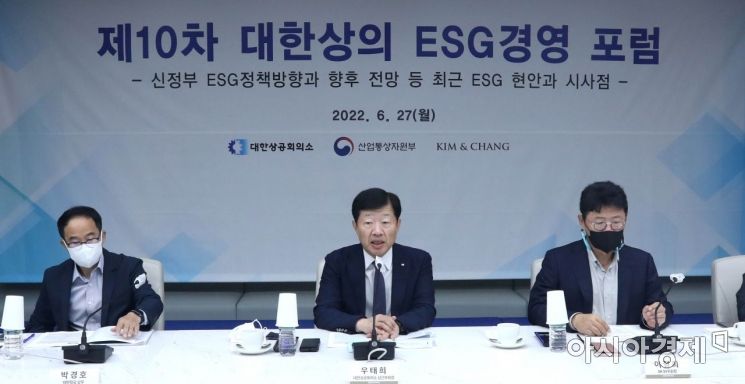 Woo Tae-hee, Executive Vice Chairman of the Korea Chamber of Commerce and Industry (center), is delivering a greeting at the 10th KCCI ESG (Environmental, Social, and Governance) Management Forum held on the 27th at the KCCI Hall.
[Asia Economy Reporter Oh Hyung-gil] In the wake of the Russia-Ukraine war and the ensuing surge in raw material prices, there is a growing call to review ESG (Environmental, Social, and Governance) issues related to economic security industries such as water, food, energy, and cybersecurity.
At the 10th Korea Chamber of Commerce and Industry (KCCI) ESG Management Forum held on the 27th in collaboration with the Ministry of Trade, Industry and Energy and Kim & Chang Law Firm, Kim Hyung-tae, Senior Economist at Kim & Chang, stated, "There is an increasing need to expand the interpretation of the 'S' in ESG, Social, to include Security."
Senior Economist Kim added, "Among economic security-related industries, the nuclear industry requires simultaneous development of Small Modular Reactor (SMR) technology and nuclear waste treatment technology. Regarding water, eco-friendly desalination technology is necessary, and for food, it is important to consider building a food network using the Indo-Pacific Economic Framework (IPEF) and developing bio-food focused on nutrition and calories."
He further emphasized, "It is necessary to review ESG issues in related export industries such as semiconductors, petrochemicals, shipbuilding, and secondary batteries. In particular, unlike the European eco-friendly model that focuses on decarbonization, attention should be paid to the American eco-friendly model that captures, neutralizes, and offsets emitted carbon in the petrochemical industry."
Kim Dong-soo, Director of the Kim & Chang ESG Management Research Institute, in his presentation titled 'New Government ESG Policy Directions and Future Prospects,' assessed, "The global market has moved beyond the stage of adopting ESG to the stage of ESG diffusion."
He continued, "Major advanced countries worldwide are promoting ESG information disclosure through legislation while regulating excessive ESG washing and evaluations, aiming to revitalize the market based on transparent ESG information. It will become possible to distinguish between companies with excellent ESG performance and those with poor performance."
Director Kim identified the new government's ESG policy priorities as ▲ private-led ESG diffusion to encourage voluntary and innovative corporate efforts ▲ expansion of ESG finance to support ESG diffusion ▲ strengthening industry-specific ESG policies to enhance industrial competitiveness ▲ and reinforcing ESG support for small and medium-sized enterprises (SMEs) and mid-sized companies.
Woo Tae-hee, Executive Vice Chairman of KCCI, stated, "Global companies have begun excluding partners who fall short in ESG management, and financial institutions increasingly require companies engaged in financial transactions to practice ESG management, highlighting the growing importance of ESG management. For the Korean economy and companies to sustain growth and take a leap forward, close communication and collaboration between the public and private sectors are necessary to elevate ESG management levels across industries."
© The Asia Business Daily(www.asiae.co.kr). All rights reserved.
![Clutching a Stolen Dior Bag, Saying "I Hate Being Poor but Real"... The Grotesque Con of a "Human Knockoff" [Slate]](https://cwcontent.asiae.co.kr/asiaresize/183/2026021902243444107_1771435474.jpg)















