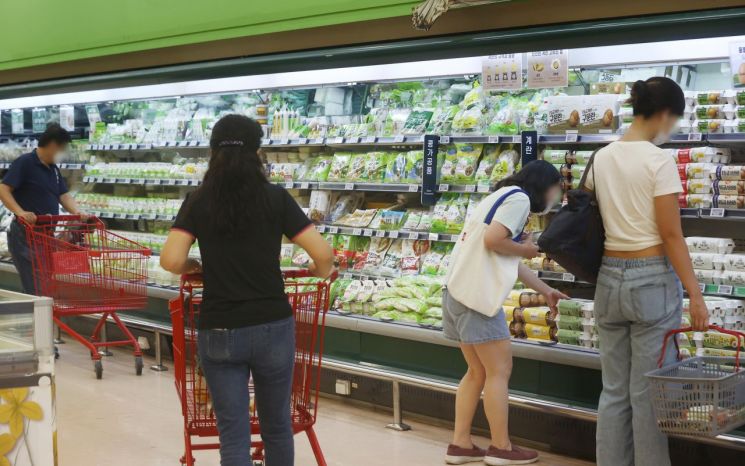
[Asia Economy Reporter Hwang Sumi] Domestic food prices are soaring sharply due to Russia's invasion of Ukraine and export restrictions imposed by major countries. Following a 5% increase in the consumer price index last month, the average monthly food expenses for a family of four in the first quarter of this year have exceeded 1 million won. There are concerns about the economic burden on low-income groups, who spend a relatively large proportion of their income on food, amid forecasts that the price increase trend will continue for some time.
According to an analysis of microdata from Statistics Korea by Yonhap News on the 26th, the average monthly food expenses (groceries + dining out) for a four-person household in the first quarter of this year amounted to 1,066,902 won. This represents a 9.7% increase compared to one year ago (972,286 won). In particular, dining out expenses at restaurants and similar places rose by 17.0% over the past year to 486,129 won. Grocery and non-alcoholic beverage purchases for home consumption increased by 4.3% to 580,773 won.
This appears to be an effect of the sharply rising consumer prices centered on food prices. According to Statistics Korea, the consumer price index in May this year was 107.56 (2020=100), up 5.4% from the same month last year. This rate of increase is the highest in 13 years and 9 months since August 2008 (5.6%). Additionally, the consumer price inflation rate reaching the 5% range is the first time since September 2008 (5.1%).
In particular, the rise in consumer prices is mainly driven by processed foods and dining out sectors. Last month, dining out prices rose 7.4%, marking the highest level since March 1998 (7.6%) during the early stages of the foreign exchange crisis. Agricultural, livestock, and fishery products increased by 4.2%, led by livestock products (12.1%), with a larger increase than the previous month (1.9%). Processed foods also rose 7.6%, the largest increase since January 2012 (7.9%).
This upward trend in food prices has expanded as global supply chain disruptions continue due to sanctions imposed by countries worldwide on Russia following its invasion of Ukraine. After Ukraine, the largest wheat producer, India also banned wheat exports in May, causing international food prices to surge sharply. The reduction in crude oil supply from Russia, an oil-producing country, also pushed up international oil prices. Furthermore, the lifting of social distancing measures increased dining out demand, which is also analyzed to have contributed to price increases.
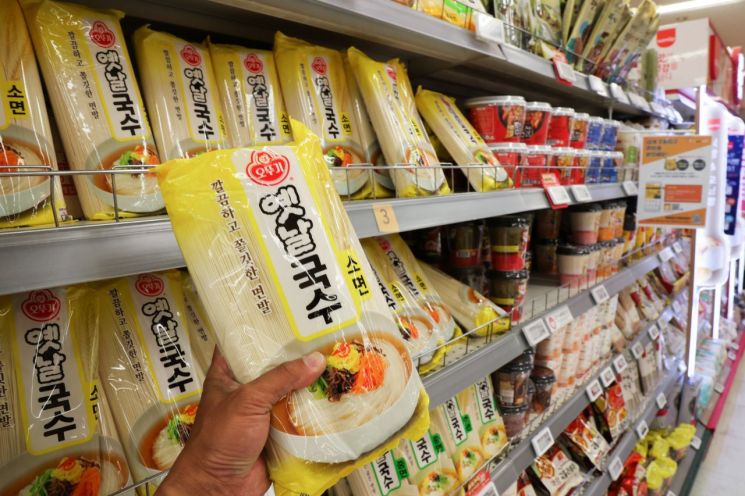 On the afternoon of the 6th, citizens were shopping at the noodle section of a large supermarket in downtown Seoul. [Image source=Yonhap News]
The Bank of Korea analyzed this in its "Price Stability Target Operation Status Review" report on the 21st, stating, "In particular, prices of processed foods and dining out have strong downward rigidity, so the upward trend in prices may continue for a considerable period." It forecasts that food price increases may further expand in the second half of this year due to the impact of the Ukraine situation. It also pointed out, "The economic burden on low-income groups, who spend a relatively large proportion of their income on related expenses, may intensify."
In fact, in the first quarter of this year, low-income groups spent more than 40% of their disposable income, excluding essential expenses such as taxes, on food. According to the Ministry of Economy and Finance and Statistics Korea on the 7th, among the lowest 20% income group (first quintile) with an average monthly disposable income of 847,039 won in the first quarter, the proportion spent on groceries and dining out was 42.2%. This figure is more than three times higher than the 13.2% average food expense proportion of the highest 20% income group (fifth quintile). It is also significantly higher compared to the overall household average proportion of 18.3%.
© The Asia Business Daily(www.asiae.co.kr). All rights reserved.
![Clutching a Stolen Dior Bag, Saying "I Hate Being Poor but Real"... The Grotesque Con of a "Human Knockoff" [Slate]](https://cwcontent.asiae.co.kr/asiaresize/183/2026021902243444107_1771435474.jpg)
















