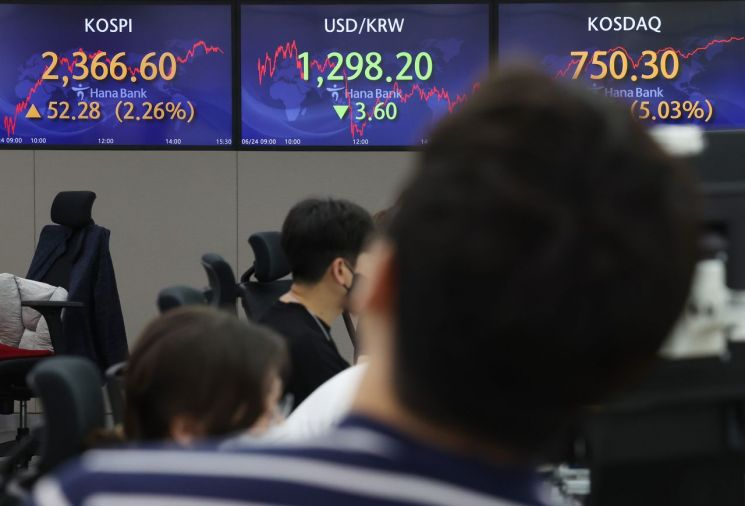
[Asia Economy Reporter Kwon Jae-hee] On the 24th, the KOSPI and KOSDAQ rebounded after three trading days, overcoming the sharp declines of the past two days. This is interpreted as a result of bargain hunting mainly by institutional investors amid perceptions of excessive price drops, combined with strengthened risk appetite driven by the decline in U.S. Treasury yields.
On that day, the KOSPI closed up 2.26% (52.28 points) at 2366.60, marking its first gain in three trading days. The index opened 0.55% (12.79 points) higher at 2327.11 and expanded its gains during the session, reaching as high as 2373.48.
By investor type, institutions led the rise with net purchases of 640.3 billion KRW. In contrast, individuals and foreigners sold stocks worth 624.9 billion KRW and 31.9 billion KRW, respectively.
Although foreigners ended the day with net selling, the scale of net sales was the smallest since the beginning of this week.
Jerome Powell, Chair of the U.S. Federal Reserve (Fed), confirmed his commitment to curbing inflation in a House of Representatives hearing the previous day and expressed confidence in economic growth in the second half of the year.
The sharp rise in the won-dollar exchange rate, which surpassed 1300 won for the first time in about 13 years the day before, also calmed down. The exchange rate closed at 1298.2 won, down 3.6 won from the previous session, marking a decline after six trading days.
Among the top 10 by market capitalization, several stocks rose sharply, including Samsung Electronics (1.74%), LG Energy Solution (1.25%), SK Hynix (1.55%), and Samsung Biologics (1.34%).
In particular, growth stocks that had recently experienced significant declines showed notable gains, such as NAVER (5.77%), Kakao (6.56%), Samsung SDI (3.19%), KakaoBank (3.11%), Krafton (3.40%), and NCSoft (3.94%).
By sector, all sectors showed strength, including Medical Precision (6.97%), Construction (4.93%), Services (4.28%), Paper & Wood (4.25%), Electricity & Gas (4.24%), and Textiles & Apparel (3.94%).
The KOSDAQ index closed sharply up 5.03% (35.92 points) at 750.30.
In the KOSDAQ market, foreigners and institutions were net buyers of 385.5 billion KRW and 138.2 billion KRW, respectively. Notably, the foreigners’ daily net purchase amount was the largest in about three months since March 31, when it reached 803.5 billion KRW.
On the other hand, individuals were net sellers of 515.2 billion KRW.
Among the top market cap stocks, most surged, including EcoPro BM (5.56%), Celltrion Healthcare (9.87%), L&F (8.25%), Kakao Games (5.78%), HLB (5.66%), Pearl Abyss (6.73%), and Celltrion Pharm (6.79%).
Within the top 100 KOSDAQ stocks by market cap, only five stocks closed down: Osstem Implant (-2.09%), Hyundai Feed (-9.50%), Koyoung (-1.09%), KG ETS (-6.40%), and Wonjoon (-2.83%).
The daily trading value on the KOSPI and KOSDAQ markets was approximately 8.3917 trillion KRW and 6.1818 trillion KRW, respectively.
Lee Kyung-min, a researcher at Daishin Securities, analyzed, "The decline in commodity prices has brought in the possibility of weakening expected inflation, and concerns over an excessively aggressive tightening stance have also eased. The supply and demand conditions, which worsened due to forced liquidation and foreign futures trading, also appear to have somewhat improved."
© The Asia Business Daily(www.asiae.co.kr). All rights reserved.
![Clutching a Stolen Dior Bag, Saying "I Hate Being Poor but Real"... The Grotesque Con of a "Human Knockoff" [Slate]](https://cwcontent.asiae.co.kr/asiaresize/183/2026021902243444107_1771435474.jpg)















