[DTx Era⑥] Movement to Develop DTx for Stroke Sequelae and Epilepsy
FDA Approves DTx 'VNS' Rehabilitation System
Method Using Electrical Pulses for Stimulation
NewNaps' 'NewNapsVision' VR for Visual Impairment Rehabilitation
Traditional Pharma Hanmi Pharm and Daewoong Join In

Existing digital therapeutics (DTx) have primarily been developed focusing on mental illnesses such as drug addiction, anxiety disorders, and attention deficit hyperactivity disorder (ADHD). The world's first FDA-approved DTx by Pear Therapeutics, 'reSET,' targets substance use disorders including alcohol and drug addiction, while another FDA-approved DTx, 'EndeavorRx' by Akili Interactive, is aimed at ADHD. Recently, however, DTx is expanding its scope to cover neurological diseases including brain disorders. Dementia is a representative indication, but development is also accelerating for DTx targeting post-stroke sequelae and epilepsy. The infinite potential of DTx is just beginning to blossom.
Accelerating Development of Neurological Disease DTx
Stroke, which collectively refers to cerebral infarction and cerebral hemorrhage, is considered a representative brain disorder. Stroke caused by cerebrovascular abnormalities occurs when blood vessels supplying blood to the brain are blocked or ruptured, damaging nearby brain areas and causing neurological symptoms. These symptoms mainly include headaches, dizziness, loss of balance, and can lead to paralysis, making normal daily life difficult.
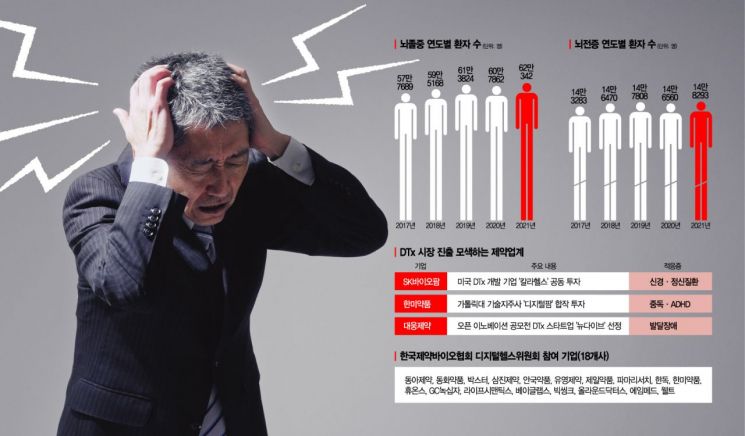
The number of stroke patients is steadily increasing. According to the Health Insurance Review & Assessment Service on the 28th, the number of stroke patients in South Korea was 570,000 in 2017, 590,000 in 2018, and 610,000 in 2019, showing a consistent rise. The number decreased to the 600,000 range in 2020 when the COVID-19 pandemic began but exceeded 620,000 last year. Particularly, severe sequelae such as limb paralysis or vision impairment can occur.
Stroke DTx mainly focuses on patient recovery. In August last year, the FDA approved the 'VNS' rehabilitation system, a DTx designed to assist uncomfortable movements of parts of the body in stroke patients. It is the first DTx with stroke as an indication and works by sending electrical pulses to stimulate.
In South Korea, NewNaps' DTx 'NewNaps Vision' is a representative example. NewNaps Vision is a virtual reality (VR)-based DTx that treats visual field defects caused by stroke. Patients wearing VR devices receive specific stimuli for 30 minutes, responding by identifying the stimuli as if playing a game. It was the first in the domestic DTx industry to receive clinical trial approval in 2019 and is currently undergoing confirmatory clinical trials at Seoul Asan Medical Center and others. Since about 20% of stroke patients suffer from visual field defects, successful development is expected to meet significant demand.
Epilepsy, formerly known as 'ganjil' in Korean, has also emerged as a major indication for DTx application. Epilepsy is a brain disorder that causes seizures, with about 140,000 patients annually in South Korea. SK Biopharm is pushing to enter the epilepsy DTx market. SK Biopharm is recognized globally for its technology in epilepsy, having succeeded in developing the innovative epilepsy drug 'cenobamate.' Cenobamate, approved by the U.S. FDA in 2019, generated sales of 80 billion KRW in the U.S. alone last year.
SK Biopharm plans to expand its portfolio beyond epilepsy drugs to include DTx that predict and detect epilepsy. In March, Cho Jung-woo, CEO of SK Biopharm, stated, "We have developed a prototype wearable EEG medical device capable of predicting and detecting epilepsy and plan to conduct domestic clinical trials within this year," adding, "We are also working on building relationships with DTx ventures." Last month, SK Biopharm invested in the U.S. DTx company Cala Health and is exploring possibilities for technological collaboration in neuroscience. Industry insiders speculate that SK Biopharm may make additional moves related to DTx in the second half of this year.
Traditional Pharmaceutical Companies Also Join DTx
Recently, Hanmi Pharmaceutical entered the DTx field through a joint investment with KT in Digital Pharm, a technology holding company of the Catholic University. Digital Pharm discovers pipelines, KT develops platforms, and Hanmi Pharmaceutical handles business strategy and marketing expertise. It is expected to initially enter the addiction-related DTx market for alcohol and nicotine, as well as the ADHD field.
 On the 23rd, the Digital Health Committee of the Korea Pharmaceutical and Bio-Pharma Manufacturers Association held its first meeting.
Daewoong Pharmaceutical is also accelerating cooperation in the DTx business. Recently, Daewoong Pharmaceutical held the 'Innovare Startup School' contest and selected four future strategic partners, including NewDive, a DTx development company. NewDive is the first domestic company to implement remote treatment for developmental disabilities on a metaverse platform. Additionally, Daewoong Pharmaceutical is promoting open innovation by including DTx in the recruitment categories of a contest held with Gyeongsangnam-do to support bio startups.
Discussions on DTx at the pharmaceutical industry level are also expected to become more active. The Korea Pharmaceutical and Bio-Pharma Manufacturers Association established the 'Digital Health Committee' to cover digital healthcare broadly, with DTx as one of the main agendas. Won Hee-mok, chairman of the Korea Pharmaceutical and Bio-Pharma Manufacturers Association, said, "Digital health is already progressing overseas and will receive considerable attention in the future," adding, "The committee is expected to play a role in matching the government, pharmaceutical companies, and startups and connecting each party."
Experts foresee that DTx will impact the entire spectrum of brain diseases in the future. Han Deok-hyun, a professor of psychiatry at Chung-Ang University Hospital and a leading authority on domestic DTx who has conducted numerous DTx clinical trials and holds related patents, said, "The basic principles of brain and psychiatric digital algorithms are similar," and predicted, "Since digital technology is very well suited to inducing changes in the brain, DTx development will further expand focusing on brain diseases."
© The Asia Business Daily(www.asiae.co.kr). All rights reserved.
![Clutching a Stolen Dior Bag, Saying "I Hate Being Poor but Real"... The Grotesque Con of a "Human Knockoff" [Slate]](https://cwcontent.asiae.co.kr/asiaresize/183/2026021902243444107_1771435474.jpg)

















