Payment of Self-Quarantine Living Support Fund Limited to Households Below 100% Median Income
Paid Leave Support Target Changed from 'All Small Businesses' to 'Businesses with Fewer Than 30 Employees'
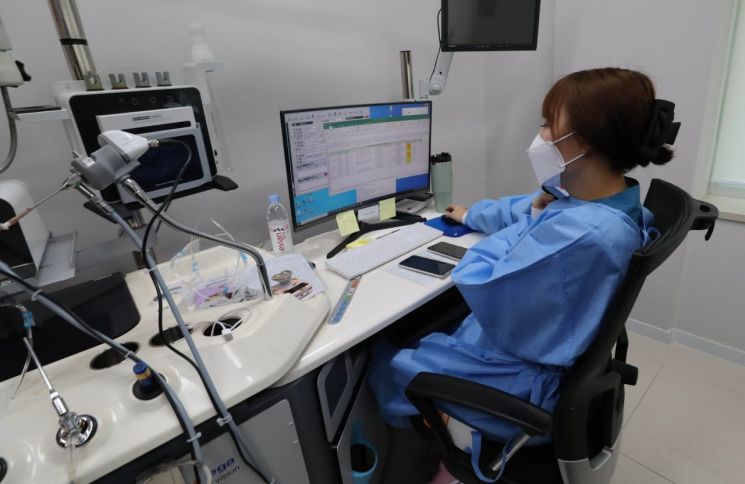
[Asia Economy Reporter Kim Young-won] The government will stop supporting home treatment costs from the 11th of next month as the COVID-19 quarantine situation improves. Living support funds and paid leave support for those in self-quarantine will be gradually reduced.
On the 24th, Lee Sang-min, the 2nd Deputy Head of the Central Disaster and Safety Countermeasures Headquarters (CDSCH) and Minister of the Ministry of the Interior and Safety, said in his opening remarks at the CDSCH meeting, "According to the stable trend of the quarantine situation, the government plans to reform the financial support system related to isolation to promote sustainable quarantine," adding, "The changes will be implemented from the 11th of next month after public guidance and on-site preparations."
Since the fourth week of March, the number of confirmed cases has steadily decreased, with 7,227 new cases reported on this day. The number of critically ill patients and deaths is also steadily decreasing, and the bed occupancy rate continues to remain in the single digits.
Accordingly, the government will first stop supporting relatively small amounts such as non-face-to-face medical consultation fees and home treatment costs, making patients responsible for these expenses. According to the National Health Insurance Service, the average out-of-pocket home treatment cost per COVID-19 patient in the first quarter of this year was about 13,000 KRW at clinics and 6,000 KRW at pharmacies.
Son Young-rae, head of the Social Strategy Division at the Central Accident Response Headquarters, explained, "The out-of-pocket expenses remaining after health insurance coverage for non-face-to-face consultation fees and outpatient centers, as well as general anti-inflammatory and pain relief medications used at pharmacies, will be shifted to be borne by the patients themselves."
However, the government will continue to support out-of-pocket expenses for COVID-19 treatments such as Paxlovid, injections, and high-cost inpatient treatment, which impose a significant burden on the public. Additionally, residents of care facilities without resident doctors, who are isolated in the facility due to underlying conditions and difficulties in receiving inpatient treatment, will continue to receive treatment cost support.
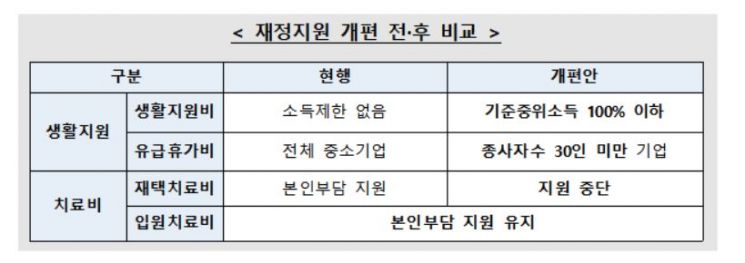
Living support funds for isolated individuals, which were previously paid regardless of income, will now only be provided to households with an income below 100% of the median income. Currently, a fixed amount of 100,000 KRW is paid to single-person households and 150,000 KRW to households with two or more people, regardless of income.
For convenience and prompt support, the criterion for determining eligibility for those below 100% of the median income will be based on health insurance premiums. Son said, "We are preparing detailed guidance for non-regular workers and those not enrolled in health insurance, and will provide further information later."
Paid leave support, which was provided to all small and medium-sized enterprises (SMEs) that offered paid leave to workers isolated or hospitalized due to COVID-19, will now only be available to companies with fewer than 30 employees. Currently, 75.3% of all SME workers are employed in companies with fewer than 30 employees.
Lee, the 2nd Deputy Head, stated, "As daily recovery accelerates, concerns about environmental pollution and resource waste are growing due to the mass disposal and discharge of quarantine supplies such as transparent partitions and hand sanitizers. We will operate a concentrated discharge period for transparent partitions to ensure focused collection and recycling, and continuously monitor the discharge volume of hand sanitizers and other items to prepare for excessive simultaneous discharge."
This reform plan will apply from the 11th to those who receive hospitalization or isolation notices after the 10th of next month. The quarantine authorities will provide guidance and training to local governments and related implementing agencies.
© The Asia Business Daily(www.asiae.co.kr). All rights reserved.
![Clutching a Stolen Dior Bag, Saying "I Hate Being Poor but Real"... The Grotesque Con of a "Human Knockoff" [Slate]](https://cwcontent.asiae.co.kr/asiaresize/183/2026021902243444107_1771435474.jpg)

















