The Old Saying "Climbing is Good for Exports" No Longer Holds... Direct Hit to the Korean Economy
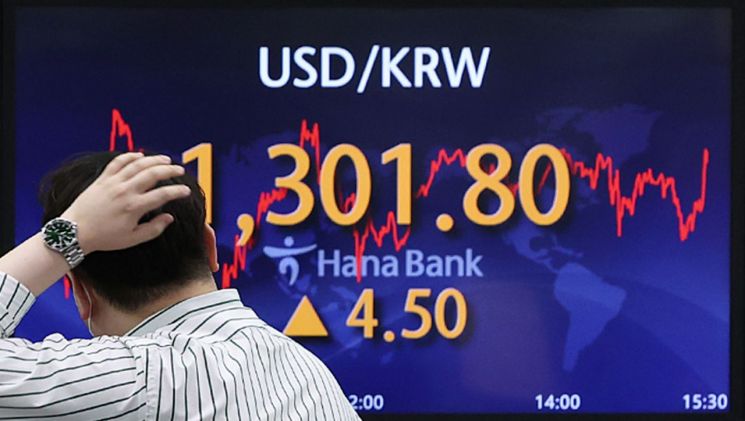
[Asia Economy Reporter Seo So-jeong, Sejong=Reporter Son Seon-hee] Amid growing concerns of an economic recession due to the U.S.'s high-intensity financial tightening, fears of the won-dollar exchange rate hitting the 1300-won level have also struck the Korean economy, raising worries that stagflation could become a reality.
As of 10:30 a.m. on the 24th in the Seoul foreign exchange market, the won-dollar exchange rate was 1300.1 won, fluctuating around the 1300-won mark. The exchange rate started trading at 1300 won, down 1.8 won from the previous day's closing price, rose to 1301.9 won around 10 a.m., and has since been battling around the 1300-won level.
Experts predict that the won-dollar exchange rate is highly likely to break through 1350 won in the short term. Jeon Gyu-yeon, a researcher at Hana Financial Investment, said, "The times when the won-dollar exchange rate entered the 1300-won range were only during the foreign exchange crisis, the dot-com bubble, and the financial crisis," adding, "Since there are no factors to lead to won appreciation, the exchange rate will rise to 1350 won, then gradually decline after September to an annual average of around 1250 won."
Generally, a high exchange rate can be advantageous for exports, but recently concerns have increased as the effect is offset by the sharp rise in import prices. Due to the surge in raw material prices this year, there has been a trade deficit for three consecutive months since April. This month, the deficit is expected to widen further due to the aftermath of the Cargo Solidarity strike.
Bang Ki-seon, First Vice Minister of the Ministry of Economy and Finance, chaired the '1st Emergency Economic Vice Ministerial Meeting' at the Government Seoul Office today and said, "In June, the number of working days decreased by two, and temporary factors such as the Cargo Solidarity strike overlapped, causing exports to show a sluggish trend," adding, "The trade deficit is also expected to widen somewhat." Last month, the trade deficit recorded was 1.71 billion dollars, and this month, a larger deficit is expected to occur.
© The Asia Business Daily(www.asiae.co.kr). All rights reserved.
![Clutching a Stolen Dior Bag, Saying "I Hate Being Poor but Real"... The Grotesque Con of a "Human Knockoff" [Slate]](https://cwcontent.asiae.co.kr/asiaresize/183/2026021902243444107_1771435474.jpg)















