US Interest Rate Hikes Continue, Countries Respond
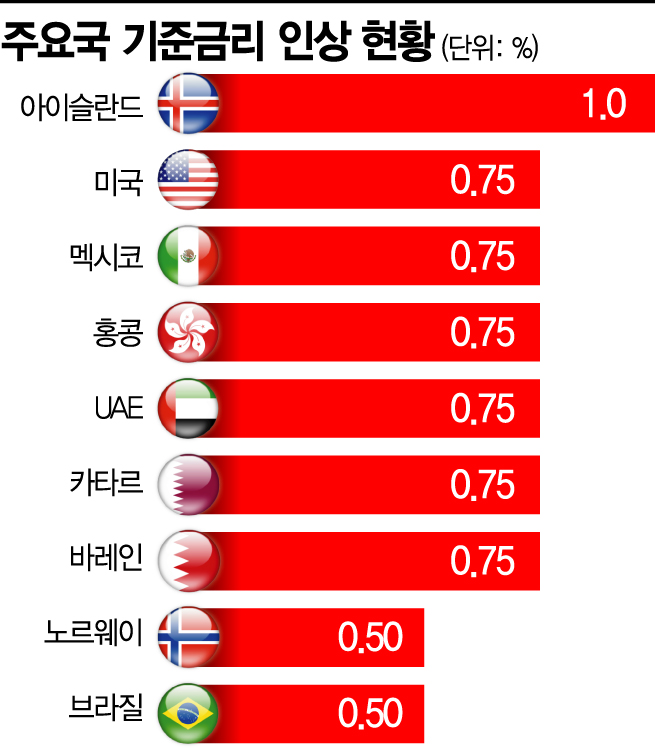
Mexico Raises Interest Rate by 0.75%P
Norway Takes a 0.5%P Big Step
Argentina with 60% Inflation Raises Rate by 3%P to 52%
[Asia Economy Reporter Kim Hyunjung] 'Big Step or Giant Step.' Central banks around the world are moving their monetary policies in one direction. The difference is whether they walk quickly or leap. Since the Plaza Accord in September 1985, this is the first time central banks have so openly intervened directly in exchange rates.
◆‘Giant Step’ amid High Inflation and Exchange Rate Surge= On the 23rd (local time), the Banco de M?xico raised its benchmark interest rate from 7% to 7.75%, a 0.75 percentage point increase. This ‘Giant Step’ is the first since Mexico adopted an inflation targeting system in 2008 and was decided unanimously by the Monetary Policy Committee. The local inflation rate for the first half of June, announced earlier that day, soared to an annual 7.88%, the highest in 21 years.
The Norges Bank also decided on the same day to raise its interest rate from 0.75% to 1.25%, a 0.5 percentage point ‘Big Step.’ This increase is the first of its size in 20 years since 2002. Norway’s inflation rate in April reached 5.4%, the highest in 13 years. Governor Ida Wolden Bache of Norges Bank said, "Steeper rate hikes will reduce the risk of high inflation," indicating the possibility of further increases.
Earlier, the UK raised its benchmark interest rate to 1.25%, the highest since early 2009 (1.5%), and Switzerland also raised its policy rate the day after the US Federal Reserve’s ‘Giant Step,’ increasing it from -0.75% to -0.25%, ending a seven-year period at negative rates since 2015. This is Switzerland’s first rate hike in 15 years since 2007.
The European Central Bank (ECB) also raised its benchmark rate by 0.25 percentage points in July and announced plans to raise it again in September. Argentina, with an inflation rate of 60%, raised its benchmark interest rate by 3 percentage points from 49% to 52% in one go. This marks the sixth consecutive rate hike, making its current rate the second highest worldwide after Zimbabwe in Africa (80%).
Central banks worldwide are concerned that the US Federal Reserve’s tightening is causing a strong dollar, which raises import prices and worsens domestic inflation. A strong dollar can lead to capital outflows from emerging markets, threatening national economies.
US interest rate hikes are expected to continue, leaving central banks no choice but to respond proactively. Jerome Powell, Chair of the US Federal Reserve, appeared before the House Financial Services Committee that day, acknowledging that monetary tightening to reduce inflation could raise unemployment but emphasized the Fed’s "unconditional" commitment to price stability. He said, "We have not experienced high inflation for a long time. This is a first," and noted the challenges of conducting monetary policy in an uncertain environment where the economy may sometimes move in unexpected directions.
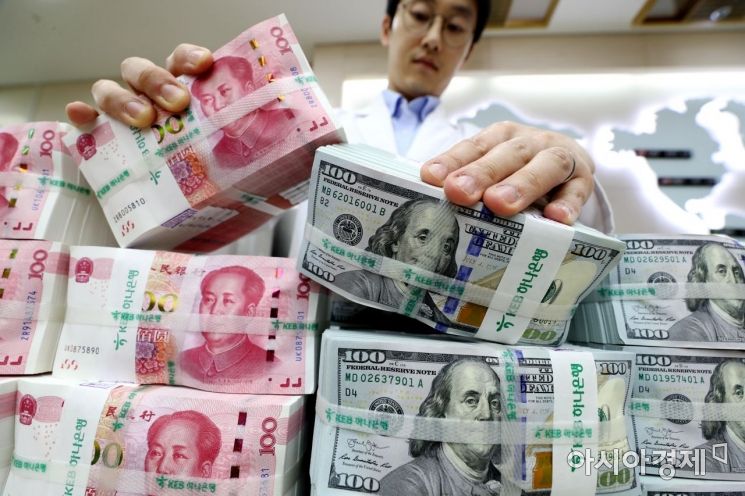 On the 5th (local time), the U.S. Department of the Treasury designated China as a currency manipulator. This is the first time in 25 years since the Clinton administration in 1994 that the U.S. has designated China as a currency manipulator. On the 6th, an employee at the KEB Hana Bank Counterfeit Response Center in Euljiro, Seoul, is organizing U.S. dollar and Chinese yuan banknotes. Photo by Moon Honam munonam@
◆No Such War Since 1985= The recent competitive interest rate hikes by countries are the first such phenomenon in about 37 years. In 1985, the US dollar value soared during Ronald Reagan’s first term due to consecutive rate hikes, reaching its highest level compared to the British pound.
The administration praised this as a symbol of a ‘strong US economy,’ but soon faced pressure from manufacturing companies struggling with exports. Lee Morgan, CEO of Caterpillar, a heavy equipment manufacturer at the time, estimated that hundreds of US companies were losing billions of dollars annually in international orders to Japanese competitors due to the strong dollar.
In September of the same year, finance ministers from five countries (G5)?the US, France, Germany, Japan, and the UK?met at the Plaza Hotel in New York and agreed to intervene in the foreign exchange market to devalue the dollar against the Japanese yen and German mark. Subsequently, the yen and mark appreciated by 65% and 57% respectively against the dollar.
Bloomberg News noted, "Since the Plaza Accord, there has been no explicit government intervention in currency values," referencing a 2010 statement by Brazil’s Finance Minister Guido Mantega, who coined the term ‘currency war’ targeting currency depreciation by countries like Switzerland and Japan. Bloomberg emphasized that "currency tensions have deepened the rift between emerging markets and advanced economies."
◆A Winnerless ‘Zero-Sum Game’= The news agency diagnosed this currency war among countries as a ‘dangerous game’ and a winnerless ‘zero-sum game.’ It predicted that the burden of inflation would ultimately be passed on to some export companies, paralyzing their growth and severely damaging the economies of developing countries with high export ratios. Jeffrey Frankel, Harvard University economics professor, viewed developing countries, especially exporters like Argentina and Turkey, as the most vulnerable. He explained, "Many emerging economies have more debt denominated in dollars than in their own currencies."
On the other hand, it is unclear how effective monetary policy will be in curbing inflation. Nathan Sheets, Citi Group’s Global Chief Economist and former official at the US Treasury and Federal Reserve Bank (FRB), revealed that the so-called pass-through rate?the extent to which exchange rates affect the Consumer Price Index (CPI)?has proven to be minimal. However, he noted that expectations could rise in situations of soaring prices. According to existing analyses, a 10% rise in the dollar’s value would have about a 0.5 percentage point mitigating effect on inflation.
Mark Sobel, former US Treasury official and advisor to the UK think tank Official Monetary and Financial Institutions Forum (OMFIF), said, "Policies targeting exchange rates are very fickle and ineffective," adding, "It is foolish to predict market reactions to such policies."
© The Asia Business Daily(www.asiae.co.kr). All rights reserved.


















