Central Banks' Smaller Rate Hikes in Response to Inflation
60 Cases in Three Months, Highest Since Early 2000s
Shift from Economic Growth to Price Control as Goal
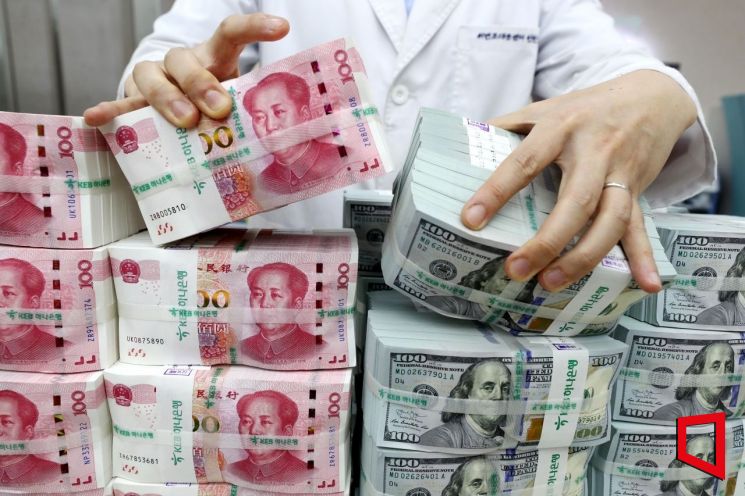 On the 5th (local time), the U.S. Department of the Treasury designated China as a currency manipulator. This is the first time in 25 years since the Clinton administration in 1994 that the U.S. has designated China as a currency manipulator. On the 6th, an employee at the KEB Hana Bank Counterfeit Response Center in Euljiro, Seoul, is organizing U.S. dollar and Chinese yuan bills. Photo by Moon Honam munonam@
[Asia Economy Reporter Kim Hyunjung] As central banks worldwide rush to raise interest rates in response to inflation, an analysis suggests that a new type of currency war has officially begun. Over the past decade, countries have aimed to weaken their currencies to boost export competitiveness of domestic companies and thereby promote economic growth. Now, they are focusing on strengthening their own currencies. This is the so-called ‘reverse currency war.’
On the 23rd (local time), Bloomberg reported, "Amid rapid price increases, enhancing purchasing power has become the top priority for central banks worldwide."
The US dollar is at the forefront of this currency war. The Dollar Index (DYX), which measures the value of the dollar against six major currencies, recorded 104.4 on the day, soaring 13.59% compared to the previous year. This is the highest level in over 20 years since 2002. The US Federal Reserve (Fed) raised the benchmark interest rate from 0.25% in January to 1.75% through three hikes in March, May, and June. This month, it took a ‘giant step’ by raising the rate by 0.75 percentage points at once.
Major countries quickly followed suit. Over the past three months, the number of benchmark interest rate hikes by central banks worldwide exceeded 60, the highest frequency since the early 2000s. The direction of monetary policy goals shifted from economic growth to price control. The size of the hikes also steepened to 0.50?0.75 percentage points, following the US lead. Michael Gahill, an economist at Goldman Sachs, stated, "It’s hard to recall a time when advanced economies’ central banks targeted currency strength so aggressively."
The only countries not participating in the currency war are Japan and China. While the Bank of Japan kept interest rates at rock-bottom to stimulate the economy, the yen’s value against the dollar fell by more than 15%. In China, which continues an expansionary monetary policy by consecutively lowering the Loan Prime Rate (LPR) and reserve requirement ratio (RRR), Premier Li Keqiang recently hinted at possible tightening, saying, "It is important to leave room for monetary policy operation to prevent future inflation and respond to new challenges."
© The Asia Business Daily(www.asiae.co.kr). All rights reserved.
![Clutching a Stolen Dior Bag, Saying "I Hate Being Poor but Real"... The Grotesque Con of a "Human Knockoff" [Slate]](https://cwcontent.asiae.co.kr/asiaresize/183/2026021902243444107_1771435474.jpg)
















