Ramen Diversifies with Trends
Men "Hearty"... Women "Without Calorie Burden"
Industry Flooded with New Products Meeting Consumer Expectations
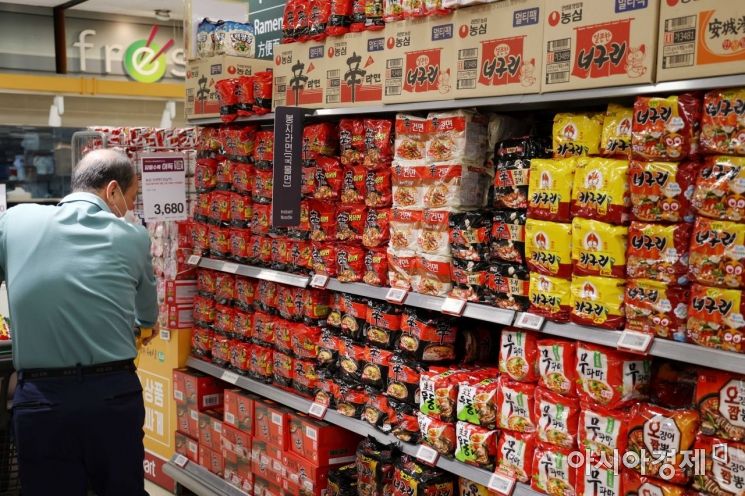
[Asia Economy Reporter Song Seung-yoon] The ramen trend is gradually changing amid the COVID-19 pandemic. The traditional duopoly represented by ‘Shin Ramyun’ and ‘Jin Ramyun’ has expanded into a wider variety of ramen products with diverse strategies, broadening consumer choices. Sales channels are also shifting increasingly towards online platforms, reflecting changes in consumer trends.
According to market research firm Euromonitor on the 24th, as of last year, Nongshim held the largest market share in the noodle segment at 49.5%. Ottogi ranked second with 26.4%, followed by Samyang at 10.2% and Paldo at 8.2%.
The ramen market was traditionally distributed mainly offline, with convenience stores surpassing discount stores in sales volume by 2019. However, the COVID-19 pandemic brought changes. Last year, large supermarkets accounted for 50% of ramen product distribution by channel, convenience stores 19.1%, online 15%, and independent supermarkets 11.2%. While all channels including large supermarkets saw a decrease in share compared to the previous year, only the online channel increased by 1.9% from 13.1%. Industry experts analyze that this is due to reduced outings during the pandemic and a growing preference for individually packaged products driven by an increase in single-person households.
Ramen preference trends are also diversifying. An analysis of ramen-related keywords on Naver Data Lab last year showed that women prefer low-calorie and spicy ramen such as cup noodles, mala tang, and Omori kimchi stew ramen, while men prefer dried noodles over glass noodles and favor products with larger portions and more substantial servings. Preferences also vary by age group. According to a survey on soup ramen preferences by consumer data platform Open Survey last year, teenagers favored Jin Ramyun, Shin Ramyun, and Neoguri in that order; people in their 20s preferred Shin Ramyun, Jin Ramyun, and Sesame Ramyun; those in their 30s and 40s showed similar preferences to teenagers; and those in their 50s preferred Shin Ramyun, Jin Ramyun, and Samyang Ramyun. In Ottogi’s own preference survey, the spicy version of Jin Ramyun had a higher purchase rate among people in their 20s, while the mild version was relatively more popular among men in their 30s.
The ramen industry is responding to these trends by releasing a variety of ramen products. The ‘modisumer’ trend, where consumers’ suggested recipes are commercialized, has led to numerous collaboration products such as Nongshim’s ‘Jjapaguri’ and ‘Kaguri,’ and the ‘Rabap Set’ jointly launched by Nongshim and CJ CheilJedang. As spicy challenges became popular on YouTube and social networking services (SNS), demand for spicier ramen continues. Alternative noodles like konjac noodles and tofu noodles are also gaining popularity in line with the low-calorie health trend.
An industry insider said, "The cycle of trend changes has become shorter than before, leading to an increase in new product launches. Each company is expected to compete more fiercely by reading quarterly trends and offering products that meet consumers’ expectations."
© The Asia Business Daily(www.asiae.co.kr). All rights reserved.
![Clutching a Stolen Dior Bag, Saying "I Hate Being Poor but Real"... The Grotesque Con of a "Human Knockoff" [Slate]](https://cwcontent.asiae.co.kr/asiaresize/183/2026021902243444107_1771435474.jpg)
















