Bioindustry with High Export Share
Profits Increase with Exchange Rate Rise
Pharmaceutical Industry Faces Raw Material Import Burden
Acts as a Factor for Drug Price Increase
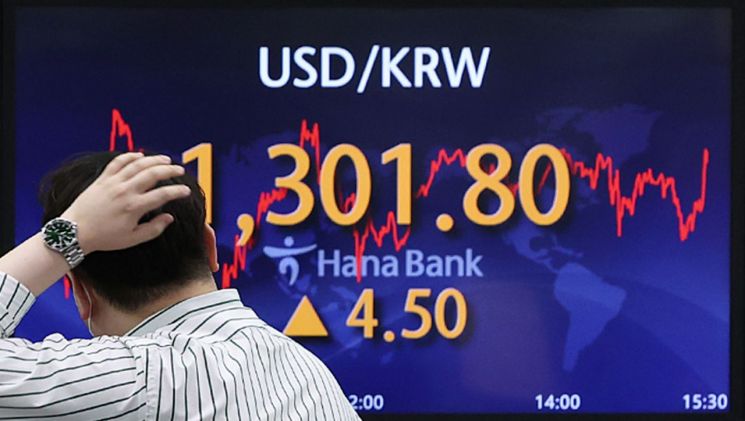
[Asia Economy Reporters Lee Gwan-joo and Lee Chun-hee] As the won-dollar exchange rate surpasses 1,300 won for the first time in 13 years, increasing exchange rate risks, the domestic pharmaceutical and bio industries are experiencing mixed fortunes. While the bio industry, which has a high export ratio, is optimistic that the rising exchange rate could be beneficial, the traditional pharmaceutical sector is closely monitoring exchange rate changes due to its high dependence on imported raw materials for medicines.
According to industry sources on the 24th, the bio industry is considered a representative sector where exchange rate increases can act as an opportunity. Since exports form the core of the business, the rise in exchange rates is not expected to be a burden. Samsung Biologics, a leading domestic bio company, projected in its business report that if the exchange rate rises to the 1,330 won level, net profit could increase by approximately 63.8 billion won. A bio industry insider explained, “Although there is some burden from the cost of raw materials and supplies, their proportion in production costs is not significant due to the nature of the business,” adding, “Since it is an export-oriented industry, we do not expect a major impact.”
Among bio companies that have signed technology export (license-out, L/O) contracts, there is even a welcoming atmosphere toward the rising exchange rate. This is because milestone and royalty payments increase, leading to a rise in actual profits. Lee Sang-hoon, CEO of ABL Bio, said, “Before a global financial crisis level hits, we have secured considerable cash through license-out deals,” and added, “Since all payments are received in dollars, we actually gain foreign exchange profits, which has put us in a comfortable position.”
On the other hand, the traditional pharmaceutical industry is carefully watching exchange rate fluctuations. First, since the proportion of imported raw materials or finished medicines used in production and distribution is not small, an increase in exchange rates can directly lead to higher costs. Especially for prescription drugs with fixed prices, rising costs worsen profitability. If a drug is designated as a “non-withdrawal drug” that the government deems essential to maintain, such as intravenous fluids, prices can be adjusted through negotiations; however, other prescription drugs must bear the cost burden as is. A representative from a mid-sized domestic pharmaceutical company said, “Due to the high dependence on imported raw materials, profitability is significantly affected by exchange rate fluctuations.”
The burden of cost increases due to exchange rates is also expected to directly affect the over-the-counter (OTC) drug market, where medicines can be purchased at pharmacies without a doctor’s prescription. Unlike prescription drugs, pharmaceutical companies can set the supply price for OTC drugs. Currently, OTC drugs are subject to a seller’s price display system, allowing pharmacies to autonomously decide retail prices, so the final price consumers pay varies by pharmacy. However, if supply prices rise, pharmacies will inevitably raise selling prices, likely resulting in an actual increase in drug prices. Many mid-sized pharmaceutical companies have already raised or plan to raise the supply prices of their flagship products by about 10% in the second half of the year.
However, there are also views that the impact of the exchange rate increase will be limited. An industry insider said, “Since domestic pharmaceutical companies mainly import raw materials from countries like China and India, the impact of exchange rate increases may not be significant. Companies trading with Japan are actually benefiting from the weak yen,” and added, “The pharmaceutical industry has long taken various measures to defend against exchange rate risks, so while there may be short-term effects, we expect to respond flexibly in the long term.”
© The Asia Business Daily(www.asiae.co.kr). All rights reserved.
![Clutching a Stolen Dior Bag, Saying "I Hate Being Poor but Real"... The Grotesque Con of a "Human Knockoff" [Slate]](https://cwcontent.asiae.co.kr/asiaresize/183/2026021902243444107_1771435474.jpg)















