[Seoul District News] Byeolbitnaerimcheon, Euddeum Park, Cultural Platform S1472 Transformed into Rest Spaces Full of Attractions and Activities... Gangdong-gu Creates 'Gucheonmyeon-ro Walking Street'... Dongjak Elementary, Noryangjin Elementary, and Jungdaebu Elementary Establish VR Sports Spaces for Indoor Physical Activity Experience
[Asia Economy Reporter Park Jong-il] Gwanak-gu (Mayor Park Jun-hee) is launching a project to create specialized spaces harmonized with local resources centered around the stations of the Sillim Line light rail, which opened on May 28.
The ‘Sillim Line’ is a light rail connecting 11 stations over a total length of 7.8 km from Gwanaksan (Seoul National University) Station to Yeouido Saetgang Station. It offers transfers to Subway Line 9 (Saetgang Station), Line 1 (Daebang Station), Line 7 (Boramae Station), and Line 2 (Sillim Station), greatly contributing to improving the transportation environment in Gwanak-gu, which was relatively underserved by public transit.
The district plans to focus not only on improving transportation through the Sillim Line light rail but also on creating specialized spaces that leverage local environmental resources representing the area, such as Byeolbitnaerincheon Stream, Gwanaksan Mountain, and the cultural platform S1472, linked to the stations.
First, in connection with Gwanaksan (Seoul National University) Station, Gwanaksan Uteum Park will be developed. The rest area will be newly renovated, and the existing parking lot site will be transformed into an open plaza, creating a complex cultural space for hikers and local residents, reborn as a landmark park of Gwanak-gu.
The only public performance hall in the area, Gwanak Art Hall, is also undergoing remodeling. It will be transformed into a community cultural space for residents, including a performance hall, children’s lounge, exhibition hall, and restaurant, making it a space enjoyable for people of all ages.
At Venture Town Station, in addition to the six startup spaces currently operated?HERE-RO 3, 4, and 5, and private company-linked startup spaces?three more startup support facilities will be added around the University area. The district plans to leverage the improved accessibility provided by the light rail to accelerate the attraction of venture companies, boosting the local economy through the creation of the Gwanak S Valley startup ecosystem.
Getting off at Seowon Station, visitors can immediately experience Gwanak-gu’s pride, Byeolbitnaerincheon Stream. Walking along the riverside, there are dazzling attractions such as wall fountains, bridge landscape lighting, and media glass. The riverside, once surrounded by concrete structures, has been enhanced with greenery through an ecological landscape improvement project, making residents’ walks lighter and more pleasant.
In particular, the district is conducting the ‘Byeolbitnaerincheon Specialized Space Creation Project.’ This aims to develop specialized spaces for outings and relaxation linked to Byeolbitnaerincheon around Seowon Station, Seoul National University Venture Town Station, and Gwanaksan Station, where the stations are located following the Sillim Line opening. Utilizing various water features and LED lighting, the project seeks to create a nighttime attraction brand where light, water, and culture harmonize, establishing a ‘livable riverside space’ where people want to linger.
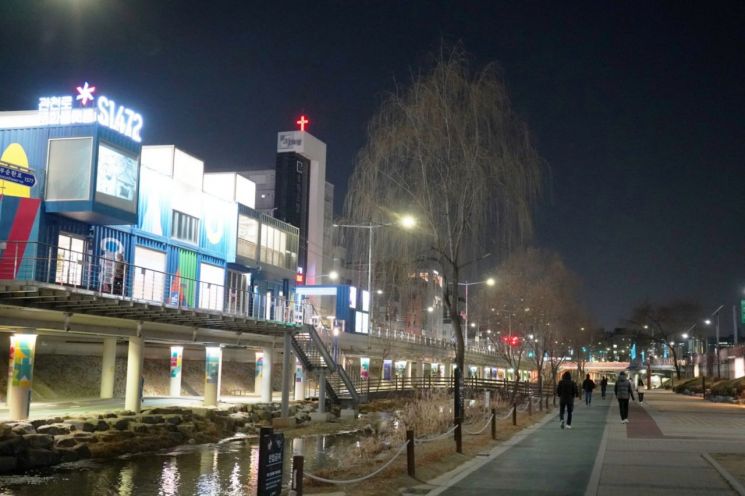
Sillim Station is full of sights and activities. The cultural platform S1472 (photo), which opened in November last year, is playing a vital role as a resident-centered complex cultural space. Along with various performances, exhibitions, and cultural arts programs, it serves as a hub for local artists’ activities and is becoming a representative landmark of Gwanak-gu.
Centered around the Sillim Sundae Town, the Seowon-dong shopping district, Sinwon Market, and Gwanak General Market area are undergoing the Byeolbit Sinsari Commercial District Renaissance Project. This large-scale project, jointly conducted by the district and the Seoul Credit Guarantee Foundation, is in its third year and aims to revitalize the local commercial district through various events such as the Byeolbit Festival and one-day classes, as well as facility improvements, transforming the Sillim Station area into a representative commercial district of Seoul.
Mayor Park Jun-hee said, “We will thoroughly prepare so that the opening of the Sillim Line light rail not only improves residents’ transportation convenience but also creates synergy effects with local resources.” He added, “We will continue to make efforts for regional development through station area development, commercial district revitalization, and improving conditions for venture company settlement.”
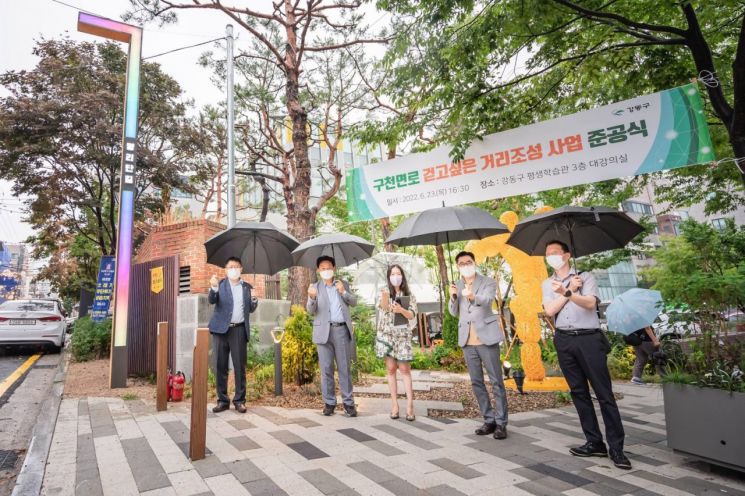
Gangdong-gu (Mayor Lee Jung-hoon) completed the ‘Gucheonmyeon-ro Walkable Street Creation’ project, a Gangdong-style village regeneration initiative carried out over 33 months, and held a completion ceremony on the 23rd.
The ‘Gucheonmyeon-ro Walkable Street Creation’ project was a key initiative by Gangdong-gu to bridge the widening gap between the new town and old town areas, which had deepened due to successive large-scale redevelopment and reconstruction projects.
The district devised multifaceted plans to revitalize the old town for balanced regional development. In particular, it focused on the Gucheonmyeon-ro area, which runs through the old town.
Gucheonmyeon-ro, extending from Gwangjin Bridge, has historically served as a central road in Gangdong-gu for a long time. However, over time, the commercial district declined, and the area became dark and gloomy, inhabited mostly by vulnerable groups. In response, the district planned to transform this historically and symbolically significant area into a successful urban regeneration model to be expanded throughout the old town, starting the project in September 2019.
In May last year, six cultural and community activity hubs opened first. These included local brand stores, shared kitchens, workshops, and book caf? libraries, providing communal spaces for residents’ cultural and leisure activities.
In November last year, the nation’s first municipally operated ‘Gangdong Children’s Restaurant’ opened. It offers quality dinner meals at 2,500 KRW to children aged 6 to 15 who eat alone, also serving as a care facility, receiving great support from local residents.
Large-scale SOC facilities tailored to local characteristics were also established. The ‘Cheonho Aurem Center,’ equipped with the ‘Cheonho Health Branch’ and ‘Single-Person Household Support Center,’ provides customized services, greatly supporting residents of Cheonho-dong who had difficulty accessing living infrastructure facilities.
Narrow two-lane roads and old buildings were renovated. The exteriors of aging buildings were improved, and indiscriminate commercial signs were replaced with LED signs harmonizing with the street. Additionally, utility poles were buried underground, and long-neglected sidewalks and roads were thoroughly refurbished.
For the first time in Gangdong-gu, smart poles combining advanced ICT were installed on the once-dark streets, providing a bright and safe walking environment with free Wi-Fi, wireless charging, and other advanced technologies.
Furthermore, symbolic sculptures representing local characteristics were installed at the entrance of Gucheonmyeon-ro, and green spaces such as street forests were created in idle spaces, producing a walkable street atmosphere.
Mayor Lee Jung-hoon said, “The Gucheonmyeon-ro Walkable Street Creation project was achieved through active participation and cooperation of local residents.” He expressed sincere gratitude to all residents who participated and cooperated during the long construction period.
He added, “I hope many residents visit Gucheonmyeon-ro, a walkable street full of various sights and activities, and create happy memories.”
Dongjak-gu (Mayor Lee Chang-woo) announced on the 24th that it will install a space for enjoying physical activities through virtual reality at Chung-Ang University Elementary School Affiliated to the College of Education (hereafter Chungdae Elementary) located in Heukseok-dong.
This project was selected last month through a public contest hosted by the Ministry of Culture, Sports and Tourism and the Korea Sports Promotion Foundation for the ‘Virtual Reality Sports Room Distribution Project.’
The purpose is to create a virtual reality sports space inside the school where students can enjoy physical activities regardless of weather conditions such as fine dust or heat waves, presenting engaging content to expand opportunities for active physical participation among youth.
Priority support was decided for schools without indoor gyms, those located on main roads where outdoor physical education classes are difficult due to fine dust, or areas near Noryangjin Goshi Village with weak infrastructure for physical activity experiences.
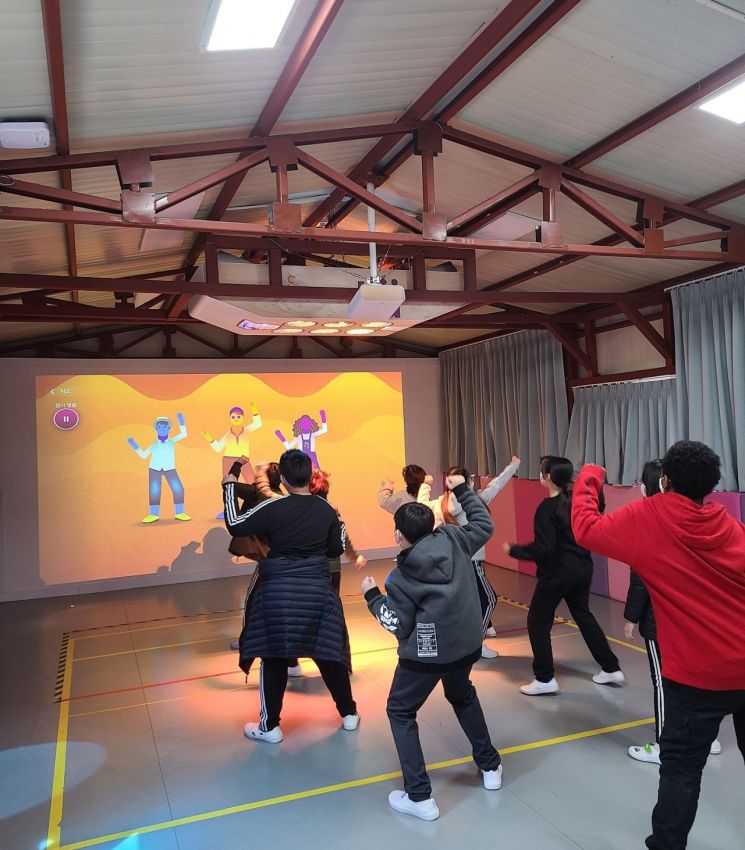
Starting with Dongjak Elementary School in 2018, a virtual reality sports space was set up this month in the physical education classroom of Noryangjin Elementary School. This year, Chungdae Elementary was selected through the contest and is scheduled to complete installation by June next year.
In the virtual reality (VR) sports space, special sensor technology allows students to engage in physical activities indoors, such as kicking or throwing balls at virtual targets on a screen.
Additionally, an integrated platform service equipped with various educational, sports, and convergence content, inter-school competition modes, and customized curriculum functions will be provided.
It is expected to be used in regular classes, after-school activities, and care programs to stimulate students’ interest in physical education, promote physical activity, improve fitness, and reduce obesity.
Park Tae-han, Director of the Sports and Culture Division, said, “This is a great opportunity to nurture creative future talents and experience a virtual world that communicates with reality.” He added, “We will continue to seek various ways to promote physical activities.”
In the youth creative innovation experience space ‘Daebang Youth Culture House Bunker,’ scheduled to open in August, a space to experience virtual and augmented reality has also been prepared. On the first floor of the Bunker, an ICT Sports Zone will be created featuring ‘MR Ball Sports’ to experience ball games and ‘Smart Climbing’ using touch screens, transforming it into a healing space for youth.
© The Asia Business Daily(www.asiae.co.kr). All rights reserved.
![Clutching a Stolen Dior Bag, Saying "I Hate Being Poor but Real"... The Grotesque Con of a "Human Knockoff" [Slate]](https://cwcontent.asiae.co.kr/asiaresize/183/2026021902243444107_1771435474.jpg)

















