Interview with Cho Sang-jun, CEO of TLI Shareholders' Alliance
Management control battle at the extraordinary general meeting on the 7th of next month
Former CEO Kim Dal-su vs. Shareholders' Alliance vote showdown
"Kim Dal-su's autocratic power created a deficit company"
"We will gain trust from minority shareholders to increase corporate value"
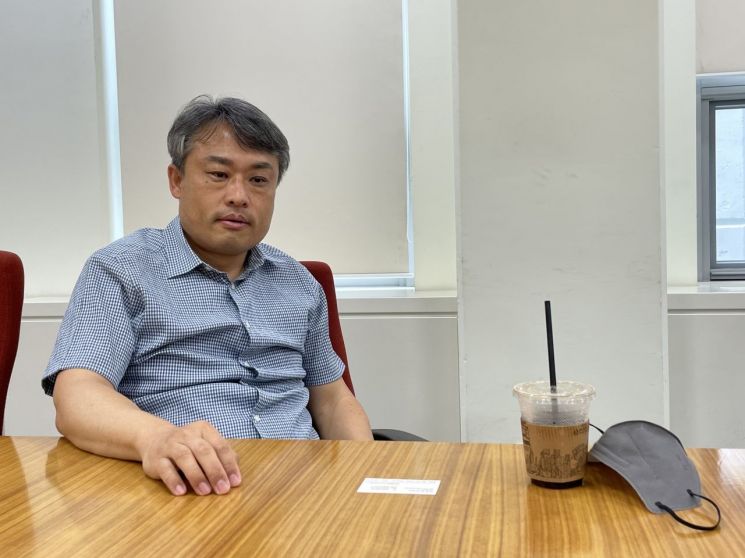 Josangjun, Representative of the Shareholders' Solidarity Association for Turnaround (Vice President of TLI Strategic Planning Office, CEO of Cellames, a cell chip analysis company)
[Asia Economy Reporter Minji Lee] "Doubling growth in 3 years, reinvesting 40% of profits, returning 30% to shareholders, 20% to employees, and 10% to society." This is the 4, 3, 2, 1 vision that TLI presented to shareholders when it went public. Now, carrying the label of a 'loss-making company,' is this a company that satisfies its shareholders and employees?"
Recently, at TLI headquarters in Seongnam-si, Gyeonggi-do, Cho Sang-jun, the representative of the Shareholders' Coalition for Turnaround (hereafter Shareholders' Coalition) (Vice President of TLI Strategic Planning Office, CEO of cell chip analysis company Cellames), spoke to Asia Economy while pointing to a phrase written at the company entrance. Cho said, "The company needs people to work, not people to enjoy benefits. To get the company properly running even now, we must somehow prevent CEO Kim Dalsu's return," emphasizing his point.
TLI is a fabless semiconductor company for displays listed on the KOSDAQ market. Last November, Cho declared his intention to participate in management as a minority shareholder. At that time, he chose 'cooperation' rather than 'conflict' with CEO Kim, who was the largest shareholder, attracting attention from market insiders. They agreed to jointly lead new business development teams to cultivate new businesses in various fields requiring system semiconductors, such as automobiles, AI (artificial intelligence), and smart factories.
Six months later, their relationship has changed 180 degrees. Cho and Kim are set to face a vote battle over company management rights at the extraordinary general meeting on July 7. Kim was ousted from his position as inside director (CEO) at the regular shareholders' meeting in March after losing the vote battle with the shareholder coalition (1.69 million votes in favor, 2.5 million against) and is now aiming for reappointment at the July extraordinary meeting.
Cho lamented, "I started coming to the company in January this year to push new businesses, but it did not take long to realize that Kim had no will to revive the company." He added, "Once, I proposed a business using semiconductor chips to develop equipment for cell toxicity evaluation, but we couldn't even go through the internal opinion-gathering process. Kim rejected the project because the investment cost was about 600 million KRW, and the new business division was thoroughly ignored within the company."
Cho claims that Kim's autocratic management style is the biggest problem. He said, "Kim was more focused on satisfying personal desires by using company capital to build a concert hall in the company building and the Jeju training center 'Dio-reum' rather than managing the stock price," evaluating him as "someone with little interest in stock price management."
Looking at TLI's performance trends, revenue has halved from 67.2 billion KRW in 2017 to 30.8 billion KRW last year. Operating profit has been in deficit every year except 2019. Market capitalization is only 60 billion KRW. The company's main products are Timing Controllers (Tcon), the core ICs for LCD panels, and LCD driver IC design technology. Sales of main products have shrunk annually due to reduced orders from a major client, the large corporation 'L Company.' Tcon sales, which account for the largest share, recorded 17.4 billion KRW last year, a 62% drop compared to 45.9 billion KRW in 2017. Even the micro LED business, which was promoted as a new business, has failed to generate significant profits due to competition. Cho explained, "Many engineers who were devoted to R&D have left the company in disappointment, and the number of employees has dropped from 146 in 2017 to 64 now. If this situation continues, the company will inevitably record losses this year and next."
Currently, the shareholding difference between Kim and the shareholder coalition is 0.43 percentage points. Since Kim was removed from the inside director position, he has steadily accumulated shares and now holds 15.8%, while the shareholder coalition holds 15.37%. Because the difference is small, the votes of minority shareholders are expected to determine the outcome of this extraordinary general meeting. Accordingly, both sides have publicly encouraged minority shareholders to exercise proxy voting rights. To fill two vacant board seats, candidates Kim Dalsu, Park Woo-jin, Ko Young-sang, and Cho Sang-jun have been proposed. Cho said, "This vote battle will be a turning point for the company's survival," adding, "If we gain shareholders' trust, we will increase the company's value through measures such as selling the Jeju training center, golf memberships, selling the company building, and expanding design service orders."
In response, Kim said, "I lost my director position in March while the company was growing from the start until now," and added, "I want to return to my position and lead the company to normalization and profitability for further development."
© The Asia Business Daily(www.asiae.co.kr). All rights reserved.
![Clutching a Stolen Dior Bag, Saying "I Hate Being Poor but Real"... The Grotesque Con of a "Human Knockoff" [Slate]](https://cwcontent.asiae.co.kr/asiaresize/183/2026021902243444107_1771435474.jpg)















