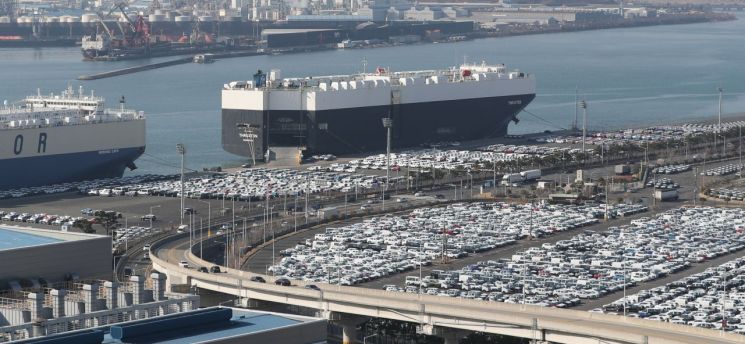
 Finished vehicles waiting in the storage yard next to the export shipment dock at Hyundai Motor Company's Ulsan plant
 [Asia Economy Reporter Choi Dae-yeol] The soaring won-dollar exchange rate has a positive impact on the profitability of automobile and parts companies, which are representative export industries, but the rapid volatility raises more concerns than expectations. On the surface, there is a benefit from exchange gains due to finished product exports, but the possibility of consumption slowdown in major markets due to exchange rate fluctuations is increasing, and in the mid-to-long term, the cost of purchasing raw materials is rising. Additionally, the Japanese yen, which is in direct competition with us in the global market, has depreciated more than the won, putting it at a disadvantage in price competition.
According to the Korea International Trade Association on the 23rd, last year, South Korea's automobile and parts exports amounted to 68.4 billion dollars. Simply put, if the won-dollar exchange rate rises by 1 won (won depreciation), it can be seen as earning an additional 68.4 billion won. In the case of Hyundai Motor Company, if the won-dollar exchange rate rises by 5% in the first quarter of this year, about 70 billion won, and for Kia, which has a large export ratio, about 120 billion won, are estimated to affect profitability (pre-tax net income).
Hyundai Motor and Kia, which account for a significant portion of domestic finished car exports, initially planned their business with the won-dollar exchange rate at around 1,130 won this year. It is known that about half of their foreign currency transactions are in dollars. Despite a decrease in sales volume in the first quarter, profitability improved significantly thanks to the exchange rate.

However, the depreciation of the won is not an unconditionally positive condition as it is now. The fact that uncontrollable external variables go beyond the predictable range is the greatest risk factor in corporate management.
Song Seon-jae, an analyst at Hana Financial Investment, explained, "It is true that the depreciation of the won helps the profitability of export companies, but the recent situation is offset by exchange rate fluctuations in other regions such as emerging countries," adding, "Consumption sentiment is slowing down in each market, and the exchange rate is intertwined with many factors in a complex way, so it is not easy to make a definitive evaluation."
Due to the depreciation of the won, the cost burden of major raw materials such as iron ore, aluminum, and copper is also increasing. A representative from the finished car industry said, "There will be some time lag before raw material prices are reflected in finished product prices, but the cost burden has already been increasing since last year," adding, "Considering the exchange rate impact, it is not possible to rule out the possibility of further increases in production costs."
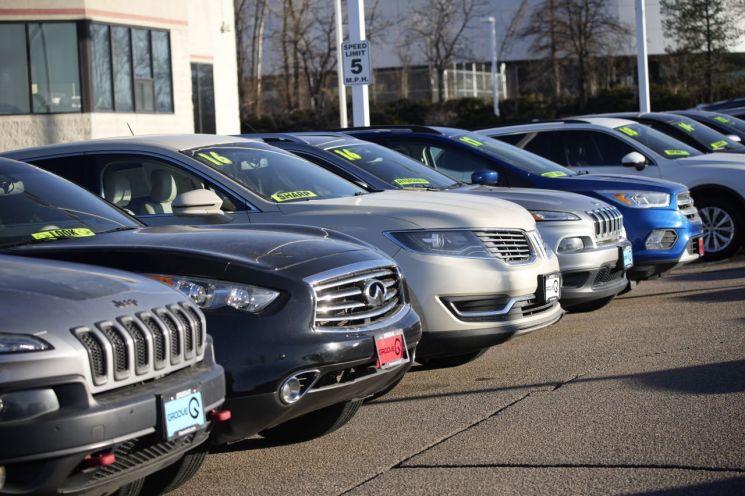
Although the trend has somewhat changed recently, Japan's maintenance of a weak yen policy is also unfavorable for our automobile companies. For now, supply-side dominance continues in the global finished car market due to production disruptions caused by parts supply issues affecting all markets, but if the market normalizes by the end of this year or next year, price competition among major makers is likely to intensify.
In major advanced markets such as the United States and Europe, Korean and Japanese cars are in direct competition, so this exchange rate risk is expected to be an important variable. A Hyundai Motor official said, "The depreciation of the Japanese yen is greater than ours, so price competition in overseas markets is somewhat burdensome."
© The Asia Business Daily(www.asiae.co.kr). All rights reserved.
![Clutching a Stolen Dior Bag, Saying "I Hate Being Poor but Real"... The Grotesque Con of a "Human Knockoff" [Slate]](https://cwcontent.asiae.co.kr/asiaresize/183/2026021902243444107_1771435474.jpg)

















