Improving Rigid 52-Hour Workweek... Promoting Labor Reform
Increasing Flexibility with 40-Hour and 60-Hour Weeks
Wage System Shift from 'Seniority-Based to Job Performance Pay'
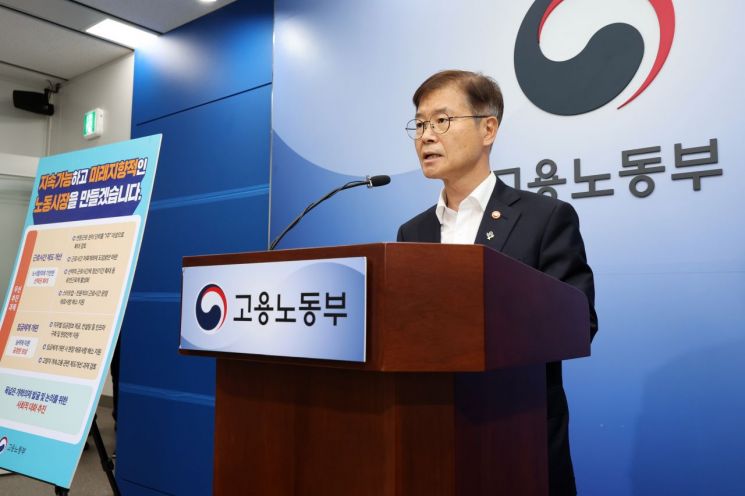 Minister of Employment and Labor Lee Jeong-sik is briefing on the direction of labor market reform promotion at the Government Complex Sejong on the morning of the 23rd.
 [Photo by Yonhap News]
The Yoon Suk-yeol administration is set to actively promote the reform of the 'working hours and wage system' based on labor market flexibility. The government plans to prepare legislative tasks by October and submit a bill to the National Assembly as early as the second half of the year. Priority will be given to managing extended working hours on a 'monthly basis' to ease the rigid 52-hour workweek system and changing the seniority-based corporate wage system to a job- and performance-based system.
On the 23rd, Lee Jeong-sik, Minister of Employment and Labor, announced this plan at the Government Complex Sejong while presenting the 'Labor Market Reform Promotion Direction.' Minister Lee emphasized, "Laws, systems, and unreasonable practices that fail to reflect the rapidly changing labor environment hinder the growth and innovation of our economy and society," adding, "We will pursue 'uninterrupted reform' based on national consensus."
The government's priority tasks for labor reform announced that day are working hours and the wage system. These two factors have the greatest impact on citizens' lives and corporate productivity and have been maintained in a rigid form for decades, acting as obstacles to economic vitality.
First, the government decided to reform the 52-hour workweek system introduced in February 2018 during the Moon Jae-in administration. The current Labor Standards Act stipulates working hours as 40 hours per week and allows up to 12 hours of overtime per week. Currently, since overtime is managed on a weekly basis, companies are bound by the 52-hour weekly limit, but the government plans to allow management on a 'monthly basis.' In this case, some weeks may have 40 hours, others 60 hours, as long as the average is 52 hours per week, providing relief to companies.
This is a review to enhance the practical applicability of the basic system maintained for 70 years since the Labor Standards Act was enacted in 1953, and it will apply to all occupations and tasks.
Additionally, the government will expand the unit period of the flexible working hours system, which allows workers to set their commuting times freely while keeping average working hours within 52 hours per week, from the current 1-3 months. It will also introduce a 'working hours savings account system' to strengthen workers' right to rest. This system allows workers to save overtime hours during busy periods and use them as leave during less busy times.
The core of the wage system reform is changing the seniority-based system to a job- and performance-based pay system. The current seniority-based wage system was suitable during the high-growth era but in the era of low growth and aging, it reduces productivity and lowers the motivation of younger workers. To encourage private companies to reform their wage systems, the government plans to build a 'Korean-style job-based wage information system' and expand consulting services.
To prepare legislative and policy tasks for labor reform, the government will form a 'Future Labor Market Research Group' composed of experts by next month. After conducting surveys and gathering public opinions by October, the government plans to proceed with legal amendments as soon as possible.
© The Asia Business Daily(www.asiae.co.kr). All rights reserved.
![Clutching a Stolen Dior Bag, Saying "I Hate Being Poor but Real"... The Grotesque Con of a "Human Knockoff" [Slate]](https://cwcontent.asiae.co.kr/asiaresize/183/2026021902243444107_1771435474.jpg)
















