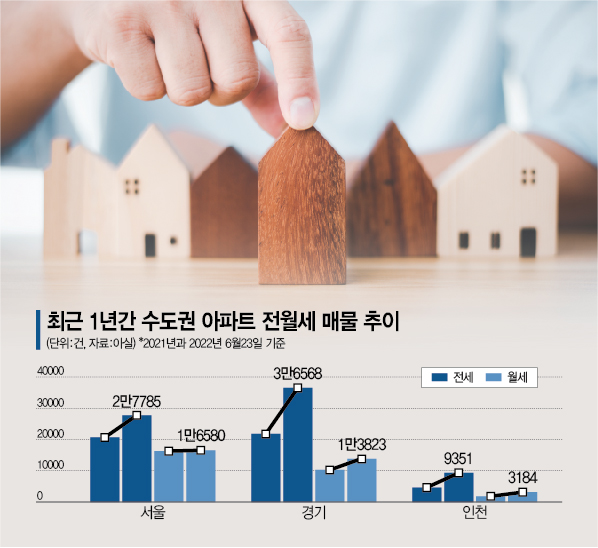
Since the beginning of the year, there have been concerns about a potential "August Jeonse and Monthly Rent Crisis" in the real estate market, but as of mid-June, the rental market has shown no significant signs of turmoil. On the contrary, buying sentiment has weakened, halting the price increase trend, and the number of Jeonse and monthly rental listings in the metropolitan area is hitting record highs daily.
According to real estate big data company Asil on the 23rd, the number of Jeonse and monthly rental listings for apartments in Seoul stood at 27,785 and 16,580 respectively, totaling 44,365 listings. This represents a 19.82% increase (7,341 listings in total) compared to the same day last year (Jeonse 20,693; monthly rent 16,331). Gyeonggi and Incheon show similar patterns. Jeonse listings in Gyeonggi surged 67.58% from 21,821 on June 23 last year to 36,568 this year, while monthly rent listings increased by 34.37% from 10,287 to 13,823. In Incheon, Jeonse listings rose 101.74% from 4,635 to 9,351, and monthly rent listings increased 71.82% from 1,853 to 3,184.
Initially, the market strongly anticipated a new phase in the rental market ahead of August this year, marking two years since the implementation of the Rental Protection Act (contract renewal request right and Jeonse/monthly rent cap). There were concerns that landlords, facing new Jeonse listings after exhausting contract renewal rights, might raise deposits and monthly rents all at once, destabilizing the market again. Considering that listings must appear at least 2-3 months before contract expiration, the market trends in June were seen as a gauge for predicting the situation after August.
However, with the increase in listings and an unprecedented transaction freeze, some argue that the "August crisis" might be an overblown concern. In Seoul, apartment Jeonse prices consistently declined from February to April this year and have since remained flat or fallen for seven consecutive weeks until last week. The Jeonse supply-demand index has stayed below 100 for over six months since December last year, indicating that supply exceeds demand. At the real estate ministerial meeting on the 21st, the government analyzed the rental market trend, stating, "Since the second half of last year, due to interest rate hikes and accumulated listings, the Jeonse market has been steadily stabilizing downward since the beginning of the year." Lee Eun-hyung, a research fellow at the Korea Construction Policy Institute, said, "Cases where contract renewal rights expire are not concentrated only in August but have been spread out over two years since the Rental Protection Act was implemented," adding, "The feared August Jeonse crisis will not occur."
Moreover, with the government introducing measures on June 21 to relax the owner-occupancy requirements and other private Jeonse and monthly rent supply plans, the number of rental listings is likely to increase further. Lim Byung-chul, senior research fellow at Real Estate R114, also said, "Considering the market situation such as the increase in listings and the dispersion of contract renewal timings, the possibility of rental market turmoil at the level of a 'crisis' is low."
© The Asia Business Daily(www.asiae.co.kr). All rights reserved.
![Clutching a Stolen Dior Bag, Saying "I Hate Being Poor but Real"... The Grotesque Con of a "Human Knockoff" [Slate]](https://cwcontent.asiae.co.kr/asiaresize/183/2026021902243444107_1771435474.jpg)















