[Measured by MB Price Index]
2%P Higher Than Government Statistics... Kerosene Price Rises Most at 60.8%
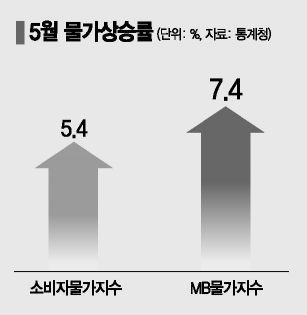
[Asia Economy Sejong=Reporter Kwon Haeyoung] The consumer price inflation rate for essential daily necessities closely related to the lives of ordinary people was found to have already exceeded 7% last month. This figure surpasses the government's official consumer price inflation rate of 5.4% by 2 percentage points, indicating that the inflation rate felt directly by the public is rising much more steeply.
According to an analysis of data from Statistics Korea on the 23rd, the consumer prices of major daily necessities and services that make up the 'MB Price Index,' which was intensively managed by the Lee Myung-bak administration in 2008 to stabilize prices for ordinary people, rose by 7.4% last month compared to a year ago. ▶Related article on page 4
The MB Price Index refers to the average price increase rate of 52 items selected by the Lee Myung-bak administration as targets for price management for ordinary people. It consists of items such as pork, mackerel, napa cabbage, green onions, flour, electricity charges, and subway and city bus fares. These items are mainly consumed by the bottom 40% income group and have a high price sensitivity, making the index a gauge of price trends for ordinary people.
Looking at individual items, fuel prices rose sharply. Kerosene increased the most at 60.8%, followed by diesel (45.8%) and gasoline (27.0%). Liquefied petroleum gas (LPG, 26.1%) also rose significantly, highlighting the rise in energy prices.
The fact that the inflation rate for ordinary people's prices is 2 percentage points higher than the government's average inflation rate (5.4%) means that the pain felt by ordinary and vulnerable groups is much greater. The consumer price inflation rate, which was 4.1% in March and 5.4% in May, is expected to exceed 6% soon, but the prices for ordinary people analyzed by the MB Price Index greatly exceed this, with the possibility of approaching 10% within the year.
Professor Sung Tae-yoon of Yonsei University's Department of Economics said, "During periods of inflation, people tend to reduce spending on everything except essential daily necessities, so the average inflation rate covering all items tends to appear relatively low," adding, "Since the inflation rate centered on daily necessities is much higher, the government should consider support for ordinary people, especially vulnerable groups."
© The Asia Business Daily(www.asiae.co.kr). All rights reserved.
![Clutching a Stolen Dior Bag, Saying "I Hate Being Poor but Real"... The Grotesque Con of a "Human Knockoff" [Slate]](https://cwcontent.asiae.co.kr/asiaresize/183/2026021902243444107_1771435474.jpg)
















