Agreement Reached After 2 Weeks of Debate... Individual Country Negotiations Begin
Gradual Phase-Out of Free Carbon Emission Allowance System
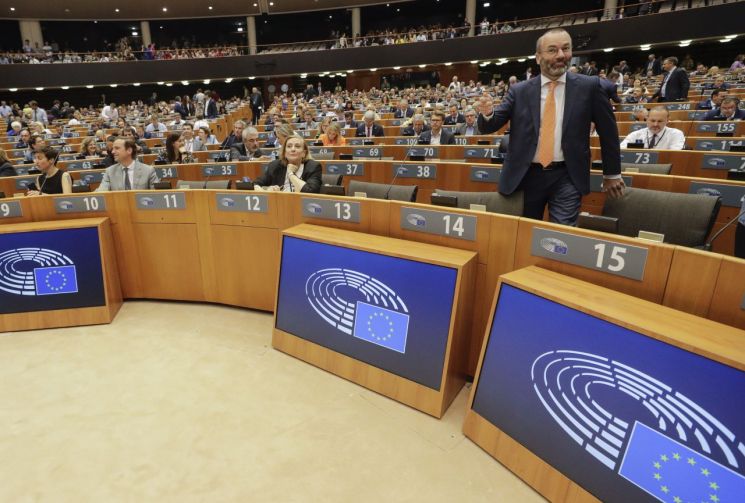
[Asia Economy Reporter Hyunwoo Lee] The European Parliament, the main decision-making body of the European Union (EU), has reached a final agreement on the Carbon Market Reform Bill. With the agreement on the previously contentious issues of abolishing the free allocation system for carbon emission allowances and implementing the Carbon Border Adjustment Mechanism (CBAM), also known as the carbon border tax, the EU's carbon neutrality policy is expected to be further strengthened. Export companies in sectors such as steel and automobiles worldwide are anticipated to carefully consider future countermeasures.
According to CNBC on the 22nd (local time), the European Parliament announced that after two weeks of debate, the Carbon Market Reform Bill was finally agreed upon. As a result of this agreement, the previously major contentious issues?the abolition of the free allocation system for carbon emission allowances and the implementation year of CBAM?were set for 2032. Following the failure to reach an agreement on the 8th, the bill, which had been struggling to find a compromise, was passed, and negotiations among individual member states are expected to begin going forward.
The free allocation system for carbon emission allowances was a measure to protect EU member state companies whose competitiveness had declined compared to imported products from countries with weaker regulations, in accordance with the EU's environmental regulations. Even within EU member states, there has been ongoing debate over the year to abolish this system. The European Commission initially advocated for abolition by 2030, but repeated failures to reach consensus due to opposition from certain countries led to a prolonged tug-of-war.
According to the current agreement, the free allocation system for carbon emission allowances will be abolished in 2032, and instead, CBAM, which functions as an additional tariff on products from countries with weaker regulations, will be implemented starting in 2032. In particular, manufacturers in the steel, automobile, and chemical sectors are expected to face challenges in preparing countermeasures.
Regarding another controversial issue?the carbon emission regulation on heating fuels?it was decided that the regulation will apply only to companies. It was agreed in principle to exempt heating fuels used in ordinary households.
© The Asia Business Daily(www.asiae.co.kr). All rights reserved.
![Clutching a Stolen Dior Bag, Saying "I Hate Being Poor but Real"... The Grotesque Con of a "Human Knockoff" [Slate]](https://cwcontent.asiae.co.kr/asiaresize/183/2026021902243444107_1771435474.jpg)
















