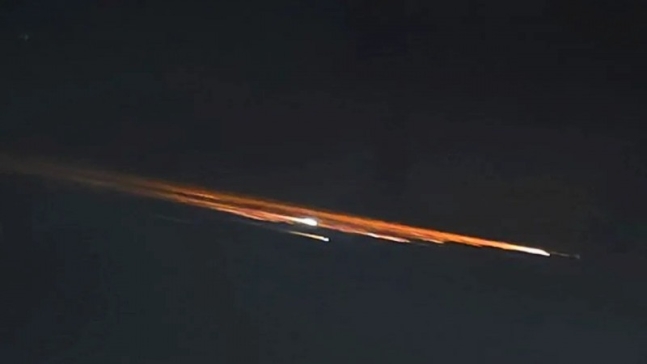
 On the 21st (local time), rocket debris was seen falling over the skies of Spain and Morocco. / Photo by Online Community Capture
[Asia Economy Reporter Na Ye-eun] Rocket debris entering the atmosphere was captured over the skies of Spain and Morocco. Local residents speculated it to be a 'UFO' or a 'meteor shower.'
According to Morocco World News and others on the 21st (local time), from around 12:30 AM, fireballs with long tails falling to the ground were observed over Morocco and Spain.
The unidentified fireballs passed over the Atlantic Ocean, flying over northern Morocco and the Mediterranean Sea, passing about 10 km from Almeria in southern Spain.
Witnesses thought it was a meteor shower, but Spain's astrophysics research institute stated that the fireballs were caused by Chinese rocket debris entering the atmosphere.
Jos? Mar?a Madiedo, an astronomer at the Andalusia Astrophysics Institute in Spain, explained, "The 'fireballs' observed over Spain are fragments of the Long March 2F rocket, launched for China's space station 'Tiangong,' re-entering the atmosphere."
He added, "The fireballs from the rocket debris burned up about 100 km off the coast of Murcia, Spain."
Earlier, on the 5th, China launched Shenzhou 14 carrying three astronauts aboard the Long March 2F and Yao-14 rockets.
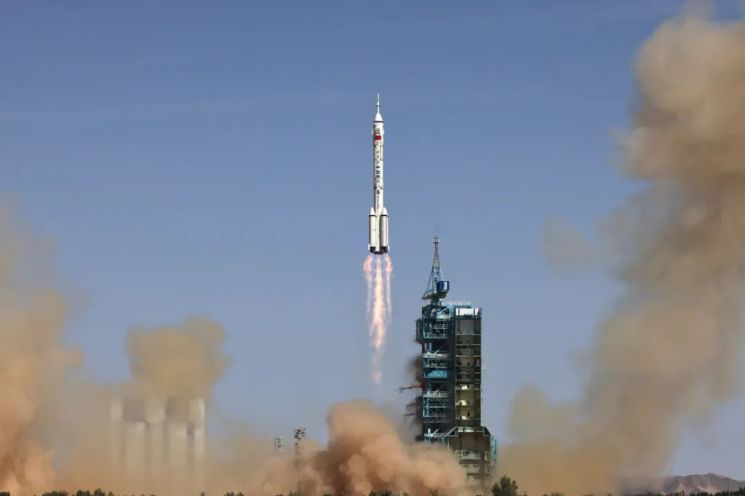
This is not the first case of rocket debris launched by China falling to the ground.
Jonathan McDowell, a researcher at the Harvard-Smithsonian Center for Astrophysics, said in February last year, "Debris from the Long March 5B rocket, with a payload capacity of 22 tons, could fall to Earth within days." The Long March 5B was the rocket that carried the core module Tianhe of the space station into orbit at that time.
Also, in April 2018, China's Tiangong 1 fell to Earth. Although there was no significant damage then, the potential crash zone covered a very wide area including the Pacific Ocean, Indian Ocean, Atlantic Ocean, South America, Australia, Africa, and Korea.
Experts explain that while much of the rocket debris is likely to burn up in the atmosphere or fall into the sea, some fragments could penetrate the atmosphere and fall into residential areas or city centers. However, the probability of a person being hit by space debris is extremely low, about one in several trillion.
© The Asia Business Daily(www.asiae.co.kr). All rights reserved.
![Clutching a Stolen Dior Bag, Saying "I Hate Being Poor but Real"... The Grotesque Con of a "Human Knockoff" [Slate]](https://cwcontent.asiae.co.kr/asiaresize/183/2026021902243444107_1771435474.jpg)
















