Health Authorities Raise Infectious Disease Alert Level from 'Interest' to 'Caution'
Passengers in Adjacent Seats on Same Flight as Confirmed Case Subject to 'Active Monitoring'
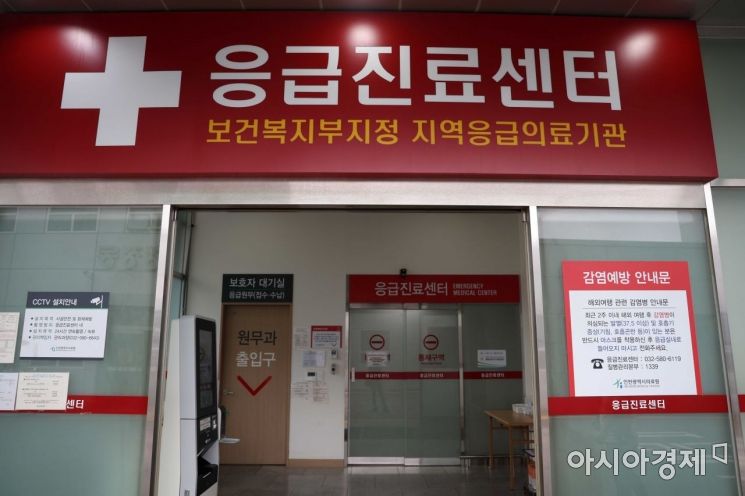 The first suspected case of monkeypox has appeared in the country, and health authorities are conducting diagnostic tests. The suspected infected individual, Mr. A, was transferred to an isolation ward at Incheon Medical Center at around 9:40 PM on the 21st. Monkeypox is a virus endemic to the African region, but since the first reported case in the UK on the 7th of last month, it has been rapidly spreading worldwide. The photo shows Incheon Medical Center on the 22nd. Photo by Moon Honam munonam@
[Asia Economy Reporter Jo In-kyung] Amid the global surge in confirmed Monkeypox cases, the first domestic confirmed case has been identified as a Korean national in their 30s who entered the country from Germany. In response to the confirmed case, health authorities have raised the infectious disease crisis level to 'Caution' and decided to strengthen quarantine measures.
On the afternoon of the 22nd, Baek Kyung-ran, Commissioner of the Korea Disease Control and Prevention Agency (KDCA), stated in a briefing, "On the 21st, a Korean national, Mr. A, who returned through Incheon Airport and showed suspicious symptoms, was tested using polymerase chain reaction (PCR) and genetic sequencing analysis, confirming the diagnosis."
Mr. A arrived at Incheon Airport from Germany around 4 p.m. on the 21st. Starting the day before arrival, he experienced headaches and, upon entry, showed mild fever (37.0℃), sore throat, weakness, fatigue, and skin lesions. During the entry process, he voluntarily reported his suspected infection to the KDCA, and was classified as a suspected patient by airport quarantine officials and central epidemiological investigators. Mr. A was transferred to Incheon Medical Center around 9 p.m. on the 21st and is currently receiving treatment in an isolation ward. Lee Sang-won, Head of the Epidemiological Investigation and Analysis Team at the Central Disease Control Headquarters, stated, "Personal information such as gender and age related to confirmed infectious disease patients is not subject to disclosure," adding, "We will only disclose that the patient is in their 30s."
Mr. A, confirmed with Monkeypox, will remain in isolation until the infectiousness is lost and recovery is confirmed, such as through the shedding of scabs from skin lesions. Health authorities plan to quarantine high-risk close contacts of the confirmed patient for up to 21 days depending on vaccination status and exposure level. However, epidemiological investigations found no high-risk contacts related to Mr. A. Passengers seated adjacent to Mr. A on the flight have been classified as medium risk and will be subject to active monitoring.
Another foreign national, Mr. B, who was reported as a suspected case on the same day in Busan, tested negative. Mr. B was ultimately confirmed to have chickenpox, not Monkeypox.
Following the confirmation of the case, health authorities held a crisis assessment meeting on the 22nd to analyze and evaluate the situation, raising the infectious disease crisis level from 'Interest' to 'Caution.' The response team has been elevated to the Central Disease Control Headquarters (led by the KDCA Commissioner), and all cities, provinces, and districts nationwide will establish and operate local disease control teams to activate an emergency quarantine system.
Additionally, health authorities will designate quarantine management areas for the second half of the year concerning Monkeypox and will strengthen overseas import monitoring by tightening fever criteria, especially for countries where Monkeypox is prevalent. Monkeypox vaccination will be made available to those who wish to receive it, considering the risk level of contacts to prevent onset and severe cases after exposure. The introduction of third-generation vaccines is also being expedited.
Currently, 100 doses of available treatments domestically (Cidofovir, Vaccinia Immune Globulin) will be distributed to medical institutions as needed. Additionally, 500 doses of the oral antiviral drug Tecovirimat for Monkeypox treatment are scheduled to be imported next month. Diagnostic testing for suspected cases will be conducted by the KDCA for the time being, but depending on the domestic Monkeypox situation and concerns about spread, testing may be expanded to local governments in the future.
Meanwhile, in accordance with the WHO International Health Regulations (IHR), health authorities have notified the WHO Western Pacific Regional Office and Germany, the country of departure of the confirmed patient, about the occurrence of the Monkeypox case and related measures.
Commissioner Baek emphasized, "Cooperation from the public and medical community is crucial for early detection of Monkeypox and preventing community spread," urging, "Citizens visiting or traveling to countries with Monkeypox outbreaks should follow personal hygiene rules such as handwashing and wearing masks, and consult the KDCA call center (1339) if symptoms develop within 21 days after returning."
© The Asia Business Daily(www.asiae.co.kr). All rights reserved.
![Clutching a Stolen Dior Bag, Saying "I Hate Being Poor but Real"... The Grotesque Con of a "Human Knockoff" [Slate]](https://cwcontent.asiae.co.kr/asiaresize/183/2026021902243444107_1771435474.jpg)















