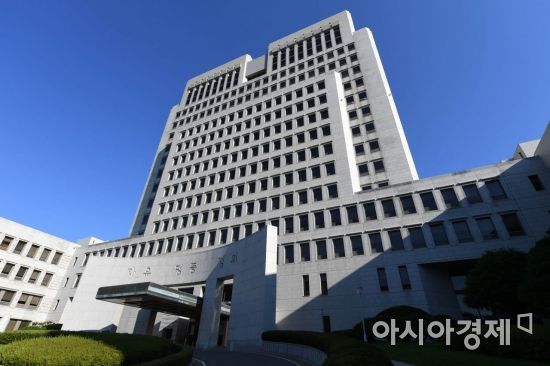
[Asia Economy Reporter Choi Seok-jin, Legal Affairs Specialist] The Supreme Court has ruled that the School Safety Mutual Aid Central Association (Mutual Aid Central Association) cannot claim the full amount of compensation paid under the School Liability Mutual Aid from the perpetrator’s insurance company.
Previously, in 2019, the Supreme Court ruled in a case related to the 'School Safety Mutual Aid,' which all schools nationwide are required to join under the 'Act on the Prevention and Compensation of School Safety Accidents' (School Safety Act), that the Mutual Aid Central Association could claim the full amount of compensation paid under the School Safety Mutual Aid from the perpetrator’s insurance company.
However, the Supreme Court judged that since the legally mandated School Safety Mutual Aid and the School Liability Mutual Aid have different legal characteristics, the compensation paid under the School Liability Mutual Aid can only be claimed against the perpetrator’s insurance company to the extent exceeding the Mutual Aid Central Association’s own burden, according to the 'mutual aid' provisions under the Commercial Act.
The Supreme Court’s First Division (Presiding Justice Oh Kyung-mi) announced on the 22nd that it overturned the lower court’s ruling in favor of the plaintiff in the appeal trial of the subrogation claim lawsuit filed by the Mutual Aid Central Association against DB Insurance and KB Insurance, and remanded the case to the Seoul Central District Court.
The court stated, "The lower court’s judgment that the Mutual Aid Central Association could exercise the direct insurance claim right against the defendants, who are the insured’s liability insurers, on behalf of the victim for the full amount of the compensation in this case, misunderstood the legal principles regarding the School Liability Mutual Aid system and subrogation of the payer."
On the afternoon of November 4, 2015, A, a first-year middle school student at the time, collided with victim B on a sidewalk in Gimpo City, Gyeonggi Province, while moving with 26 students to a park soccer field for a soccer club class, failing to notice B walking from the opposite direction and hitting B’s left shoulder.
Due to the impact of the collision with A, B fell backward and hit his head on the ground, sustaining injuries including traumatic subdural hemorrhage and cerebral infarction that required 20 weeks of treatment. B was hospitalized and treated but ultimately passed away on March 22, 2018.
B’s side filed a lawsuit claiming damages against A’s parents, the two insurance companies A was enrolled in, Gyeonggi Province as the establishment and operation entity of A’s school, and the Mutual Aid Central Association. After B’s side won in the second trial on February 2, 2019, the Mutual Aid Central Association paid 100 million won to B’s bereaved family.
Subsequently, the Mutual Aid Central Association filed a lawsuit to subrogate approximately 666.66 million won and 333.33 million won plus interest from the two insurance companies A was enrolled in, based on the 'insurance premium sharing' provisions in the policy.
The key issue in the trial was whether the legal principle from the Supreme Court ruling that the School Safety Mutual Aid allows subrogation of the full compensation amount from the perpetrator’s insurance company could be applied equally to the School Liability Mutual Aid.
The first and second trials had ruled that the Mutual Aid Central Association could recover the full amount of compensation already paid under the School Liability Mutual Aid from the perpetrator’s insurance company.
The Mutual Aid Central Association argued that as a party with a legitimate interest to repay the victim’s damage compensation debt, it could exercise the victim’s direct insurance claim right under Article 481 of the Civil Act regarding subrogation of the payer, and that the Supreme Court’s legal principle that "the School Safety Mutual Aid Association can directly claim insurance money from the perpetrator’s liability insurer to the extent of compensation paid to the victim" should apply equally to the School Liability Mutual Aid, which is a similar social insurance.
Article 481 of the Civil Act (Statutory Subrogation of the Payer) states that "a person with a legitimate interest in repayment shall naturally subrogate the creditor by repayment."
However, the Supreme Court found it difficult to accept the lower court’s judgment and overturned the second trial ruling that had favored the Mutual Aid Central Association.
The main reason was that the legally mandated School Safety Mutual Aid and the School Liability Mutual Aid, which is a kind of profit-making business, should be regarded as having different legal natures.
The court cited the previous Supreme Court ruling, stating, "The School Safety Mutual Aid is a system established by special law from the perspective of mutual aid and social security," and added, "Because the perpetrator’s liability insurer should not enjoy the benefit of being exempted from their insurance payment obligation due to this social security nature of the compensation, the School Safety Mutual Aid Association can recover the amount equivalent to the compensation paid by exercising the victim’s direct insurance claim right by subrogation after paying the compensation to the insured victim."
The court also referenced a Constitutional Court decision, pointing out, "The plaintiff (Mutual Aid Central Association) is a special corporation established by the Minister of Education to conduct investigations and research for the establishment of school safety accident prevention policies and standards for payment of School Safety Mutual Aid benefits," and "The plaintiff is a separate independent corporation from the School Safety Mutual Aid Association, with different establishment entities and purposes, and is neither a superior nor a supervisory body of the School Safety Mutual Aid Association."
The court further stated, "Unlike the School Safety Mutual Aid, the School Liability Mutual Aid is not a system established and directly regulated by the School Safety Act," and "The Mutual Aid Central Association operates the School Liability Mutual Aid business as a kind of 'profit-making business' based on the School Safety Act and its enforcement decree."
It added, "The content of the compensation is determined by the mutual aid terms prepared by the plaintiff, and unlike the School Safety Mutual Aid which compensates for damages to the insured’s own life or body, it pays compensation for liability for damages that the insured must bear to third parties."
The court pointed out, "Considering that the School Liability Mutual Aid has a different legal nature from the School Safety Mutual Aid, which is directly established and regulated by the School Safety Act, the purpose of related laws, the basis and content of the School Liability Mutual Aid business, the process of concluding mutual aid contracts, and the scope of compensation, the School Liability Mutual Aid should be regarded as 'mutual aid' under Article 664 of the Commercial Act, and the insurance provisions of the Commercial Act should be applied accordingly."
Article 664 of the Commercial Act (Application to Mutual Insurance and Mutual Aid) stipulates that the provisions in Part 4 of the Commercial Act concerning insurance shall apply mutatis mutandis to mutual insurance and mutual aid to the extent that it does not contradict their nature.
In conclusion, the court stated, "Therefore, unlike the School Safety Mutual Aid Association, which can subrogate the beneficiary under the School Safety Act when paying compensation under the School Liability Mutual Aid, the plaintiff cannot exercise the victim’s direct insurance claim right by subrogation against the perpetrator’s liability insurer, and can only exercise subrogation rights to the extent of the liability insurer’s burden when the plaintiff has paid compensation exceeding its own burden in the overlapping insurer relationship with the liability insurer."
Since the Mutual Aid Central Association, which paid compensation under the School Liability Mutual Aid, is in an equal overlapping insurer relationship with the two insurance companies that perpetrator A enrolled in, it means that if it paid more than its originally burdened portion, it can only exercise subrogation rights for the portion borne by the other insurance company.
© The Asia Business Daily(www.asiae.co.kr). All rights reserved.
![Clutching a Stolen Dior Bag, Saying "I Hate Being Poor but Real"... The Grotesque Con of a "Human Knockoff" [Slate]](https://cwcontent.asiae.co.kr/asiaresize/183/2026021902243444107_1771435474.jpg)
















