National Average Gasoline Price 2,116 KRW, Diesel 2,127 KRW... 7 Consecutive Weeks of Increase
"Public Transport Is More Comfortable" Commuters Increasingly Use Public Transit
Credit Card Benefits Lead to 'Fuel Hunting' for Cheaper Gas Even if by a Penny
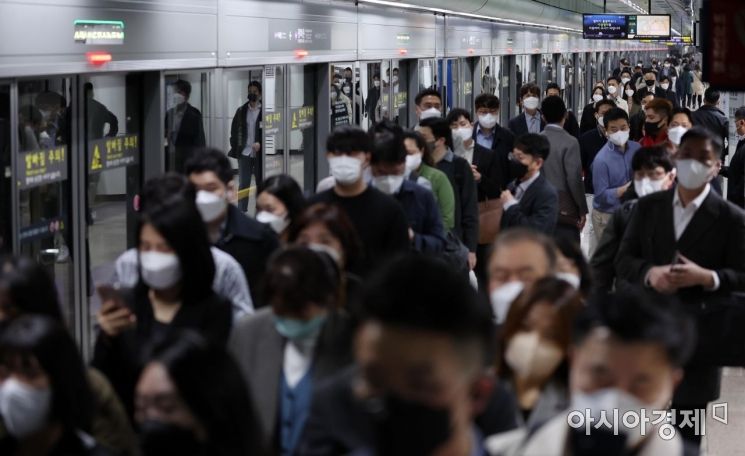 On April 18th, commuters hurried their steps at Gwanghwamun Station of the Seoul subway during the morning rush.
[Asia Economy Reporter Kim Jung-wan] Kim Mo (55), an office worker who used to drive about 50 km round-trip daily from Goyang City, Gyeonggi Province to his workplace in Jongno, Seoul, recently switched to commuting by subway. Although the subway is so crowded that there is barely any space to stand, leaving him drenched in sweat and exhausted, considering the soaring fuel prices that are hard to bear, public transportation is a more comfortable option.
As fuel prices surge, more office workers are giving up commuting by private car and switching to public transportation. Since Russia's invasion of Ukraine, the prices of gasoline and diesel have continued to soar, increasing the economic burden felt by citizens.
According to the Korea National Oil Corporation's oil price information service Opinet on the 25th, the average nationwide gasoline price at gas stations for the fourth week of June (June 19?23) was 2,115.8 KRW per liter, up 34.8 KRW from the previous week. Since May, the fuel tax reduction rate was expanded from the existing 20% to 30%, and although gasoline prices dropped by 44.2 KRW in the first week of May compared to the previous week, prices have risen for seven consecutive weeks since then.
Given this situation, more citizens are turning to public transportation such as subways and buses instead of private cars. According to Seoul Metro, the number of passengers on subway lines 1 to 8 increased from 157.34 million in March, right after Russia's invasion of Ukraine, to 176.61 million in April, and reached 194.68 million last month. The average daily number of passengers also surged 24% from 5.07 million in March to 6.28 million in May over two months.
Those who find it difficult to use public transportation due to circumstances are engaged in a "cheap fuel" search war. On online car-related communities, many are seeking solutions such as finding credit cards that offer point benefits or discounts when paying at gas stations.
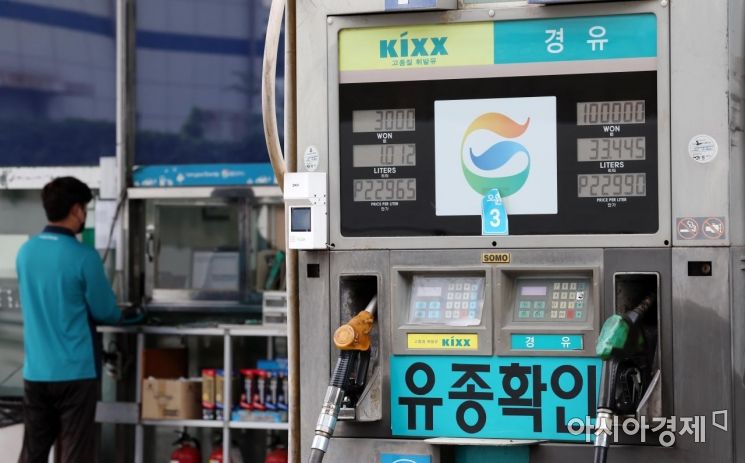 As fuel prices continue to soar day after day, more people are looking for credit cards with benefits or relatively cheaper gas stations as measures to save on fuel costs. The photo shows a gas station in Seoul on the 19th. Photo by XXX
The number of people doing "fuel runs" to relatively cheaper gas stations is also increasing. Lee Mo (49), who lives in Eunpyeong-gu, Seoul, said, "Recently, I have been searching online to find the cheapest gas station nearby and going there," adding, "Fuel prices rise overnight, and if I don't do this, the burden becomes too heavy."
Meanwhile, there are cases where people have decided not to drive their private cars at all except for family outings. Park Mo, a worker in his 40s, said, "Fuel prices have risen so much that I try not to use my car not only for commuting but also for other schedules," emphasizing, "Using public transportation might be a bit tough, but in this era of high inflation, I think we have to adapt like this."
Meanwhile, although the government expanded the fuel tax reduction rate from 20% to 30% starting last month, fuel prices show no signs of falling. Ryu Seong-geol, chairman of the People Power Party's Special Committee on Price and Livelihood Stabilization, announced on the 21st, "Bae Jun-young, a member of the committee, will lead the proposal of an amendment to the Transportation Energy and Environment Tax Act to expand the legal limit of fuel tax reduction from the current 30% to 50%."
Experts diagnose that since international oil prices have risen sharply, if the fuel tax had not been reduced, the price increase would have been even greater. Professor Sung Tae-yoon of Yonsei University's Department of Economics explained, "International oil prices have risen so sharply now that even with the fuel tax cut, prices are not going down," adding, "In reality, if there had been no fuel tax reduction, prices would have risen further." He continued, "If necessary, it is important to respond by reducing the tax burden through additional fuel tax cuts."
© The Asia Business Daily(www.asiae.co.kr). All rights reserved.
![Clutching a Stolen Dior Bag, Saying "I Hate Being Poor but Real"... The Grotesque Con of a "Human Knockoff" [Slate]](https://cwcontent.asiae.co.kr/asiaresize/183/2026021902243444107_1771435474.jpg)
















