President Yoon Orders Strengthening of Quarantine Management
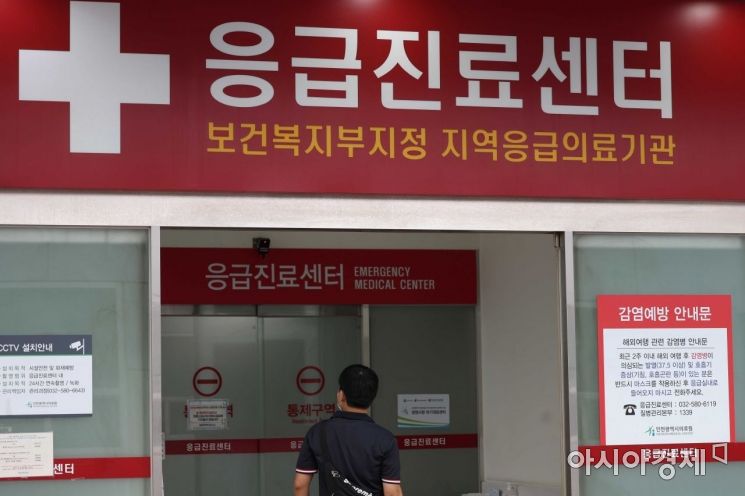 The first suspected case of monkeypox has appeared in the country, and health authorities are conducting diagnostic tests. The suspected infected individual, Mr. A, was transferred to an isolation ward at Incheon Medical Center at around 9:40 PM on the 21st. Monkeypox is a virus endemic to the African region, but since the first reported case in the UK on the 7th of last month, it has been rapidly spreading worldwide. The photo shows Incheon Medical Center on the 22nd. Photo by Mun Honam munonam@
Suspected cases of Monkeypox, a viral disease spreading globally, have been reported for the first time in South Korea. One foreign national who arrived on the 20th and one Korean national who returned on the 21st are currently isolated and receiving treatment at hospitals in Busan and Incheon, respectively. President Yoon Suk-yeol instructed the quarantine authorities to "strengthen quarantine management for overseas arrivals through airports and closely monitor any additional domestic cases."
According to the quarantine authorities on the 22nd, two suspected Monkeypox cases were reported domestically for the first time the previous day, and diagnostic tests are currently underway. The first suspected patient, a foreign national identified as Mr. A, arrived on the 20th by air and began experiencing systemic symptoms including sore throat and lymphadenopathy, along with vesicular skin lesions starting from the 19th. He received medical care on the morning of the 21st at a hospital in Busan (a nationally designated inpatient treatment facility). The hospital reported Mr. A as a suspected Monkeypox case at 4 p.m. that day and transferred him to an isolation ward for treatment.
The other suspected patient, Mr. B, a Korean national, was confirmed to have returned through Incheon Airport around 4 p.m. the previous day. Mr. B began experiencing headaches on the 18th before arrival and showed symptoms such as a mild fever of 37 degrees Celsius, sore throat, weakness, and fatigue upon entry. He self-reported his suspected infection to the Korea Disease Control and Prevention Agency before arrival and was classified as a suspected case by airport quarantine officials and central epidemiologists. Mr. B waited in an airport isolation facility and was transferred to Incheon Medical Center around 9 p.m. that day, where he is currently receiving treatment in an isolation ward.
A presidential office official stated that President Yoon instructed, "If necessary, prepare thoroughly to ensure that currently secured vaccines and treatments can be rapidly distributed to medical sites, and promptly complete the introduction of third-generation vaccines and antiviral drugs for Monkeypox."
Monkeypox is a virus endemic to the African region, but since the first reported case in the UK on May 7, it has rapidly spread to Europe, North America, and other countries worldwide. According to the international statistics site Our World in Data, as of the 20th, confirmed Monkeypox cases were reported in 40 countries, including 574 in the UK, 497 in Spain, 412 in Germany, 297 in Portugal, 183 in France, 177 in Canada, and 113 in the United States, totaling 2,679 cases. The World Health Organization (WHO) plans to convene an emergency committee on the 23rd to assess whether Monkeypox constitutes a "public health emergency of international concern."
Earlier, the Korea Disease Control and Prevention Agency designated Monkeypox as a Class 2 infectious disease, the same level as COVID-19, on the 8th to enable a swift response if it enters the country. Confirmed patients are to be isolated and treated at the National Medical Center. Accordingly, medical institutions must report confirmed cases to the quarantine authorities within 24 hours. The authorities will classify contacts of confirmed cases into low, medium, and high-risk groups based on exposure levels, and only high-risk contacts, such as recent cohabitants, will be quarantined for 21 days.
However, criticism may arise that the quarantine system is not thorough enough, as in the case of suspected patient Mr. A, who showed symptoms but entered the country by air and only sought medical care a day later. The quarantine authorities stated, "We are currently conducting Monkeypox diagnostic tests and epidemiological investigations on the two suspected patients," and added, "We will provide guidance on measures and response plans through a briefing as soon as the test results are available."
© The Asia Business Daily(www.asiae.co.kr). All rights reserved.
![Clutching a Stolen Dior Bag, Saying "I Hate Being Poor but Real"... The Grotesque Con of a "Human Knockoff" [Slate]](https://cwcontent.asiae.co.kr/asiaresize/183/2026021902243444107_1771435474.jpg)
















