33 Billion Yen Inflow into Yen-Linked ETF This Month
"Possibility of Yen Weakness Continuing Through Second Half"
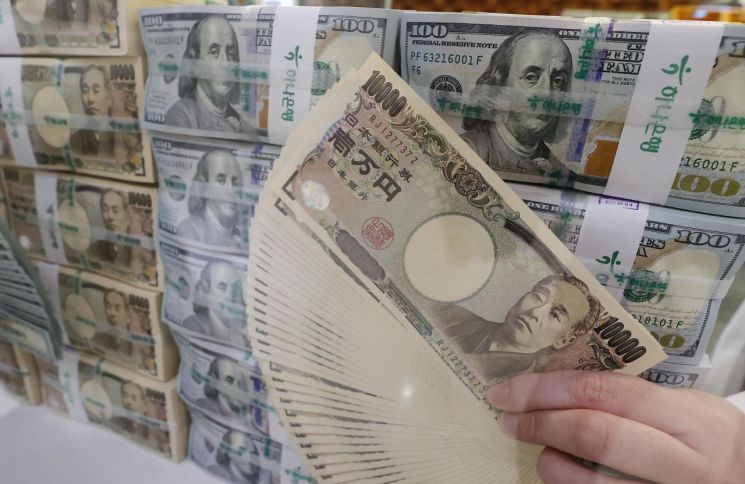
[Asia Economy Reporter Minji Lee] The number of investors seeking to profit from yen investments is increasing. The yen has fallen to levels similar to those during the financial crisis, raising expectations for a rebound.
According to the Korea Exchange on the 22nd, 3.3 billion KRW of individual funds flowed into the "TIGER Japan Yen Futures" ETF (Exchange-Traded Fund) from the 1st of this month until the day before. This is the only domestic ETF linked to the yen's value, generating profits when the yen appreciates. Although trading volume was minimal, ranging from 80 to 2,000 shares in January this year, it has reached up to 115,000 shares this month.
The influx of funds into the ETF is due to many investors believing the yen has fallen as much as it can. Currently, the yen is valued at 136.48 yen per US dollar. This is the lowest level in 24 years and is not much different from the 140 yen per dollar level recorded during the 1998 East Asian financial crisis. The won-yen exchange rate has also recently dropped from the 1,000 won level to around 940 won over the past three months.
The significant depreciation of the Japanese currency is because the Bank of Japan (BOJ) is out of sync with major central banks worldwide in its monetary policy. On the 17th, the BOJ maintained its accommodative monetary policy at the Monetary Policy Meeting, keeping the short-term policy rate at -0.1%. This contrasts with the Bank of Korea's Monetary Policy Committee, which is accelerating rate hikes in line with the US Federal Reserve. With one side rapidly raising rates and the other not, the interest rate differential has caused the yen to weaken sharply.
The Japanese yen is expected to continue its weakness for the time being. This is because the Japanese government is still strongly driving its weak yen policy. Above all, since national growth has stalled, there is a strong intention to lower the yen's value to improve corporate earnings and expand private consumption. In May, Tokyo's core Consumer Price Index (CPI) recorded 1.9%, marking nine consecutive months of increase, but the Japanese government is focusing on economic growth and is tolerating this. Researcher Bowen Choi from Korea Investment & Securities explained, "Since external activities were restricted due to COVID-19 until the end of March, Japan is more interested in support measures for affected companies rather than responding to inflation, so the yen's weak trend will continue for a while."
There are also opinions that the yen's weak trend could continue until the latter half of the second half of the year, so it may be better to wait a little longer for the right investment timing. The securities industry sees the Japanese government's tolerance limit for inflation pressure at around 140 yen per dollar. If this level is exceeded, the government may feel pressured and abruptly change its monetary policy. Researcher Kyuyun Jeon from Hana Financial Investment advised, "Considering the won-yen and dollar-yen exchange rates, the yen is currently cheap, so there is an expectation it could rise later. However, since the weakness may last longer than expected, investing now may not yield significant profits."
© The Asia Business Daily(www.asiae.co.kr). All rights reserved.
![Clutching a Stolen Dior Bag, Saying "I Hate Being Poor but Real"... The Grotesque Con of a "Human Knockoff" [Slate]](https://cwcontent.asiae.co.kr/asiaresize/183/2026021902243444107_1771435474.jpg)















