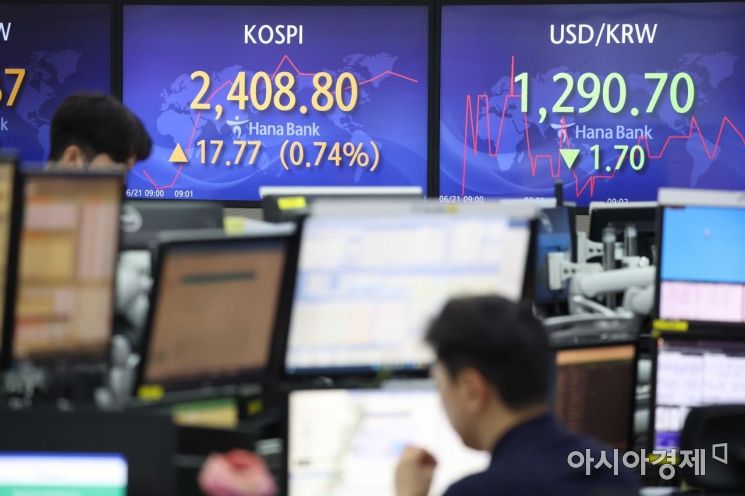
 On the 21st, when the KOSPI index started with a slight rise, dealers were working in the Hana Bank dealing room in Euljiro, Seoul. Photo by Mun Ho-nam munonam@
[Asia Economy Reporter Seo So-jeong] Recently, as volatility in financial markets such as stocks and foreign exchange has increased, the Financial Stress Index (FSI), which indicates instability in the financial system, rose to 8.9 as of March, entering the caution stage (8 or above and below 22), and surged until the 13th of last month. Since this index entered the caution stage during the global financial crisis in 2008 and then shifted to the crisis stage after eight months, analysts say the situation needs to be closely monitored.
According to the Bank of Korea's "2022 First Half Financial Stability Report" released on the 22nd, the FSI, calculated based on real and financial indicators affecting financial stability, recorded 13 as of last month. The FSI is a comprehensive financial stability indicator reflecting stock, foreign exchange, and bond markets, bank delinquency rates, current account balance, credit default swap (CDS) spreads, growth rate, and inflation rate. The FSI is divided into three stages: 0?8 is the stable stage, above 8 is the caution stage, and above 22 is the crisis stage.
The FSI exceeded the risk stage in April 2020 (24.4) but fell to 0 by June last year, then has been rising again since the second half of last year. The index was 6.2 in January this year, rose to 8.9 in March due to increased volatility in financial market price variables, entering the caution stage, and continued to rise to 10.4 in April and 13 in May.
This index entered the caution stage at 9.2 in January 2008 during the global financial crisis, then entered the crisis stage at 27 in September of the same year, and surged to 57.6 in December.
The Financial Vulnerability Index (FVI), which comprehensively reflects financial imbalance situations and financial institutions' resilience, also showed a slight decrease to 52.6 in the first quarter of this year from 54.8 in the fourth quarter of last year, but remained above the long-term average (37.4 since 2007), with household debt accumulation and high housing prices as major vulnerability factors.
The Bank of Korea stated, "Since the second half of last year, external risks have become significantly prominent, increasing volatility in financial markets," adding, "With accumulated household debt and high housing prices as major vulnerabilities in our economy, the possibility that domestic and external risk factors will negatively affect financial stability is increasing."
© The Asia Business Daily(www.asiae.co.kr). All rights reserved.
![Clutching a Stolen Dior Bag, Saying "I Hate Being Poor but Real"... The Grotesque Con of a "Human Knockoff" [Slate]](https://cwcontent.asiae.co.kr/asiaresize/183/2026021902243444107_1771435474.jpg)















