Public Display of Dokseodang Gyehoe-do Purchased at U.S. Auction Last March
Early Joseon Period Dated Work with Few Existing Pieces "Highly Valuable"
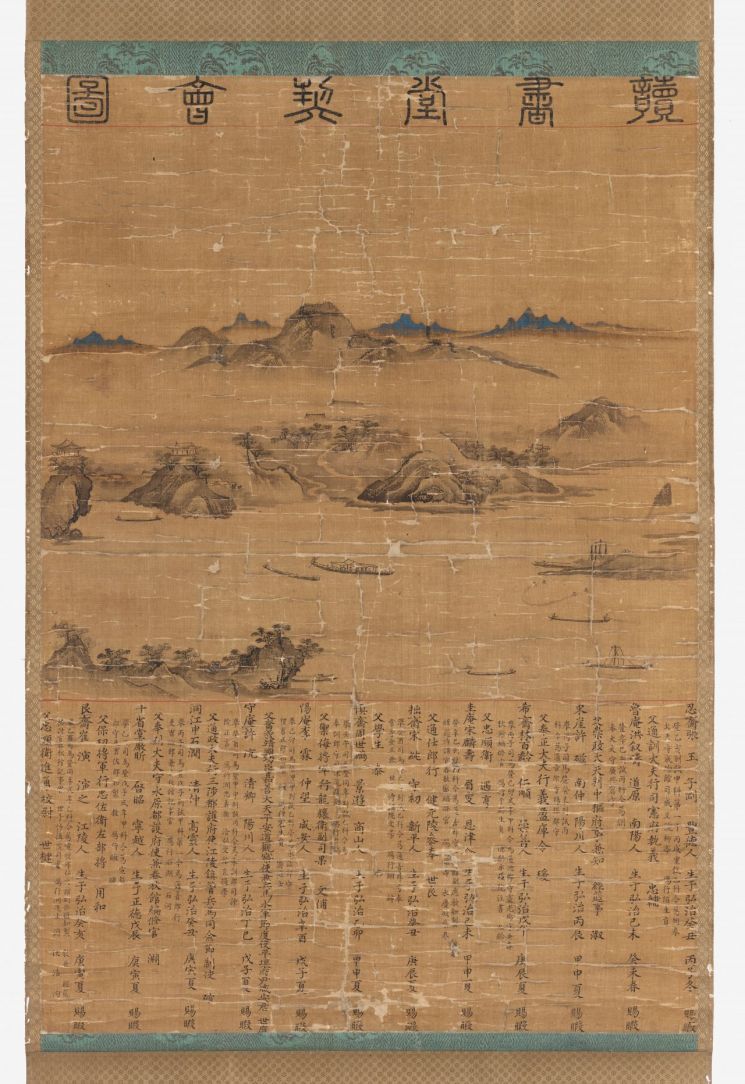
'Doksodang Gyehoe-do (讀書堂契會圖)' is a painting created to commemorate a gathering of officials on sabbatical for study during the reign of King Jungjong of Joseon (1506?1544). Sabaek for study (賜暇讀書) was a system that granted young civil officials leave to devote themselves to scholarship in order to cultivate talent. It was first implemented during King Sejong's reign for the scholars of Jiphyeonjeon. After several openings and closures, it was abolished simultaneously with the establishment of the Kyujanggak.
There are three extant Doksodang Gyehoe-do paintings. One of them returns to Korea after 490 years. On the 22nd, the Cultural Heritage Administration will unveil the Doksodang Gyehoe-do purchased by the Overseas Korean Cultural Heritage Foundation at an auction in the United States last March, at the National Palace Museum of Korea. It is the earliest known example among the gyehoe-do (契會圖; paintings depicting gatherings of officials) rendered in true-view landscape style.
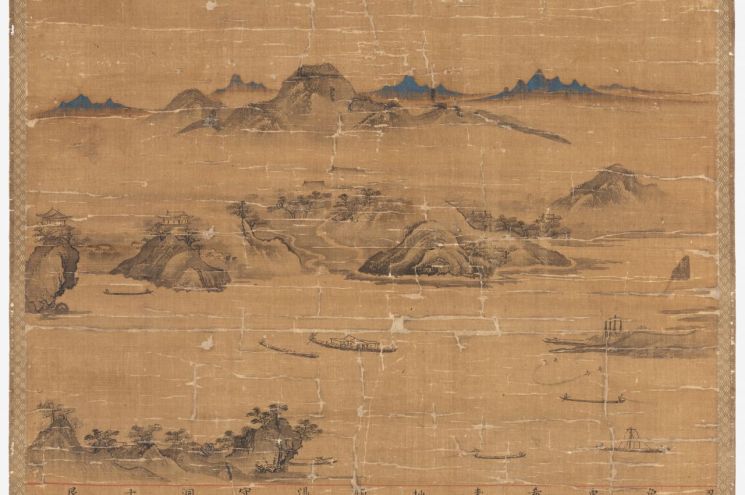
The painting measures 187.2 cm in width and 72.4 cm in height. It is colored with ink on silk. At the top, the title 'Doksodang Gyehoe-do' is inscribed in seal script. The middle section depicts the area around Dumopo (present-day Oksu-dong, Seongdong-gu) along the Han River, centered on the towering Eungbong (Maebongsan). Following the path along the riverside leads to Doksodang (讀書堂), the study hall used as the sabbatical study space, visible only by its roof shrouded in mist. The gathering is portrayed on the Han River, where attendees dressed in official robes enjoy a lively boat outing.
The lower section lists the pen names, names, clans, birth years, sabbatical study periods, years of passing the state examination, ranks, and official positions at the time of the gathering for twelve attendees. All are officials in their 20s to 30s. Among them, Ju Sebung (1495?1554) was a clean and upright official (淸白吏) who founded Baegundong Seowon, the first private Confucian academy. Song Insu (1499?1547) was a master of Neo-Confucianism and author of 'Gyueamjip,' while Song Sun (1493?1582) was an official renowned for his poetry and prose.
A Cultural Heritage Administration official explained, "The officials' ranks provide clues to estimate the painting's production date. According to the 'Jungjong Sillok,' Song Insu and Heo Hang (1497?1537) were appointed to new positions in 1531 and 1532 respectively, and the ranks they held in 1531 are recorded in the painting's colophon." The official added, "Given that this is a rare early Joseon period dated work (紀年作), its value is very high."
The circumstances of the painting's export abroad remain unknown. Until now, the owner was Kanda Kiichiro, a Japanese who served as director of the Kyoto National Museum. After his death, it is said that another owner who acquired it from his heirs put it up for auction.
The returned Doksodang Gyehoe-do will be exhibited to the public through the special exhibition 'The Journey of Cultural Heritage Beyond the Nation' held at the National Palace Museum of Korea's special exhibition hall starting on the 7th of next month. A Cultural Heritage Administration official expressed hope that "it will be widely utilized in future research and exhibitions at the National Palace Museum of Korea."
© The Asia Business Daily(www.asiae.co.kr). All rights reserved.
![Clutching a Stolen Dior Bag, Saying "I Hate Being Poor but Real"... The Grotesque Con of a "Human Knockoff" [Slate]](https://cwcontent.asiae.co.kr/asiaresize/183/2026021902243444107_1771435474.jpg)
















