Samsung Electronics Falls to '50,000 Won'... Retail Investors Panic
Foreign Investors Expected to Accelerate Exit from Domestic Stock Market
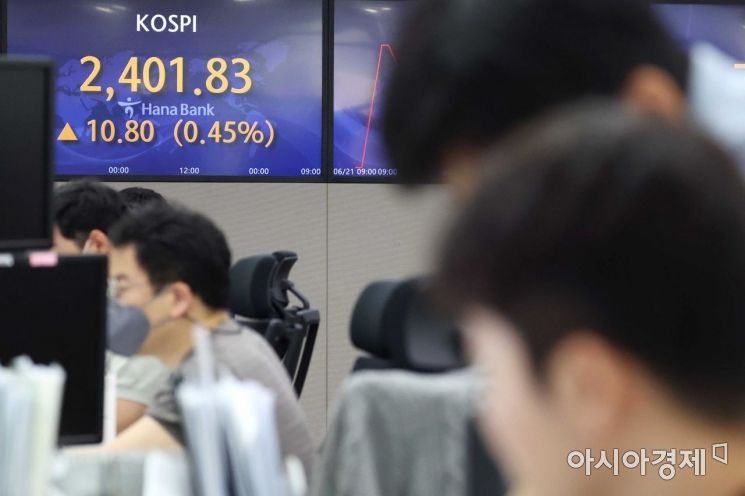 On the 21st, when the KOSPI index started with a slight rise, dealers were working in the Hana Bank dealing room in Euljiro, Seoul. Photo by Moon Honam munonam@
[Asia Economy Reporter Heo Midam] Samsung Electronics has fallen to the 50,000 KRW range, continuing its streak of 52-week lows. Once aiming for the "100,000 Electronics," Samsung Electronics has now dropped to the "50,000 Electronics," causing deep sighs among individual investors. Some investors are considering selling as they expect it will be difficult for the stock price to rise in the near term. However, there are still movements among some to take advantage of the downturn as a buying opportunity at low prices.
According to the Korea Exchange on the 21st, Samsung Electronics closed at 58,700 KRW, down 1,100 KRW (1.84%) from the previous trading day. During the session, it fell to 58,100 KRW, setting a new 52-week low.
This is due to ongoing uncertainties in the semiconductor industry and overall investment sentiment being dampened by factors such as rising inflation in the United States. Earlier, on the 17th, Samsung Electronics closed at 59,800 KRW, falling into the "50,000 Electronics" range for the first time since November 2020.
Samsung Electronics has been regarded as a representative national stock with over 5 million small shareholders owning less than 1% of shares. According to the Financial Supervisory Service's electronic disclosure system (DART), as of the end of last year, the number of small shareholders holding Samsung Electronics stock was 5,066,351. Considering South Korea's population was 51.74 million last year, about 10% of the entire population are Samsung Electronics shareholders.
However, with a continuous decline this year, the worries of the "Donghak Ants" (individual investors) are deepening. Yoon (26), an office worker who bought Samsung Electronics shares at around 78,000 KRW, said, "Samsung Electronics no longer seems safe. I bought one share every payday, but since the value is going down instead of up, I am wondering if I should sell."
Foreign investors are also selling off shares. This year, foreigners have sold more than 8 trillion KRW worth of Samsung Electronics stock. As of the 17th, the foreign ownership ratio of Samsung Electronics was 49.97%, falling below 50% for the first time in six years since April 28, 2016 (49.59%).
The foreign selling trend is expected to continue. If the U.S. Federal Reserve (Fed) takes another giant step (a 0.75 percentage point increase in the benchmark interest rate) in July, an inversion phenomenon could occur where South Korea's benchmark interest rate becomes lower than that of the U.S., potentially accelerating the exit of foreign investors from the domestic stock market.
On the other hand, some see this crash as a "buying opportunity." One netizen said on a stock community, "Long-term investment will definitely be profitable. I don't think it will go down to '40,000 Electronics.' When the economy recovers, Samsung Electronics' stock price will surely turn upward."
In the securities industry, it is expected that Samsung Electronics' stock price will not fall below 50,000 KRW. Minhee Lee, a researcher at BNK Investment & Securities, stated in a report, "The recent sharp drop in Samsung Electronics' stock price appears to be a process of preemptively reflecting the risk of economic recession following rapid financial tightening. Judging by the PBR (price-to-book ratio) of 1.1, which was supported even during past financial crises and the pandemic, the stock price is unlikely to fall below 50,000 KRW."
© The Asia Business Daily(www.asiae.co.kr). All rights reserved.
![Clutching a Stolen Dior Bag, Saying "I Hate Being Poor but Real"... The Grotesque Con of a "Human Knockoff" [Slate]](https://cwcontent.asiae.co.kr/asiaresize/183/2026021902243444107_1771435474.jpg)
















