Bank of Korea Reviews Price Stability Target Operation
Governor Lee Chang-yong: "Intervene if Exchange Rate Imbalance Occurs"
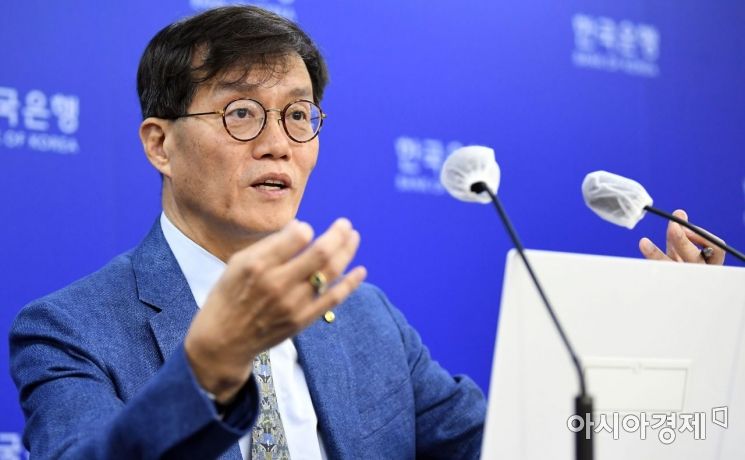 Lee Chang-yong, Governor of the Bank of Korea, holds a briefing on the status of inflation targeting operations at the Bank of Korea press room in Jung-gu, Seoul, on the 21st. Photo by Moon Ho-nam munonam@
Lee Chang-yong, Governor of the Bank of Korea, said regarding the possibility of implementing a 'big step' by raising the base interest rate by 0.5 percentage points at once at next month's Monetary Policy Committee meeting, "We do not decide interest rates based solely on inflation," and added that since there are about three weeks left, the decision will be made after reviewing the information. Regarding the exchange rate, he said, "If a concentration phenomenon occurs, there is a reason to intervene."
Governor Lee made these remarks during a Q&A session with reporters at the 'Price Stability Target Operation Status Review Briefing' held at the Bank of Korea headquarters in Jung-gu, Seoul, on the 21st. He said, "Whether to take a big step is not decided solely by inflation," and added, "Since (our country) has many variable-rate bonds, we need to consult with Monetary Policy Committee members to determine an appropriate (rate hike) level considering the impact of interest rate hikes on household interest burdens."
However, Governor Lee stated, "Although there are various considerations, in the current phase where inflation is continuously expanding, the stance of maintaining monetary policy focused on inflation until the trend somewhat calms down remains unchanged," indicating that the policy of raising the base interest rate will continue.
Regarding market forecasts that the Bank of Korea's base interest rate will reach 2.75-3% by the end of the year, he said, "Since international financial markets and oil prices are unstable, and the market is in a period of adapting to new information after the FOMC (Federal Open Market Committee) announcement, it is premature to assume that interest rates will rise further or that the inflation level we expect will exceed the mid-5% or 6% range."
On the timing when domestic inflation will peak, he said, "The market and overall view expect the inflation rate to peak around the third quarter," but added, "However, uncertainties such as war remain significant."
Regarding concerns about the interest rate inversion between Korea and the U.S. due to the sharp rate hikes in the U.S., he said, "If the interest rate gap with the U.S. becomes too large while U.S. rates are rising, various problems such as exchange rate fluctuations and capital outflows may occur," but also emphasized, "It is important to examine whether the interest rate gap occurs only in our country or also in other major countries, and to assess the impact on exchange rates and capital outflows to respond appropriately."
Governor Lee said, "Since our base interest rate is below the (neutral rate), we will first move toward the neutral rate, and if inflation continues to rise, we will decide on additional hikes by considering various variables." Regarding the view that the neutral rate should be disclosed, he said, "Personally, I believe that the Bank of Korea explicitly announcing it could inevitably cause misunderstandings."
Regarding the won-dollar exchange rate approaching 1,300 won, he said, "We need to check whether only our currency is moving or if it is moving along with other currencies, but if a concentration phenomenon occurs due to reasons unique to us, there is naturally a reason to intervene," adding, "It is important how to manage the combination of interest rates, exchange rates, and growth." He also said, "Compared to the May Monetary Policy Committee situation, downside risks to the economy and upside risks to inflation have increased."
Regarding Deputy Prime Minister and Minister of Economy and Finance Choo Kyung-ho's comment that the economy is facing a complex crisis, he said, "I understand that it refers to the combination of burdens such as oil prices, global exports, the economy, exchange rates, capital outflows, and vulnerable groups," and added, "The Ministry of Economy and Finance, Financial Services Commission, and Financial Supervisory Service are discussing which policy mix is most desirable."
© The Asia Business Daily(www.asiae.co.kr). All rights reserved.

















