Mandatory Construction Rate of 11.2% for 3 Major Telecoms
Lack of Ultra-Broadband Demand Causes
Absence of Killer Content and Revenue Models
Industry Neglect Leaves It an Outcast
Must Admit Failure and Shift Policy
Learn Utilization Strategies from US and Japan
[Asia Economy Reporter Minyoung Cha] Even in the fourth year of 5G commercialization, the utilization of the 28 GHz high-frequency band remains low, prompting calls from both the industry and the National Assembly for a new policy direction. While the United States and Japan, which were the first to commercialize, have effectively halted investments in the 28 GHz band, South Korea's three major telecom companies have barely exceeded a 10% mandatory construction rate for 28 GHz base stations, highlighting the urgent need for realistic policy measures.
28 GHz: The 'Gyeruk' of Dream 5G
On the 21st, Kim Yong-hee, a research fellow at Open Route, who attended the “Desirable 5G 28 GHz Frequency Policy Direction Forum” hosted by Assemblymen Byun Jae-il of the Democratic Party and Kim Young-sik of the People Power Party from the National Assembly’s Science, Technology, Information and Broadcasting Committee, pointed out that "the fundamental reason for the difficulty in activating 5G 28 GHz is the lack of demand for ultra-wideband services."
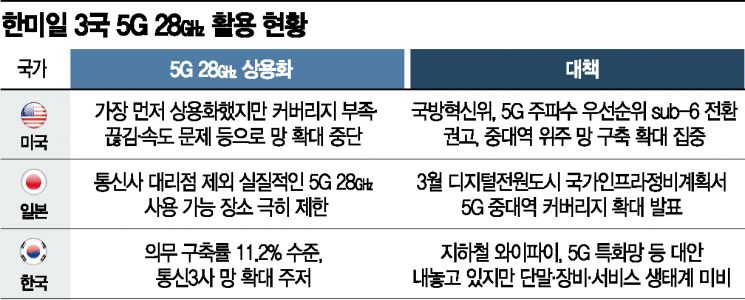
Initially, the 5G 28 GHz band, expected as the “dream 5G,” attracted attention for its speed 20 times faster than LTE, promising revolutionary changes. However, the need to build base stations densely led to a situation where the cost outweighed the benefits. Due to the absence of killer content and related revenue models, all three telecom companies have neglected this band, turning it into a neglected asset. According to Assemblywoman Yang Jeong-sook’s office, the mandatory compliance rate for 28 GHz base stations by the three telecom companies is about 11.2%, barely surpassing the Ministry of Science and ICT’s cancellation threshold of 10%. Even this figure includes recognition of joint construction of subway Wi-Fi as fulfilling the quota.
There were also remarks comparing this to the WiBro case, which was once a proud domestic telecom technology but eventually faded away. Research fellow Kim said, "Due to the lack of killer services and the underdeveloped ecosystem of terminals, equipment, and services, it is similar to the past WiBro case," adding, "This is not unique to South Korea; the United States and Japan have also stalled investments in the 28 GHz band."
Establishing Realistic Policies by Referencing the US and Japan
The challenge of utilizing the 28 GHz frequency band is not unique to South Korea. The United States, which lagged behind South Korea in the initial commercialization of 5G, was the first to commercialize the 28 GHz band but acknowledged policy failure and redesigned its 5G policy to refocus on the development of mid-band (C-band). This was due to the narrow coverage and frequent disconnections that limited the practical use of the 28 GHz band. Japan built 28 GHz base stations mainly around telecom company stores, but the usable locations are extremely limited, resulting in low utilization. Japan also acknowledged policy failure and announced plans to expand 5G mid-band coverage through the national infrastructure maintenance plan in March.
The Ministry of Science and ICT, the relevant government department, is also facing difficulties. It is challenging to demand unrealistic investments from the three telecom companies, and it is also difficult to propose alternatives for utilizing the 28 GHz frequency. The market expects close consultations on the 28 GHz frequency policy direction at a meeting scheduled for the 7th of next month between Minister Lee Jong-ho and the CEOs of the three telecom companies. An industry insider said, "Demand for the 28 GHz frequency band is nonexistent, so requiring tens of trillions of won in investments is an excessive burden," adding, "A policy shift focusing on mid-band frequencies like the 5G 3.5 GHz band, where actual demand exists, is necessary."
A National Assembly official stated, "Although the 5G 28 GHz frequency band is entering its fourth year since allocation, there are no actual commercialization cases, and most of the frequency usage rights (intangible assets) secured by the three telecom companies with investments exceeding 200 billion won each have been accounted for as impairment losses, indicating that the service and terminal ecosystem is virtually nonexistent," adding, "It is time to consider realistic frequency utilization policy alternatives from a macro perspective, taking into account technology, market, and consumers."
© The Asia Business Daily(www.asiae.co.kr). All rights reserved.
![Clutching a Stolen Dior Bag, Saying "I Hate Being Poor but Real"... The Grotesque Con of a "Human Knockoff" [Slate]](https://cwcontent.asiae.co.kr/asiaresize/183/2026021902243444107_1771435474.jpg)















