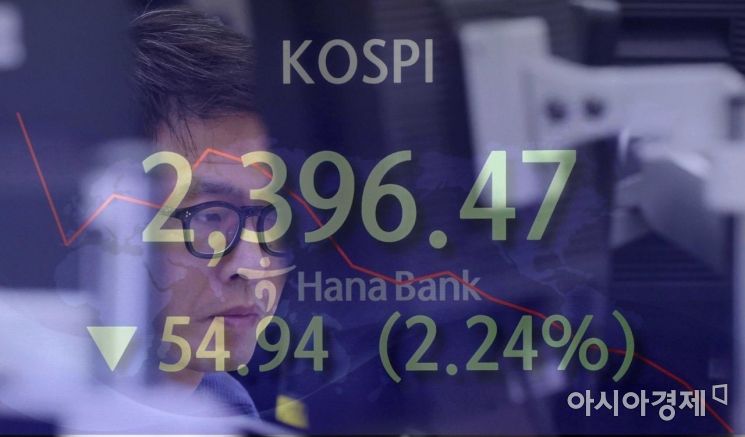
[Asia Economy Reporter Kwon Jae-hee] As the KOSPI fell to the 2500 level due to interest rate hikes and recession concerns, worries among Donghak Ants who poured tens of trillions of won into the Korean stock market this year are deepening. It has been revealed that the scale of forced liquidation due to margin calls, caused by investors borrowing money to invest in stocks and failing to meet collateral ratios, reaches up to 30 billion won per day.
According to the Korea Exchange on the 19th, the net purchase amount of domestic stocks by individual investors from the beginning of this year until the 17th reached 27.1 trillion won (20.8 trillion won in the KOSPI market and 6.2 trillion won in the KOSDAQ market).
The stock most purchased by individual investors in the domestic market is undoubtedly Samsung Electronics.
The net purchase amount of Samsung Electronics common stock by individual investors since the beginning of the year is 14.4184 trillion won. During this period, individuals also bought preferred shares of Samsung Electronics worth 1.4352 trillion won. The combined net purchase amount of Samsung Electronics common and preferred shares by individuals amounts to 15.8536 trillion won. This means about 58.5% of the net purchase amount by individuals in the domestic stock market was concentrated in Samsung Electronics.
Following that, individual investors also net purchased Naver and Kakao, the representative growth stocks in Korea, with amounts of 2.1502 trillion won and 1.8038 trillion won respectively.
Other stocks in the top net purchase amounts include SK Hynix (1.4352 trillion won), Samsung Electro-Mechanics (1.0416 trillion won), LG Electronics (846.5 billion won), LG Household & Health Care (796.5 billion won), Hyundai Motor (791.7 billion won), and Doosan Enerbility (776.7 billion won).
However, with the recent sharp interest rate hikes in the U.S. and recession concerns causing the KOSPI index to fall below the 2500 level, the performance of individual investors has been dismal.
The average purchase price of Samsung Electronics, the most purchased stock by individual investors (net purchase amount/net purchase quantity), was 67,900 KRW, which means a loss of about 12% compared to the closing price on the 17th (59,800 KRW).
The impact of interest rate hikes on growth stocks was even greater. This year, individual investors net purchased Naver and Kakao at average prices of 311,841 KRW and 92,405 KRW respectively, but these prices have plunged to 237,500 KRW and 72,200 KRW respectively. This translates to losses of -24% for Naver and -22% for Kakao.
Additionally, the top 10 stocks by individual net purchases, including Samsung Electronics preferred shares (-9%), SK Hynix (-1%), Samsung Electro-Mechanics (-11%), LG Electronics (-16%), LG Household & Health Care (-24%), Hyundai Motor (-2%), and Doosan Enerbility (-17%), are all recording negative average returns.
Experts advise caution against reckless bargain hunting as global stock markets are expected to continue high volatility for the time being.
Jung Myung-ji, head of the Investment Information Team at Samsung Securities, said, "There may be technical rebounds, but without momentum to reverse the trend, a volatile market within a lowered index level is likely to persist for a considerable period. From a long-term investment perspective, it could be an opportunity to buy at low prices, but if you aim to make profits in a short period, buying now is not advisable."
Seo Sang-young, head of the Content Division at Mirae Asset Securities, emphasized, "Prioritize buying stocks with good earnings at low points, but absolutely avoid investing in deficit or marginal companies that pose risks during economic slowdowns."
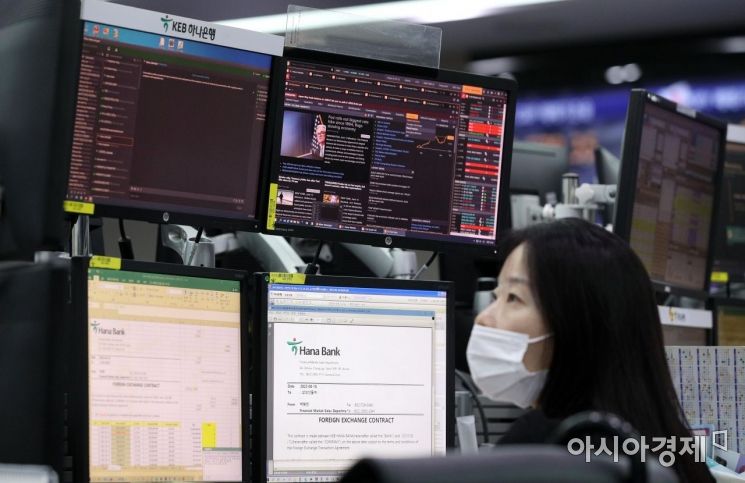
The scale of forced liquidation due to margin calls, caused by investors borrowing money to buy stocks and failing to repay, has also surged due to the sharp stock price decline.
According to the Korea Financial Investment Association, as of the 16th, the actual scale of forced liquidation compared to unsettled margin trading debts was 30.27 billion won. The forced liquidation amount on the 15th was 31.56 billion won, the highest in over eight months since October 7 last year (34.42 billion won).
Margin trading is a very short-term credit transaction where individual investors borrow money from securities firms to buy stocks and repay the funds three days later. Forced liquidation occurs when investors fail to pay the settlement amount for stocks bought on credit (margin trading), and the securities firm forcibly sells the stocks to recover the debt.
The daily average forced liquidation amount, which was between 12.7 billion and 17.4 billion won until the 13th of this month, jumped to 26.03 billion won on the 14th and exceeded 30 billion won for two consecutive days thereafter.
Starting with "Black Monday" on the 13th, the KOSPI fell to the 2500 level, marking a "week of fear" in the stock market, which led to a flood of forced liquidation volumes. Last week (13th to 17th), the KOSPI dropped by 5.97%, and the KOSDAQ index fell by 8.18%.
An increase in forced liquidation leads to a surge in sell orders in the stock market, intensifying downward pressure on the market itself. Investors fearing forced liquidation may engage in so-called "panic selling" during sharp price drops, further amplifying the decline.
Jung from Samsung Securities said, "The current high level of forced liquidation means that investors cannot cover collateral shortages with cash and are struggling to raise funds. As the market continues to fall, the frequency and intensity of forced liquidation due to collateral shortages will increase, potentially causing a chain reaction where selling begets more selling."
Due to the stock price decline and increase in forced liquidation, the balance of margin loans has fallen to its lowest level in 16 months.
According to the Korea Financial Investment Association, as of the 16th, the balance of margin loans, which is the amount individuals borrow from securities firms to invest in stocks and have yet to repay, was 20.6863 trillion won. This is the lowest since February 4, 2021 (20.2629 trillion won).
The margin loan balance refers to the amount individuals have invested in stocks through margin trading but have not yet repaid. It typically tends to increase when stock prices are expected to rise.
Until the end of last year, the margin loan balance exceeded 23 trillion won, but since April, it has maintained a level between 21 and 22 trillion won, indicating a cooling off of the "debt investment" (borrowing to invest) fever that was hot after COVID-19.
Furthermore, the surge in forced liquidation due to the sharp stock price decline likely contributed to the decrease in margin loan balances. When the collateral maintenance ratio for margin trading falls below the standard due to stock price drops, forced liquidation occurs the next day, reducing the balance.
Investor deposit funds, which represent standby funds in the stock market, amounted to 57.0207 trillion won as of the 16th, down about 21 trillion won compared to the all-time high of 77.9018 trillion won on May 3 last year.
© The Asia Business Daily(www.asiae.co.kr). All rights reserved.
![Clutching a Stolen Dior Bag, Saying "I Hate Being Poor but Real"... The Grotesque Con of a "Human Knockoff" [Slate]](https://cwcontent.asiae.co.kr/asiaresize/183/2026021902243444107_1771435474.jpg)
















