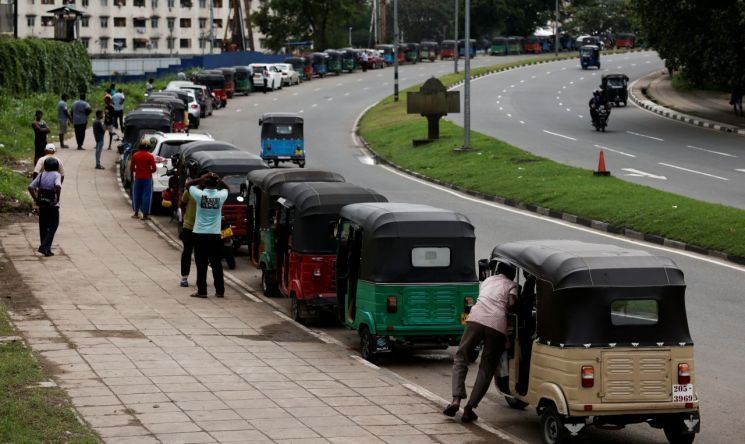
 On the 17th (local time), in Colombo, the capital of Sri Lanka, which is experiencing a severe economic crisis, three-wheeled vehicles are lined up in large numbers waiting to refuel.
 [Image source=Yonhap News]
[Asia Economy Reporter Hwang Sumi] The Sri Lankan government has taken measures to overcome the worst economic crisis. Following the decision to grant paid leave to public officials struggling with commuting due to severe fuel shortages, it has now ordered remote work as well.
According to major foreign media on the 18th (local time), the Sri Lankan Ministry of Public Administration and Home Affairs announced that all government offices, including schools, will be closed for two weeks starting from the 20th. Public sector workers have been instructed to work from home, allowing only a minimal number of staff to come to the office. The administration stated that with this measure, only personnel in essential service sectors such as healthcare among approximately one million public officials will work at the office.
This measure takes into account the limited fuel supply and fragile public transportation system in Sri Lanka. Previously, Sri Lanka faced a sharp increase in external debt as its main industry, tourism, collapsed. On top of that, government economic policy failures such as excessive tax cuts have compounded the crisis, leading to the worst economic emergency.
Foreign currency reserves have been depleted, and imports of fuel, food, medicine, and other daily necessities have effectively stopped. Long lines have formed at Sri Lankan gas stations as people wait to buy fuel, and rolling blackouts continue. In particular, agricultural output has significantly decreased due to the government's decision last year to fully adopt organic farming methods, temporarily banning the use and import of pesticides.
In this situation, the Sri Lankan government introduced a fuel rationing system on the 12th to overcome fuel shortages. On the 14th, it announced that public officials would be given paid leave every Friday to encourage farming. This measure aims to increase agricultural production and assist public officials facing commuting difficulties due to fuel shortages.
Additionally, public sector workers who have gone abroad for employment will be granted unpaid leave for up to five years. This is interpreted as an effort to encourage overseas employment to earn even a small amount of foreign currency.
Meanwhile, Sri Lanka, which declared a debt default of $51 billion (approximately 66 trillion won) in April, is currently negotiating with the International Monetary Fund (IMF) for bailout support. It is also receiving emergency aid from India, China, and the World Bank (WB).
© The Asia Business Daily(www.asiae.co.kr). All rights reserved.
![Clutching a Stolen Dior Bag, Saying "I Hate Being Poor but Real"... The Grotesque Con of a "Human Knockoff" [Slate]](https://cwcontent.asiae.co.kr/asiaresize/183/2026021902243444107_1771435474.jpg)















