Ready-mix Concrete Industry Faces Transport Union's Refusal to Transport... Shutdown Again?
Cement Industry Strongly Opposes Continued Safety Freight Rates... Cargo Solidarity Re-strike Sparks
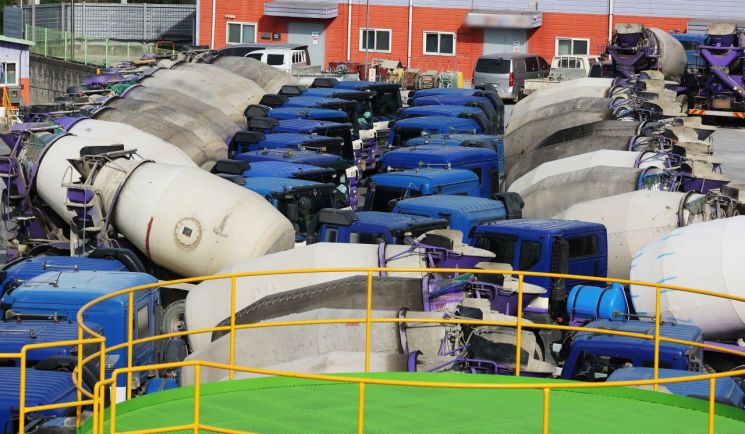 Ready-mix concrete trucks parked at a ready-mix concrete plant that stopped operating due to the suspension of cement shipments during the Cargo Solidarity strike.
 [Photo by Yonhap News]
[Asia Economy Reporter Kim Jong-hwa] The cement and ready-mixed concrete (Remicon) industries are stirring once again. The Remicon industry has been notified by the Korea Labor Union Federation's Remicon Transport Labor Union (Transport Union) to enter collective bargaining for a transportation fee increase, while the cement industry is opposing the Ministry of Land, Infrastructure and Transport's (MOLIT) and the Korean Confederation of Trade Unions Public Transport Union Cargo Solidarity (Cargo Solidarity)'s agreement to continue the Safe Freight Rate System.
The Remicon industry faced a transportation refusal from the Transport Union immediately after the Cargo Solidarity's general strike ended, and the cement industry clearly opposed the continuation of the Safe Freight Rate System, leaving the spark for Cargo Solidarity's re-strike.
Recently, the Transport Union sent official letters to major Remicon companies in the metropolitan area, requesting a 27% increase in Remicon transportation fees and demanding participation in collective bargaining by the 22nd. Including costs such as DEF (Diesel Exhaust Fluid), holiday bonuses, and work hour exemption allowances requested by the Transport Union, some regions are expected to see increases exceeding 30%. The Transport Union stated that if these demands are not accepted, they will initiate collective transportation refusal (industrial action) starting next month.
Remicon companies do not recognize individual transport operators as union members. The Transport Union is a special employment labor union formed mainly around the National Remicon Transport Federation (Jeonunryeon). Jeonunryeon, composed of individual business owners who are Remicon truck owners, applied for and received approval as a special employment labor union from Gyeonggi Province in December last year. Therefore, collective actions by the Transport Union, which consists of individual business owners not affiliated with companies, are considered industrial actions rather than strikes.
Due to the Cargo Solidarity strike, the Remicon industry, which had to halt factory operations nationwide because of the inability to receive cement supplies, now faces the risk of shutting down factories again due to conflicts with Remicon transport truck owners.
A Remicon industry official stated, "Most Remicon transport operators are individual business owners under consignment contracts and are not subject to collective bargaining," adding, "With raw material and oil prices sharply rising and management burdens accumulating, a 27% increase in transportation fees for transport operators who receive full fuel cost support is unreasonable."
The cement industry is boiling with discontent. On the 15th, MOLIT and Cargo Solidarity agreed to continue the Safe Freight Rate System beyond this year, which was initially set to expire after three years, excluding the cement industry, the main party involved. Although the general strike ended urgently, the possibility of the Safe Freight Rate System continuing by partially accepting Cargo Solidarity's demands regardless of the cement industry's stance has intensified industry opposition.
The cement industry has consistently argued for the abolition of the Safe Freight Rate System, citing excessive logistics costs. Currently, the system applies only to bulk cement trailers (BCT) used for cement transport and container vehicles for import/export, with rates determined annually by the MOLIT Safe Freight Committee based on distance and sections. The system aims to guarantee a minimum basic income to truck drivers to prevent speeding, overloading, and overwork, but the industry believes there is little noticeable difference in speeding and overloading.
In particular, the inclusion of bulk cement trailers (BCT), which account for only 0.7% of all freight trucks, in the Safe Freight Rate System is seen by the cement industry as lacking representativeness and difficult to accept as reflecting the overall freight transport environment.
A cement industry official said, "Since the implementation of the Safe Freight Rate System for BCT vehicles, logistics costs have increased by about 120 billion KRW annually," adding, "While we agree with the purpose of the Safe Freight Rate System, there should be an accurate investigation and assessment of its effects over the three years, and the shipper's perspective should be more reflected."
© The Asia Business Daily(www.asiae.co.kr). All rights reserved.
![Clutching a Stolen Dior Bag, Saying "I Hate Being Poor but Real"... The Grotesque Con of a "Human Knockoff" [Slate]](https://cwcontent.asiae.co.kr/asiaresize/183/2026021902243444107_1771435474.jpg)
















