'Children's Science Museum' Reaction Explodes... Benchmarking of Excellent Cases from Other Regional Science Museums Follows
Over 12,500 Visitors in One Month to New Exhibition Hall... Success Factors Include AI Robot and Age-Appropriate Interactiv
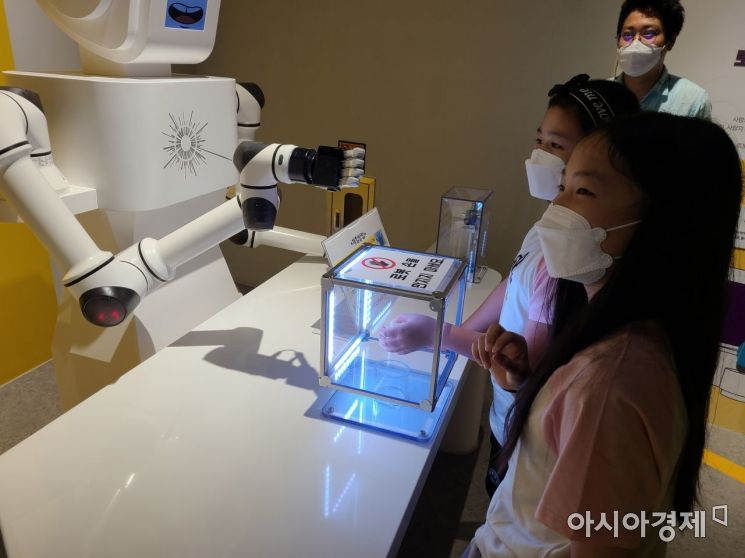 Students from Jungdong Elementary School in Gurye, Jeonnam, are experiencing robot exhibits at the National Gwangju Science Museum located in Buk-gu, Gwangju Metropolitan City on the 17th.
[Asia Economy Honam Reporting Headquarters Reporter Park Jin-hyung] "Wow. Wow. Wooow!"
On the 17th, at the Children's Science Museum, the first children-only science museum in the Honam region located in the Gwangju Metropolitan City Buk-gu High-tech Industrial Complex, children's exclamations of amazement kept bursting out.
Students from Jungdong Elementary School in Gurye, Jeonnam, 85 km away, who came for a group experiential learning trip, widened their eyes and wore expressions full of curiosity. They were busy continuously exclaiming as they saw, heard, and experienced the exhibits installed throughout the place.
Among them, the attention of the typically restless elementary students was focused on one spot: a robot that plays the rock-paper-scissors game. The children lined up and put their hands into a cube-shaped device to compete against the robot.
"Wow, I won again!" One child who threw a fist jumped up and down excitedly, making the supervising teacher naturally smile.
Children also gathered closely around the Cartoon Studio, where an industrial robot arm equipped with a special pen draws pictures, unable to take their eyes off it in fascination.
Yeom Min-woo (11) said with a smile, "I took a photo and sent it, and the robot is drawing my face exactly," adding, "It's great to learn vivid scientific principles."
The National Gwangju Science Museum is accelerating the popularization of science.
With the new exhibition hall projects, 'Children's Science Museum' (15.7 billion KRW) and 'Artificial Intelligence Hall' (6 billion KRW), which exceed the annual budget, receiving positive responses and high expectations from visitors, the project promoters are also encouraged.
As the science museum's operation returned to normal in line with the recovery from COVID-19, the number of visitors has recovered to nearly 70% compared to 2019.
Although external activities were restricted due to the pandemic issues over the past two years, synergy effects were created by holding weekend offline events such as dinosaur sand art and magic theaters.
The Gwangju Science Museum opened in 2013 and is now in its ninth year. It operates or is about to open a total of four exhibition halls, including the permanent exhibition hall located in the main building and the special exhibition room.
There are about 400 interactive exhibits themed on light, sound, and art.
Because the pace of scientific and technological development is so fast, if the exhibition halls are not revamped, the revisit rate inevitably drops due to visitors finding it "boring" or "nothing new."
The "time of the exhibition hall" must always flow forward. Developing new content is key to continuously stimulating children's imagination and curiosity.
The Children's Science Museum, built with a total floor area of 3,395㎡ over two above-ground floors and one basement floor, opened last month and is playing a significant role as a "Future Imagination Playground." It is said that science museums in other regions benchmark it as an excellent case.
This place is composed of content related to the Fourth Industrial Revolution technologies such as the Internet of Things, Big Data, Artificial Intelligence, Autonomous Vehicles, and 3D Printers, allowing visitors to approach future industries in a friendly way.
Representative exhibits like 'Rock-Paper-Scissors' and 'Maze Escape' help visitors easily understand unfamiliar future science technologies through robot competitions, and the soon-to-be-introduced VR simulator experience 'Odyssey,' which simulates 'Surviving on Mars,' is expected to become a main exhibit.
The response is explosive. As of the 14th of this month, the Children's Science Museum has had a cumulative total of 12,526 visitors.
Overall, as of last month, a cumulative total of 4.8 million visitors?more than three times the local population?have visited, with an average of 4,500 to 5,000 citizens visiting on peak weekends.
This management performance is clearly reflected in the financial statements.
The science museum's sales jumped from 12.7 billion KRW in 2017 to 26.1 billion KRW in 2020, soaring 105% in three years.
Although sales dipped somewhat to 19.3 billion KRW in 2021, the peak of the COVID-19 situation, it is considered a solid performance given the external environment.
Next year, the Gwangju Science Museum will also open the 'Artificial Intelligence Hall,' a two-story building with a total floor area of 1,730㎡, sowing the seeds for the spread of science culture.
This hall will allow visitors to experience future core technology, artificial intelligence, through immersive content. Visitors can experience future life via the metaverse, understand components of AI such as Big Data, Machine Learning, and Deep Learning, and view artworks combining AI and art.
Senior Researcher Lee Sung-bae said, "Our top priority is to spread a culture that perceives and enjoys science as play," adding, "Through continuous content improvement centered on future science and technology, we will become an institution that receives ongoing love from residents."
© The Asia Business Daily(www.asiae.co.kr). All rights reserved.

















