China Likely to Leverage US Inflation Crisis to Address Issues
Biden and Xi Jinping Expected to Hold Summit Soon
[Asia Economy Beijing=Special Correspondent Jo Young-shin] As the implementation of the U.S. 'Uyghur Forced Labor Prevention Act (UFLPA)' enters its final countdown, U.S. customs authorities have seized products produced in China by the American shoe company Skechers.
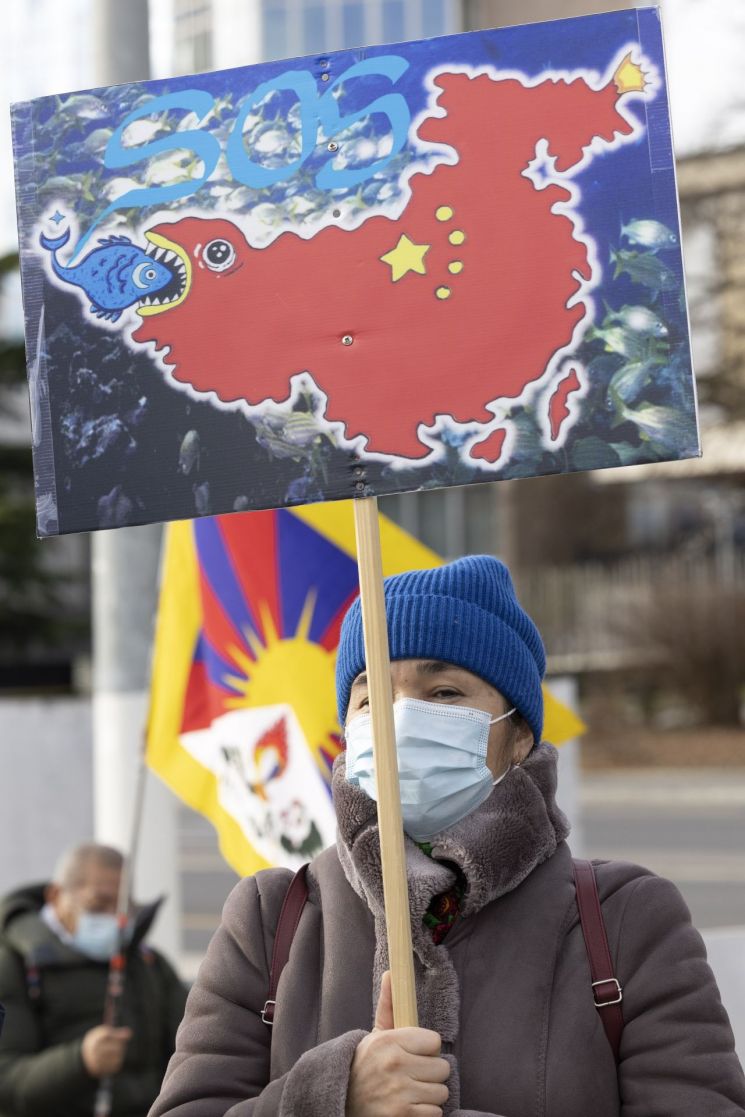
Last year, the U.S. Congress passed a bill that considers all products produced in the Xinjiang Uyghur region to be made by forced labor, completely banning the import of products produced in that region. President Joe Biden signed the bill in December last year, and the law will take effect on the 21st of this month.
The state-run Global Times reported on the 17th that the American shoe company Skechers' products produced and imported from China were recently seized by U.S. customs authorities. The Global Times stated that Skechers submitted a report claiming that the local production line in Xinjiang operates a halal restaurant and that no human rights issues were confirmed, requesting U.S. customs to exclude the production line from the blacklist, but the request was rejected.
U.S. customs authorities appear to have taken issue with Skechers' subcontracting structure. The products imported by Skechers were produced by Dongguan Oasis Footwear Industry in Guangdong Province, China. Dongguan Oasis produces some of the products ordered by Skechers in Tumxuk City, Xinjiang Uyghur Autonomous Region. This is a subcontracting structure with further subcontracting. Dongguan Oasis is known to have established a production line in Tumxuk City since 2013 and employed about 1,000 Uyghurs.
Professor Zhu Ying of Southwest University of Political Science and Law in China said, "The U.S. is using domestic laws to indiscriminately build trade barriers," and pointed out, "The Uyghur Forced Labor Prevention Act will increase trade costs for American companies and eventually lead to rising prices in the U.S."
Some analysts suggest that China might attempt to leverage the U.S. inflation crisis to resolve the Xinjiang Uyghur issue. It is reported that the U.S. is considering withdrawing punitive tariffs imposed on Chinese products amid soaring prices.
However, even if the punitive tariffs are withdrawn, if China fully reflects the increase in raw material prices in its export prices, the effect will be nullified. Despite rising international raw material prices such as oil, China's Producer Price Index (PPI) has been on a downward trend since October last year. Thanks to price controls(?), China is currently the only country where both the PPI and Consumer Price Index (CPI) remain stable statistically.
Meanwhile, Bloomberg reported on the 16th (local time) that a video conference between President Biden and President Xi Jinping is being planned as early as July. Following the face-to-face meeting on the 13th (local time) between Jake Sullivan, U.S. National Security Advisor, and Yang Jiechi, member of the Political Bureau of the Chinese Communist Party, in Luxembourg, there is speculation that the two leaders will hold talks on regional and economic issues including Ukraine.
© The Asia Business Daily(www.asiae.co.kr). All rights reserved.
![Clutching a Stolen Dior Bag, Saying "I Hate Being Poor but Real"... The Grotesque Con of a "Human Knockoff" [Slate]](https://cwcontent.asiae.co.kr/asiaresize/183/2026021902243444107_1771435474.jpg)















