KOSPI Falls Below 2500... First Time in 1 Year and 7 Months
Samsung Electronics Hits '52-Week Low' for 3 Consecutive Trading Days
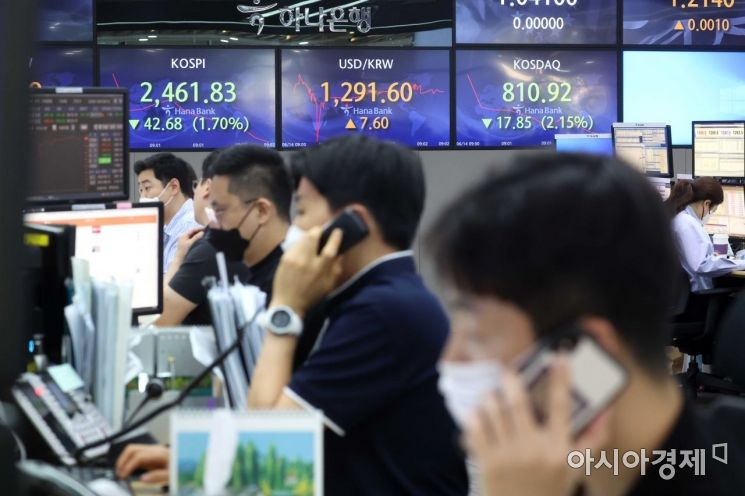 On the 14th, as the KOSPI fell more than 1% in the early session, breaking below the 2500 mark, dealers were working in the Hana Bank dealing room in Euljiro, Seoul. Photo by Moon Honam munonam@
[Asia Economy Reporter Heo Midam] As the KOSPI fell below the 2,500 mark for the first time in 1 year and 7 months, domestic and international financial markets have been volatile, causing individual investors (retail investors) to become more cautious. In particular, the so-called "national stocks," large-cap stocks, have been continuously plummeting, deepening the worries of retail investors. Some retail investors are hesitating about selling their stocks but are responding that they will hold long-term investments until they make a profit, saying "selling now would mean a loss."
On the 14th, the KOSPI opened at 2,472.96, down 31.55 points (1.26%) from the previous trading day. This is the first time the index has fallen below 2,500 since November 2020. The KOSDAQ opened at 816.25, down 12.52 points (1.51%) from the previous day.
Top market capitalization stocks are also generally showing a downward trend. Right after the market opened, Samsung Electronics fell 1.6% from the previous day to 61,100 KRW, hitting a 52-week low. Samsung Electronics has been hitting new lows for three consecutive trading days.
Leading domestic growth stocks Naver and Kakao also plunged more than 3%, breaking their 52-week lows again following the previous day. On the other hand, among the top market cap stocks, LG Energy Solution was the only one to show an upward trend due to the announcement of a large-scale expansion plan the day before.
As the downturn intensifies, retail investors' worries deepen. Shin (31), an office worker who bought Samsung Electronics shares at around 82,000 KRW last year, said, "I don't know when Samsung Electronics' stock price will start to rise. When I first bought the stock, I thought it would go up to '100,000 Electronics'." He added, "Samsung Electronics is called the 'national stock.' I am waiting with the thought that 'it will go up someday.' I believe that if I invest long-term, an opportunity will come eventually."
Kang (25), an office worker holding Kakao shares, also sighed over the falling market. Kang said, "Everyone around me is investing in stocks, so I started too, but I think it was a mistake. I invested considering the company's performance, but the stock price keeps falling, so it's frustrating. I wish I had just done a fixed deposit instead."
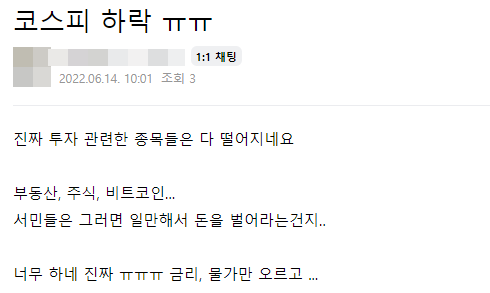
Complaints from investors continue in stock-related communities as well. Netizens responded, "At this rate, Samsung Electronics might drop to the 50,000 KRW range," "I've never seen such a sharp drop since I started investing. I'm worried about how much it will fall today," "The stock market is wrecked. Trying to make money easily but only losing money. Think carefully before investing in stocks," and "These days, you shouldn't think about short-term trading; you must do 'jangtu (long-term investment)' no matter what."
Given the situation, some investors are withdrawing from the stock market. According to the Korea Financial Investment Association, investor deposits decreased by about 10 trillion KRW from 67.5 trillion KRW at the end of December last year to 57.5 trillion KRW at the end of May this year. Compared to April this year (61.4 trillion KRW), it also dropped by about 4 trillion KRW. Investor deposits refer to the money investors leave with securities firms to buy stocks.
Meanwhile, the Bank of Korea held an "Emergency Market Situation Review Meeting" chaired by Deputy Governor Lee Seunghun on the same day to assess the impact of recent changes in the international financial market situation on the domestic financial and foreign exchange markets.
Deputy Governor Lee said, "As volatility is expected to expand significantly in the domestic financial and foreign exchange markets, we will closely monitor market conditions going forward and actively take measures to stabilize the market if necessary."
© The Asia Business Daily(www.asiae.co.kr). All rights reserved.
![Clutching a Stolen Dior Bag, Saying "I Hate Being Poor but Real"... The Grotesque Con of a "Human Knockoff" [Slate]](https://cwcontent.asiae.co.kr/asiaresize/183/2026021902243444107_1771435474.jpg)
















