Seoul National University Establishes 'Radioactive Waste Graduate School'... Training 65 Master's and PhD Students Over 5 Years
Radioactive Waste Disposal Facility Essential for Nuclear Power Countries... Yoon Administration to Accelerate Construction
Maxter Capacity Already at Limit... Saturation Expected from 2031
Government to Propose Special Act as Early as Next Month... Aiming for National Assembly Approval Within the Year
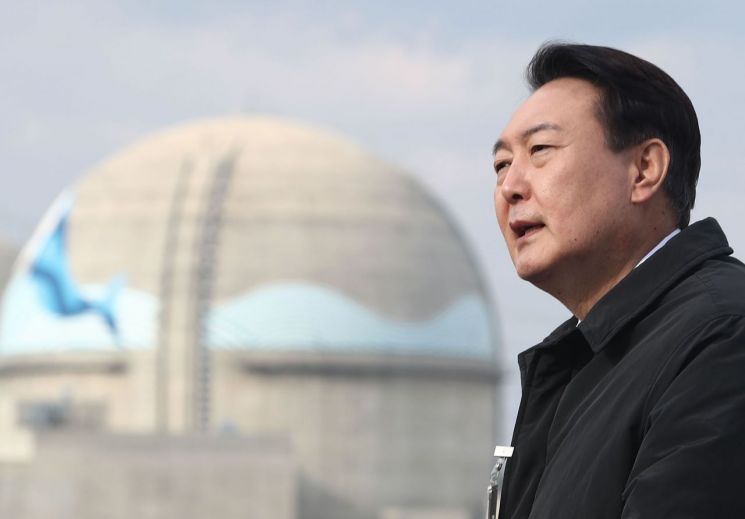 President Yoon Suk-yeol visited the construction suspension site of Shin Hanul Units 3 and 4 located in Uljin County, Gyeongbuk, in December last year during his presidential campaign and announced his Wonjeong policy. [Image source=Yonhap News]
[Asia Economy Sejong=Reporter Lee Jun-hyung] The government has launched an initiative to cultivate specialized talent in high-level radioactive waste management. This decision stems from the recognition that advanced personnel dedicated to radioactive waste management are essential to advancing nuclear power policies. The government plans to propose the "High-Level Radioactive Waste Special Act" as early as next month to establish a radioactive waste disposal facility.
On the morning of the 14th, the Ministry of Trade, Industry and Energy announced that it held a plaque ceremony for the "Graduate School of Convergence for High-Level Radioactive Waste Management" at Seoul National University. Previously, through the "2022 Energy Workforce Development Project," the government decided to establish a convergence graduate school at Seoul National University to train experts in radioactive waste. Four departments at Seoul National University, including Nuclear Engineering, and the Korea Radioactive Waste Agency are participating in the educational program. The government plans to provide approximately 1 billion KRW annually in national funding to the graduate school and aims to train 65 master's and doctoral-level radioactive waste specialists over the next five years.
The government's move to cultivate talent in radioactive waste management is intended to support the construction of a disposal facility. A disposal facility serves as a kind of "restroom" for safely storing spent nuclear fuel generated from nuclear power plants. The higher the nuclear power plant operation rate, the greater the need for disposal facilities.
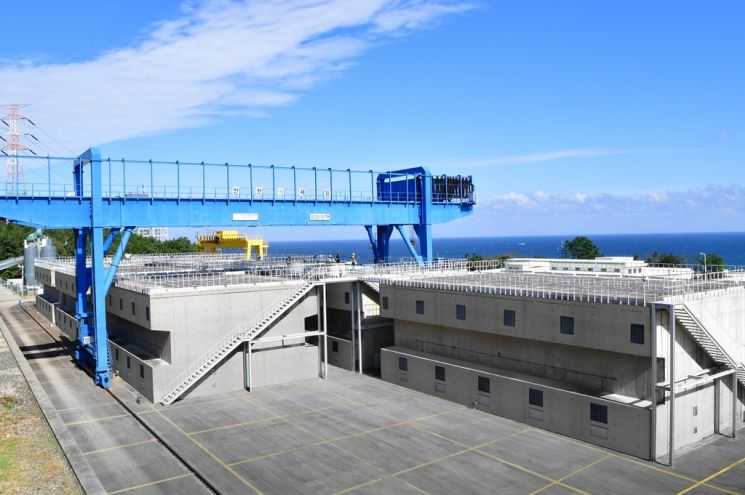 Temporary Spent Nuclear Fuel Storage Facility (MACSTOR) at Wolsong Nuclear Power Plant located in Gyeongju, Gyeongbuk.
 [Photo by Korea Hydro & Nuclear Power]
The problem is that there is currently no proper disposal facility in South Korea. The government initially attempted to secure sites for disposal facilities starting in the 1980s but was repeatedly thwarted by local opposition. As a result, domestic nuclear power plants store radioactive waste in temporary storage facilities called MACSTOR.
MACSTOR is insufficient to handle the future volume of spent nuclear fuel. As a concrete structure, MACSTOR has limited storage capacity and an incomplete storage method. The safest way to store spent nuclear fuel is through deep geological disposal, which involves constructing a permanent storage facility in bedrock 300 to 1000 meters underground. The International Atomic Energy Agency (IAEA) also identifies deep geological disposal as the most appropriate method for permanent storage of spent nuclear fuel.
This is why the construction of disposal facilities has been selected as a key national agenda under the Yoon Seok-yeol administration, which aims to become a "nuclear power superpower." To increase the share of nuclear power generation to 30-35% as planned, the government must proceed with establishing intermediate storage facilities followed by permanent disposal facilities. As nuclear power generation increases, the amount of spent nuclear fuel also rises, but MACSTOR capacity is already approaching its limit. According to the Ministry of Trade, Industry and Energy, MACSTOR facilities at Gori and Hanbit nuclear power plants will reach saturation by 2031, followed sequentially by those at Hanul and Shin-Wolsong nuclear power plants.
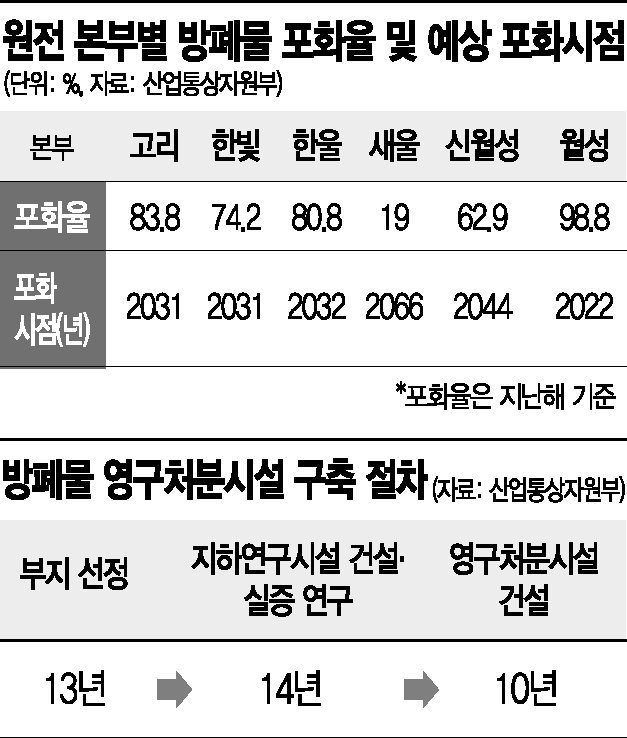
The government plans to propose the special act as early as next month to accelerate the construction of disposal facilities. The special act will define the procedures, methods, and schedules for building the disposal facility. It is likely to be proposed through a member's bill, which generally passes faster than government-initiated legislation. If the special act passes the National Assembly in the second half of this year, the government intends to begin the site selection process for the disposal facility next year.
The Ministry of Trade, Industry and Energy, the responsible ministry, emphasizes the urgency of enacting the special act. Considering that the government roadmap estimates about 37 years to complete the disposal facility, even if site selection begins next year, the facility would not be secured until around 2060 at the earliest.
An official from the ministry stated, "The EU Taxonomy requires that nuclear power plants have disposal facilities by 2050 to be classified as green investments," adding, "To expedite the construction of disposal facilities, passing the bill within this year is the ideal direction."
© The Asia Business Daily(www.asiae.co.kr). All rights reserved.
![Clutching a Stolen Dior Bag, Saying "I Hate Being Poor but Real"... The Grotesque Con of a "Human Knockoff" [Slate]](https://cwcontent.asiae.co.kr/asiaresize/183/2026021902243444107_1771435474.jpg)

















